Telling them apart
Atlantic Croaker vs Spot Croaker
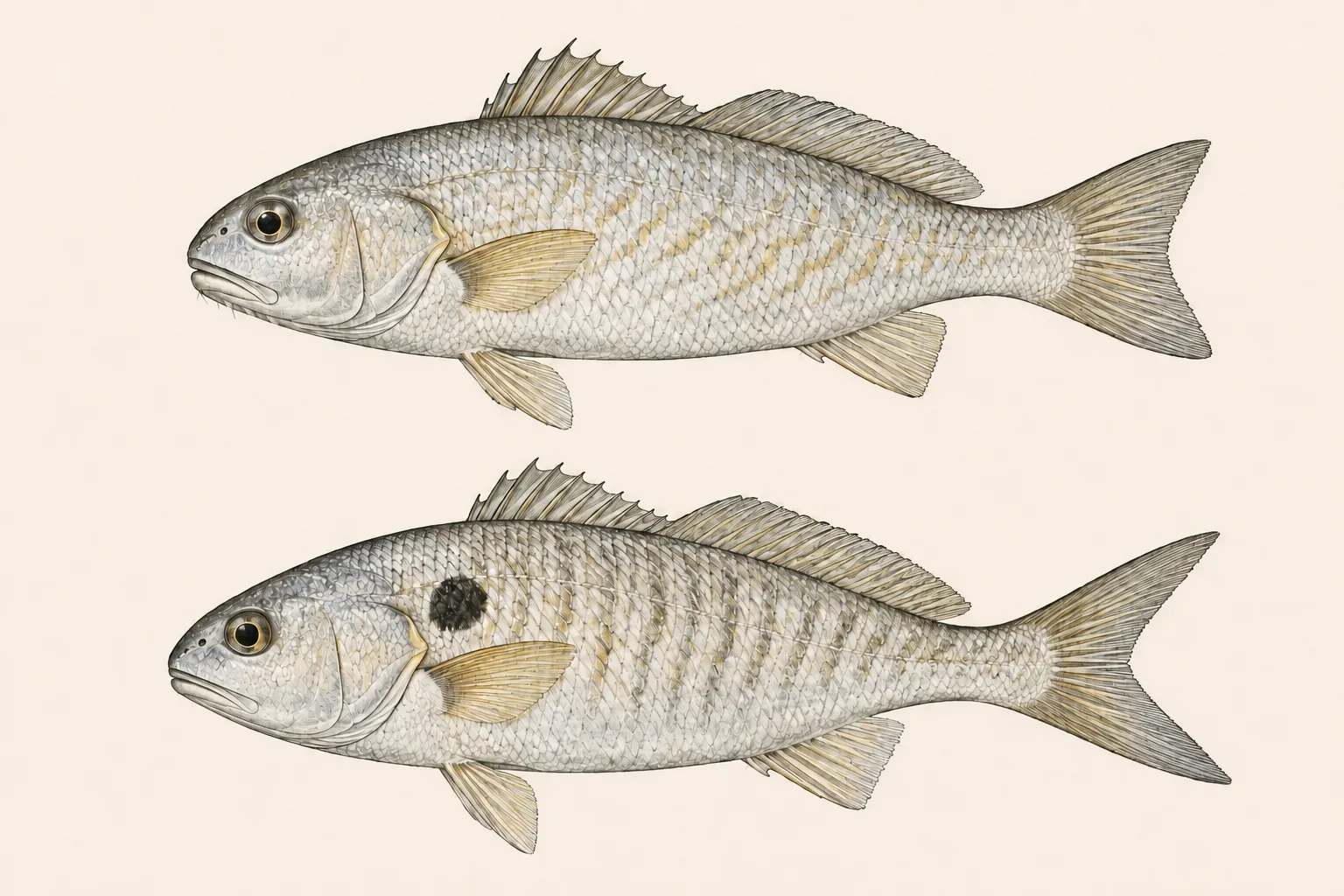
Look under the chin, then at the shoulder. An Atlantic croaker has several pairs of small chin barbels and no shoulder blotch. A spot has a prominent dark shoulder blotch and no barbels at all.
Last updated
Side by side
| What to look at | Atlantic Croaker | Spot Croaker |
|---|---|---|
| Scientific name | Micropogonias undulatus | Leiostomus xanthurus |
| Chin barbels | Three to five pairs, small | None |
| Shoulder | Plain | A prominent round dark blotch |
| Flank markings | Faint wavy oblique bars | Twelve to fifteen faint oblique bars |
| Tail | Slightly forked | Distinctly forked |
| Sound | Audible croak when handled | Quieter |
| Where | Estuaries and surf over soft bottom | Piers, surf and sounds over soft bottom |
Why the difference matters
They are the two most-caught fish on an Atlantic pier and are constantly called by each other's names. Neither is usually a legal problem, but the barbels and the shoulder spot are the fastest identification on the whole coast and worth knowing on sight.
Size limits, bag limits, slot limits and seasons are set by your state wildlife agency — and for many offshore and migratory species by federal regulators — and on many waters they differ from the statewide rule. They also change between seasons. Check the current regulations for the exact water you are fishing before you keep a fish — we do not republish limits here, because a number that is a season out of date is worse than no number.
Full entries
Each fish has its own page with every field mark, the rest of its look-alikes, where it holds and the conditions it feeds in: Atlantic Croaker and Spot Croaker.
Or skip the key entirely — photograph the fish and Global Fishing League names the species, returns the scientific name with it, and files the catch with the tide, pressure, water temperature and everything else it came from.