Telling them apart
Largemouth Bass vs Smallmouth Bass
Close the fish's mouth and look at the eye. On a largemouth bass the upper jaw extends back past the rear edge of the eye; on a smallmouth it usually ends beneath the middle of the eye, before its rear edge. Colour backs it up — largemouth are green with a horizontal stripe, smallmouth are bronze with vertical bars.
Last updated
Identification diagram: where to look
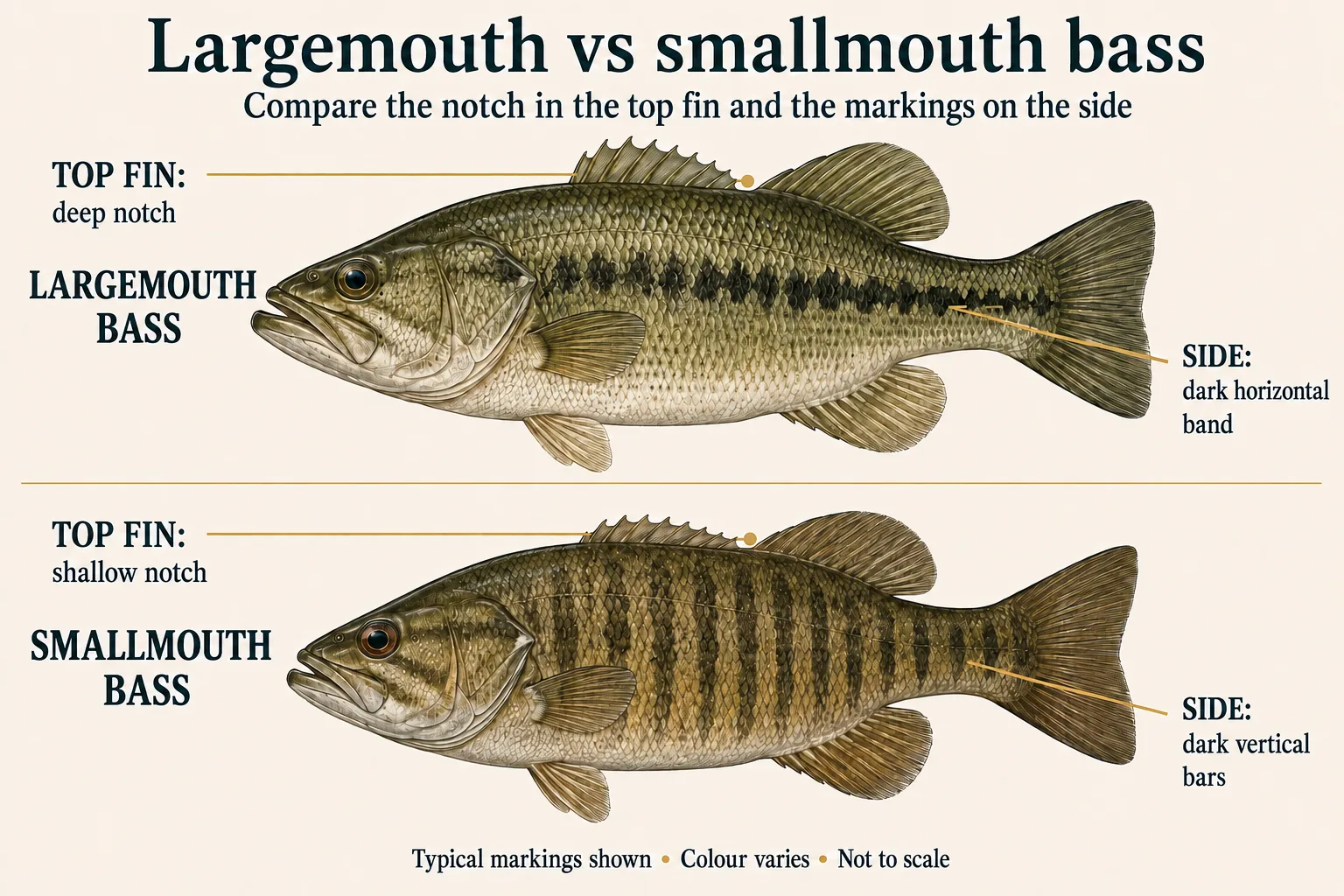
- Upper jaw — close the mouth first. Imagine a vertical line down from the rear edge of the eye. The rear end of the upper jaw extends beyond that line in largemouth bass. In smallmouth bass it usually ends beneath the middle of the eye, before that line.
- Top fin — find the notch between its two sections. The dip between the stiff front section and softer rear section is deep in largemouth bass and shallow in smallmouth bass.
- Side of the body — use markings as supporting evidence. Look for a broken horizontal band in largemouth bass and vertical bars in smallmouth bass. Colour and the strength of the markings vary.
Illustrated field marks checked on against New York DEC: bass identification illustration; Minnesota DNR: smallmouth bass identification. Original illustrations; typical features shown, not to scale.
Side by side
| What to look at | Largemouth Bass | Smallmouth Bass |
|---|---|---|
| Scientific name | Micropterus salmoides | Micropterus dolomieu |
| Upper jaw | Reaches back past the rear edge of the eye | Usually ends beneath the middle of the eye, not beyond its rear edge |
| Colour | Green to olive with a pale belly | Bronze to brassy brown |
| Flank markings | A dark ragged horizontal stripe, broken into blotches | Dark vertical bars, fading and darkening with mood |
| Dorsal fin | A deep notch that almost separates the two dorsals | A shallow notch; the dorsals stay clearly joined |
| Face | No bars radiating from the eye | Three dark bars radiating back across the gill cover |
| Water it holds in | Warm, weedy, slow — ponds, backwaters, reservoir margins | Cool, clear, rocky — current seams, gravel shoals, rocky points |
| Feeding temperature | Hardest between 65 and 80 °F | Hardest between 58 and 72 °F, and active far colder |
Why the difference matters
Many states set different length limits, slot limits or daily bags for the two, even where they are managed together as black bass, so the call can decide whether a fish is legal. It also tells you what you are fishing: a smallmouth means cool, clean, rocky water with current, and a largemouth means warm cover. The two respond to different conditions as well — largemouth track light and barometric pressure, smallmouth track current and wind.
Size limits, bag limits, slot limits and seasons are set by your state wildlife agency — and for many offshore and migratory species by federal regulators — and on many waters they differ from the statewide rule. They also change between seasons. Check the current regulations for the exact water you are fishing before you keep a fish — we do not republish limits here, because a number that is a season out of date is worse than no number.
Full entries
Each fish has its own page with every field mark, the rest of its look-alikes, where it holds and the conditions it feeds in: Largemouth Bass and Smallmouth Bass.
Or skip the key entirely — photograph the fish and Global Fishing League names the species, returns the scientific name with it, and files the catch with the tide, pressure, water temperature and everything else it came from.