
Telling them apart
Barracuda vs Needlefish
Look at the jaws. A needlefish has both jaws drawn out into a long thin beak of equal length. A barracuda's lower jaw juts past the upper and carries large uneven fangs, on a much deeper body.
Last updated
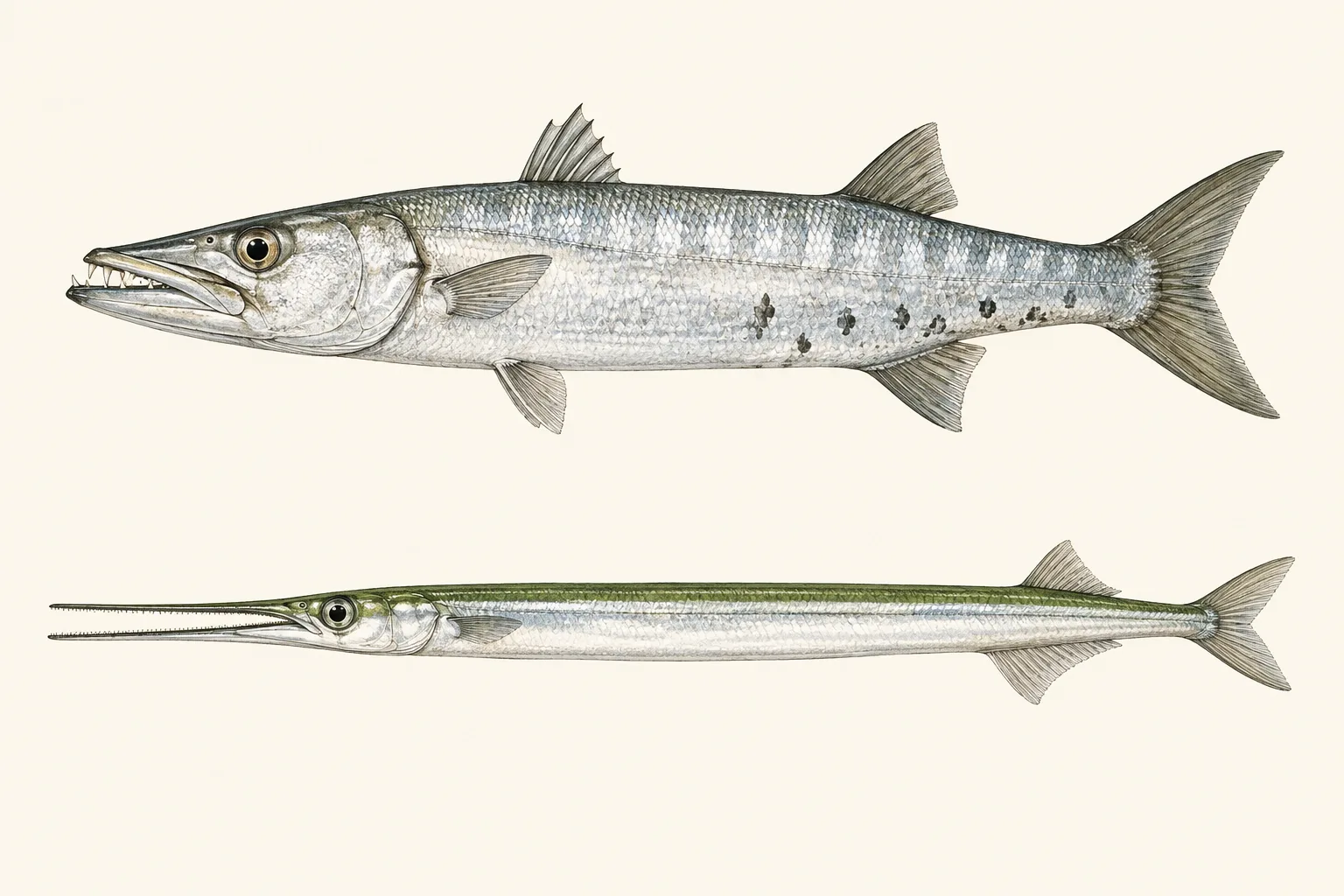
Side by side
| What to look at | Barracuda | Needlefish |
|---|---|---|
| Scientific name | Sphyraena barracuda | Strongylura spp. |
| Jaws | Lower juts past the upper | Both equally elongated into a beak |
| Teeth | Large, uneven fangs | Fine needle teeth in rows |
| Body | Deep and muscular | Extremely slender, almost cylindrical |
| Dorsal fins | Two, set widely apart | Set far back near the tail |
| Flank | Scattered dark blotches low on the rear body | A bright silver stripe, often green-backed |
| Bones | Normal | Distinctly green |
Why the difference matters
They share the same flats, dock lights and passes, and a small barracuda and a big needlefish read the same way at a distance. Neither is usually a limit question, but both bite through leader and both are worth handling carefully — knowing which one is coming to the boat changes how you unhook it.
Size limits, bag limits, slot limits and seasons are set by your state wildlife agency — and for many offshore and migratory species by federal regulators — and on many waters they differ from the statewide rule. They also change between seasons. Check the current regulations for the exact water you are fishing before you keep a fish — we do not republish limits here, because a number that is a season out of date is worse than no number.
Full entries
Each fish has its own page with every field mark, the rest of its look-alikes, where it holds and the conditions it feeds in: Barracuda and Needlefish.
Or skip the key entirely — photograph the fish and Global Fishing League names the species, returns the scientific name with it, and files the catch with the tide, pressure, water temperature and everything else it came from.