
Telling them apart
Black Rockfish vs Blue Rockfish
Look at the rear edge of the anal fin. On a black rockfish it is straight or slants forward; on a blue rockfish it is smoothly rounded. Colour is unreliable — both are dark and both vary with the bottom.
Last updated
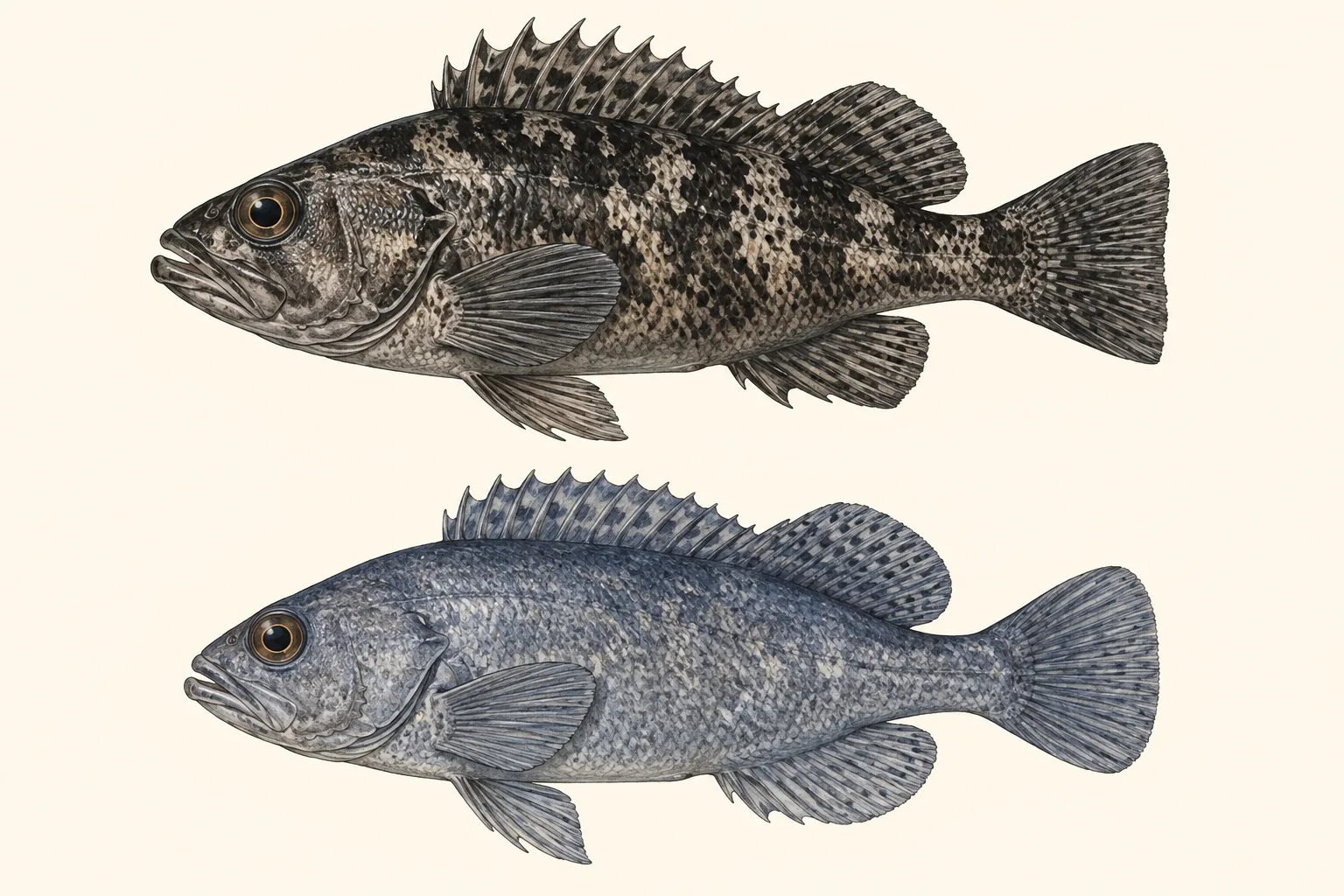
Side by side
| What to look at | Black Rockfish | Blue Rockfish |
|---|---|---|
| Scientific name | Sebastes melanops | Sebastes mystinus |
| Anal fin rear margin | Straight or slanting forward | Smoothly rounded |
| Mottling | Bold and contrasty on the upper body | Soft and diffuse |
| Colour | Black to dark grey | Slate blue to blue-grey |
| Mouth | Larger, upper jaw past mid-eye | Smaller, upper jaw to mid-eye |
| Dorsal fin | Black speckling | Less speckled |
| Where | Nearshore reefs, kelp, jetties, mid-water | Kelp canopy and shallow reef, often higher still |
Why the difference matters
Pacific groundfish regulations are frequently written by species group and by depth, and the two are not always in the same bucket. The anal fin margin is the only reliable field mark — colour, which is what most people go on, is the least reliable thing about either fish.
Size limits, bag limits, slot limits and seasons are set by your state wildlife agency — and for many offshore and migratory species by federal regulators — and on many waters they differ from the statewide rule. They also change between seasons. Check the current regulations for the exact water you are fishing before you keep a fish — we do not republish limits here, because a number that is a season out of date is worse than no number.
Full entries
Each fish has its own page with every field mark, the rest of its look-alikes, where it holds and the conditions it feeds in: Black Rockfish and Blue Rockfish.
Or skip the key entirely — photograph the fish and Global Fishing League names the species, returns the scientific name with it, and files the catch with the tide, pressure, water temperature and everything else it came from.