Telling them apart
Common Carp vs Grass Carp
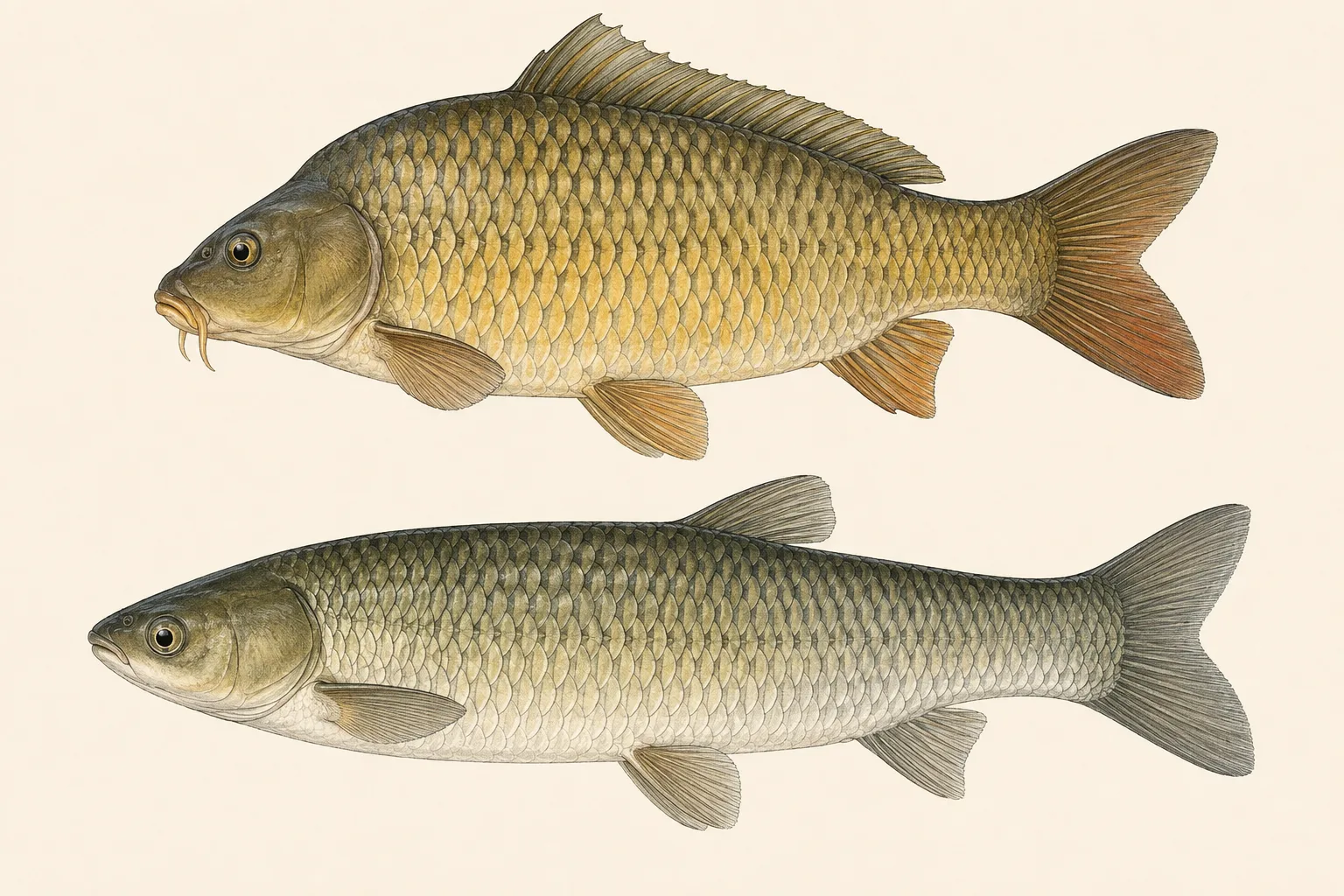
Look at the corners of the mouth. A common carp has two pairs of barbels; a grass carp has none at all. The dorsal fin confirms it — long with a serrated leading spine on a common carp, short and soft on a grass carp.
Last updated
Side by side
| What to look at | Common Carp | Grass Carp |
|---|---|---|
| Scientific name | Cyprinus carpio | Ctenopharyngodon idella |
| Barbels | Two pairs at the mouth | None |
| Dorsal fin | Long, with a serrated leading spine | Short, eight to ten rays, no serrated spine |
| Body | Deep and heavy-shouldered | Broad and torpedo-shaped |
| Mouth | Downturned for grubbing the bottom | Terminal, facing forward |
| Diet | Omnivore, roots the bottom | Herbivore, grazes soft vegetation |
Why the difference matters
Grass carp are stocked at real expense to control weed, and many states protect them specifically — some require any grass carp to be released unharmed, and some ponds are managed around a handful of fish doing a job. Killing one in the belief it was a common carp is both a violation and an expensive mistake for whoever owns the water.
Size limits, bag limits, slot limits and seasons are set by your state wildlife agency — and for many offshore and migratory species by federal regulators — and on many waters they differ from the statewide rule. They also change between seasons. Check the current regulations for the exact water you are fishing before you keep a fish — we do not republish limits here, because a number that is a season out of date is worse than no number.
Full entries
Each fish has its own page with every field mark, the rest of its look-alikes, where it holds and the conditions it feeds in: Common Carp and Grass Carp.
Or skip the key entirely — photograph the fish and Global Fishing League names the species, returns the scientific name with it, and files the catch with the tide, pressure, water temperature and everything else it came from.