Telling them apart
Crevalle Jack vs Blue Runner
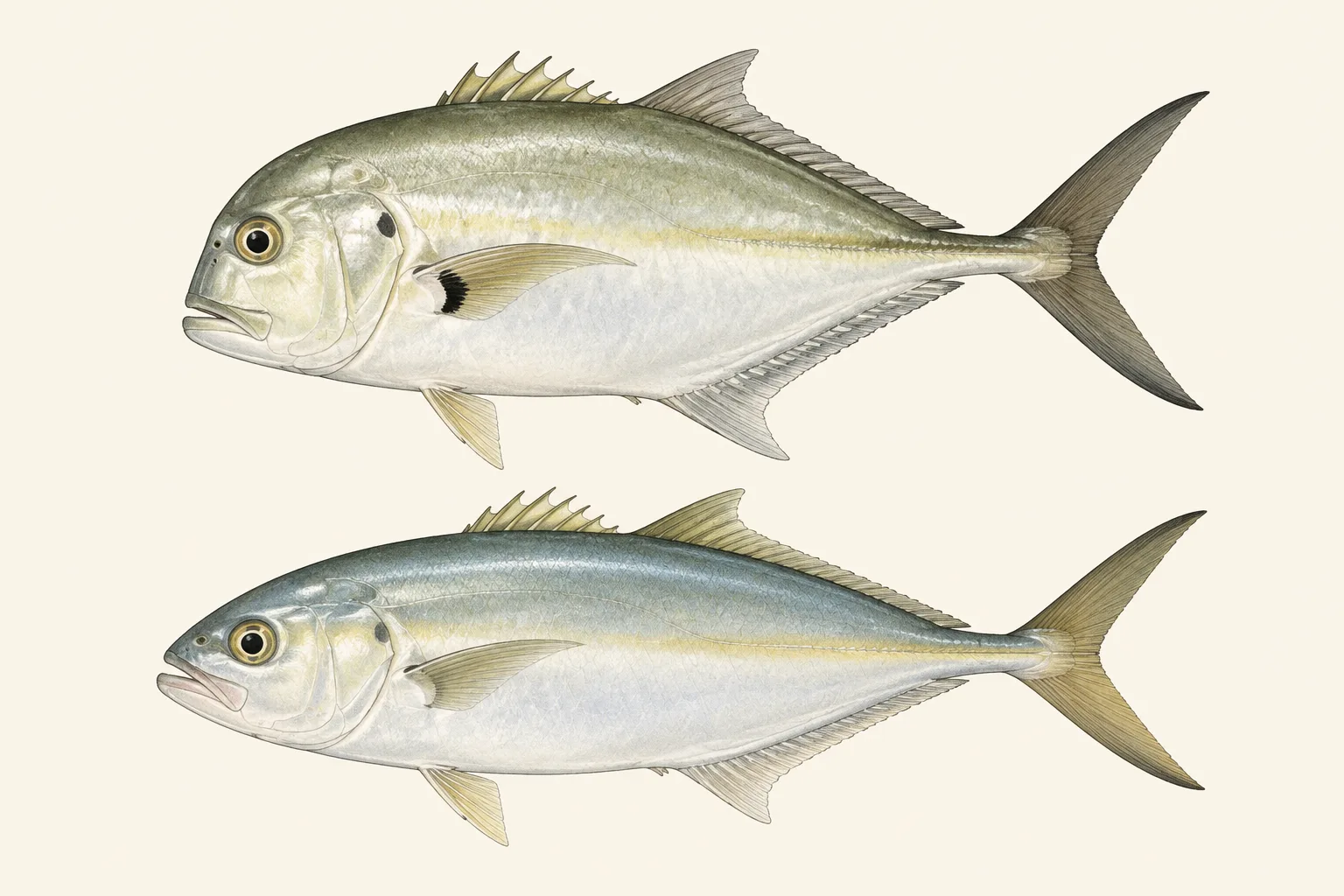
Look at the forehead and the pectoral fin. A crevalle jack has a steep, blunt, almost vertical head and a black blotch at the base of the pectoral. A blue runner has a gently sloped head and no pectoral blotch.
Last updated
Side by side
| What to look at | Crevalle Jack | Blue Runner |
|---|---|---|
| Scientific name | Caranx hippos | Caranx crysos |
| Forehead | Steep and blunt, almost vertical | Gently sloped |
| Pectoral fin base | A distinct black blotch | No blotch |
| Gill cover spot | Present | Present, smaller |
| Size | Grows large and heavy | Stays small |
| Tail | Dusky | Dusky to olive |
| Usual role | A target | More often live bait than target |
Why the difference matters
Small crevalle and blue runners look alike in a livewell and are used for opposite purposes — one is bait for something bigger and one is what you were hoping to catch. The pectoral blotch takes a second to check and is the whole answer.
Size limits, bag limits, slot limits and seasons are set by your state wildlife agency — and for many offshore and migratory species by federal regulators — and on many waters they differ from the statewide rule. They also change between seasons. Check the current regulations for the exact water you are fishing before you keep a fish — we do not republish limits here, because a number that is a season out of date is worse than no number.
Full entries
Each fish has its own page with every field mark, the rest of its look-alikes, where it holds and the conditions it feeds in: Crevalle Jack and Blue Runner.
Or skip the key entirely — photograph the fish and Global Fishing League names the species, returns the scientific name with it, and files the catch with the tide, pressure, water temperature and everything else it came from.