
Telling them apart
Gag Grouper vs Black Grouper
Look at the trailing edge of the tail. A gag grouper has a wavy dark margin with a distinct white line just inside it. A black grouper has a square-cut, plain dark margin and no white line.
Last updated
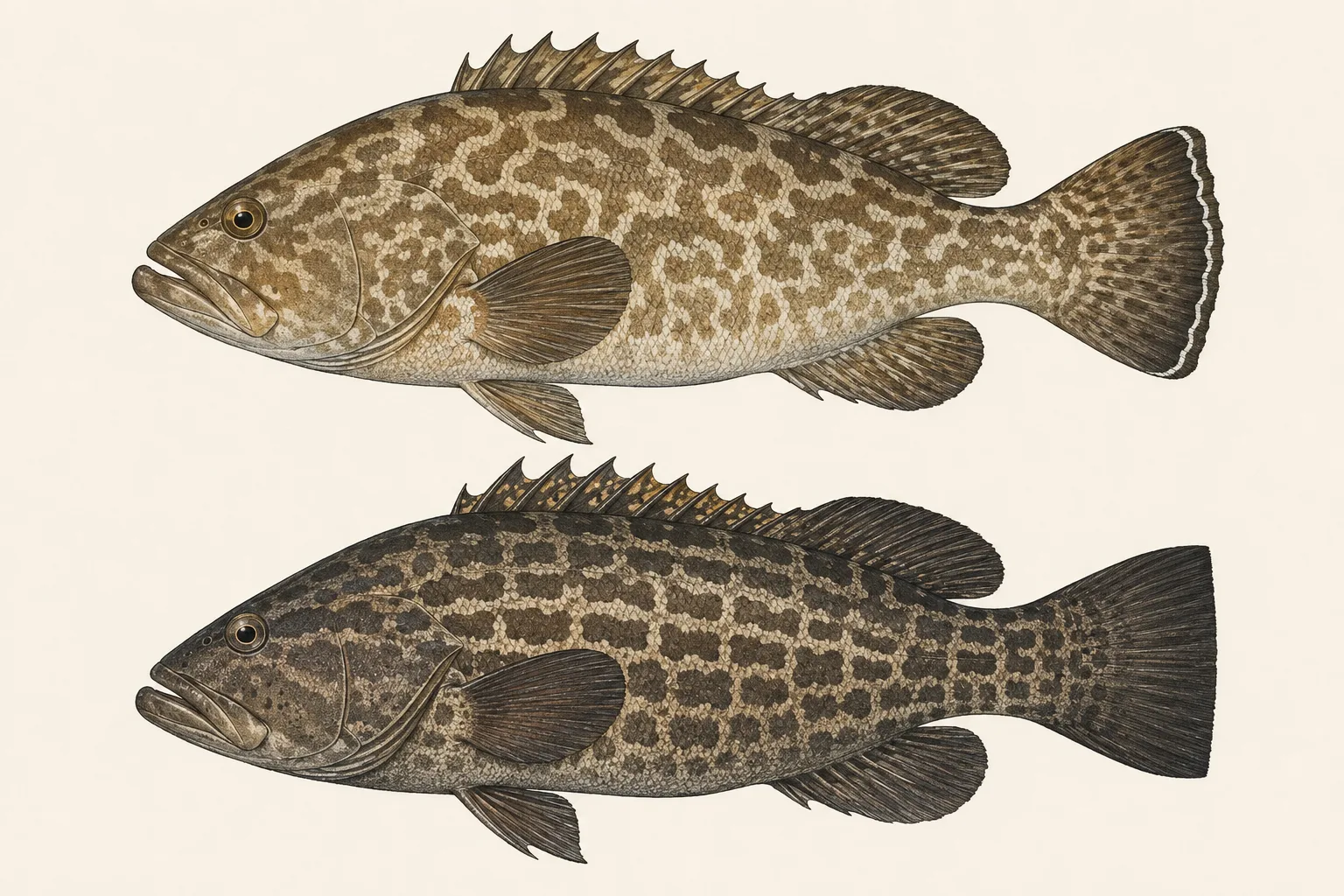
Side by side
| What to look at | Gag Grouper | Black Grouper |
|---|---|---|
| Scientific name | Mycteroperca microlepis | Mycteroperca bonaci |
| Tail margin | Wavy and dark, with a white line inside it | Square-cut and plain dark |
| Markings | Irregular worm-like or kiss-shaped marks | Rectangular chain-link blotches in regular rows |
| Spiny dorsal edge | Notched between the spines | Notched, with brassy spotting between the blotches |
| Habitat | Offshore ledges and wrecks; juveniles use inshore grass | High-relief coral reef, ledges and drop-offs |
| Season behaviour | Moves shallower as water cools in autumn | Stays on deeper high-relief structure |
Why the difference matters
Gag and black grouper carry different limits and different seasons in the Gulf and South Atlantic, and they are routinely confused at the dock — including by people who have caught both for years. The tail margin is the check. If the fish is going in the box, look at it while the fish is still wet, because the markings fade.
Size limits, bag limits, slot limits and seasons are set by your state wildlife agency — and for many offshore and migratory species by federal regulators — and on many waters they differ from the statewide rule. They also change between seasons. Check the current regulations for the exact water you are fishing before you keep a fish — we do not republish limits here, because a number that is a season out of date is worse than no number.
Full entries
Each fish has its own page with every field mark, the rest of its look-alikes, where it holds and the conditions it feeds in: Gag Grouper and Black Grouper.
Or skip the key entirely — photograph the fish and Global Fishing League names the species, returns the scientific name with it, and files the catch with the tide, pressure, water temperature and everything else it came from.