
Telling them apart
King Mackerel vs Spanish Mackerel
Follow the lateral line. On a king mackerel it drops abruptly beneath the second dorsal fin; on a Spanish mackerel it slopes gently all the way to the tail. A Spanish also has a black patch on the front of the first dorsal fin.
Last updated
Identification diagram: where to look
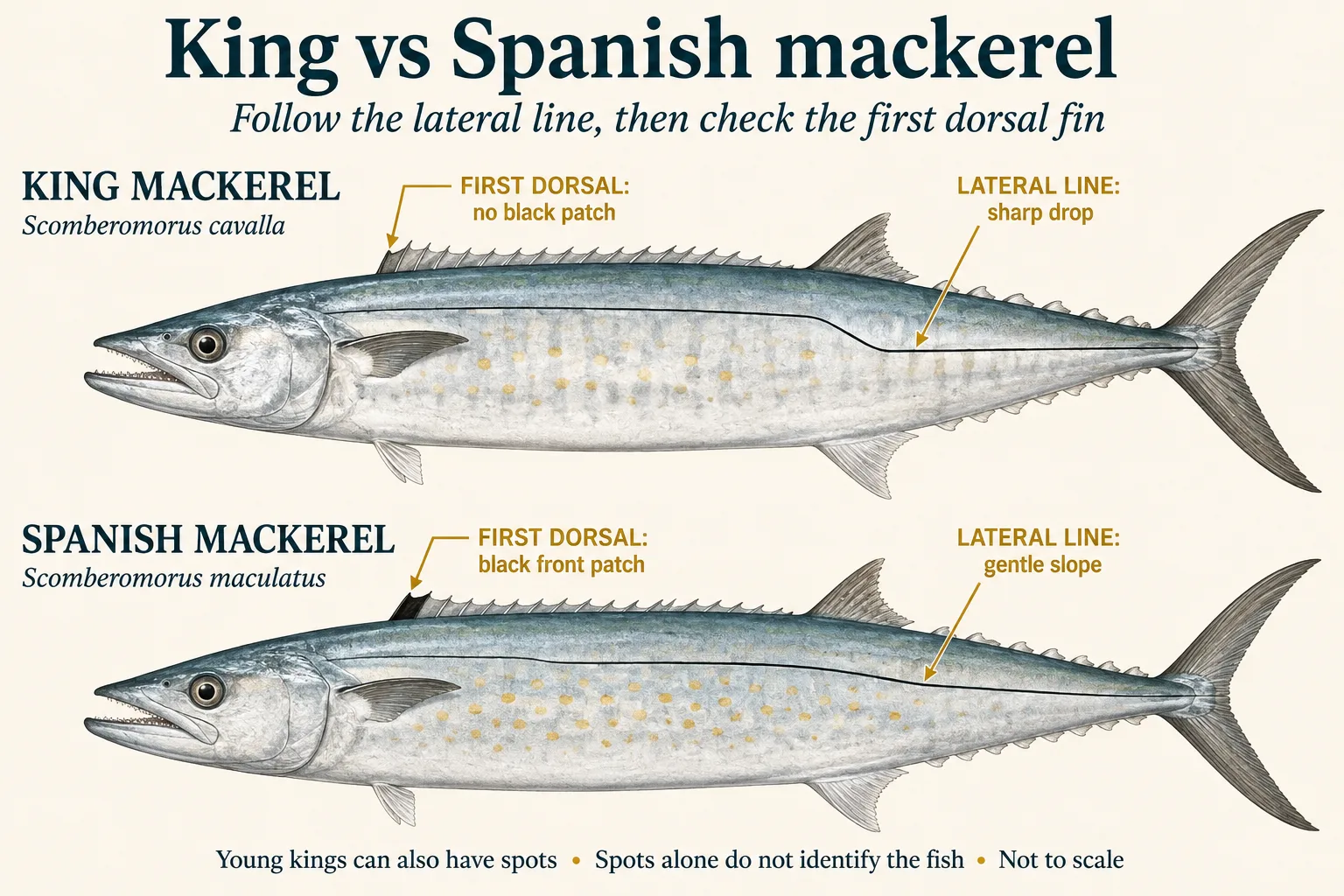
- Side of the body — trace the lateral line towards the tail. The lateral line is the sensory line along the fish’s side. On king mackerel it drops sharply beneath the second dorsal fin, the smaller top fin nearer the tail. On Spanish mackerel it slopes gradually.
- First top fin — inspect the end nearest the head. Spanish mackerel have a black patch at the front of the first dorsal fin. King mackerel lack this patch. The fin may be folded down, hiding the feature.
- Spots — do not use them alone. Young king mackerel can have yellowish spots too. A spotted fish is not automatically a Spanish mackerel.
Illustrated field marks checked on against Florida FWC: king mackerel illustration and field marks; Florida FWC: Spanish mackerel illustration and field marks. Original illustrations; typical features shown, not to scale.
Side by side
| What to look at | King Mackerel | Spanish Mackerel |
|---|---|---|
| Scientific name | Scomberomorus cavalla | Scomberomorus maculatus |
| Lateral line | Drops sharply beneath the second dorsal | Slopes gently and evenly to the tail |
| First dorsal fin | No black patch | A distinct black patch at the front |
| Spots | None on adults; juveniles show faint bronze spots that fade | Round to oval golden-yellow spots at every size |
| Size | Grows far larger | A much smaller fish |
| Where | Nearshore and offshore structure, wrecks and colour changes | Beaches, inlets and nearshore structure in fast schools |
Why the difference matters
The limits are very different, and this is the classic mistake: a juvenile king mackerel is spotted, looks like a Spanish, and is frequently kept as one. Because kings carry a substantial minimum size and a small bag while Spanish do not, the lateral line is the check worth making every time. Use it before the fish goes in the box, not at the cleaning table.
Size limits, bag limits, slot limits and seasons are set by your state wildlife agency — and for many offshore and migratory species by federal regulators — and on many waters they differ from the statewide rule. They also change between seasons. Check the current regulations for the exact water you are fishing before you keep a fish — we do not republish limits here, because a number that is a season out of date is worse than no number.
Full entries
Each fish has its own page with every field mark, the rest of its look-alikes, where it holds and the conditions it feeds in: King Mackerel and Spanish Mackerel.
Or skip the key entirely — photograph the fish and Global Fishing League names the species, returns the scientific name with it, and files the catch with the tide, pressure, water temperature and everything else it came from.