
Telling them apart
Longear Sunfish vs Redbreast Sunfish
Look at the edge of the ear flap. A longear's is broad with a pale white or red margin running around it. A redbreast's is long, narrow and solid black right to the edge, with no margin at all.
Last updated
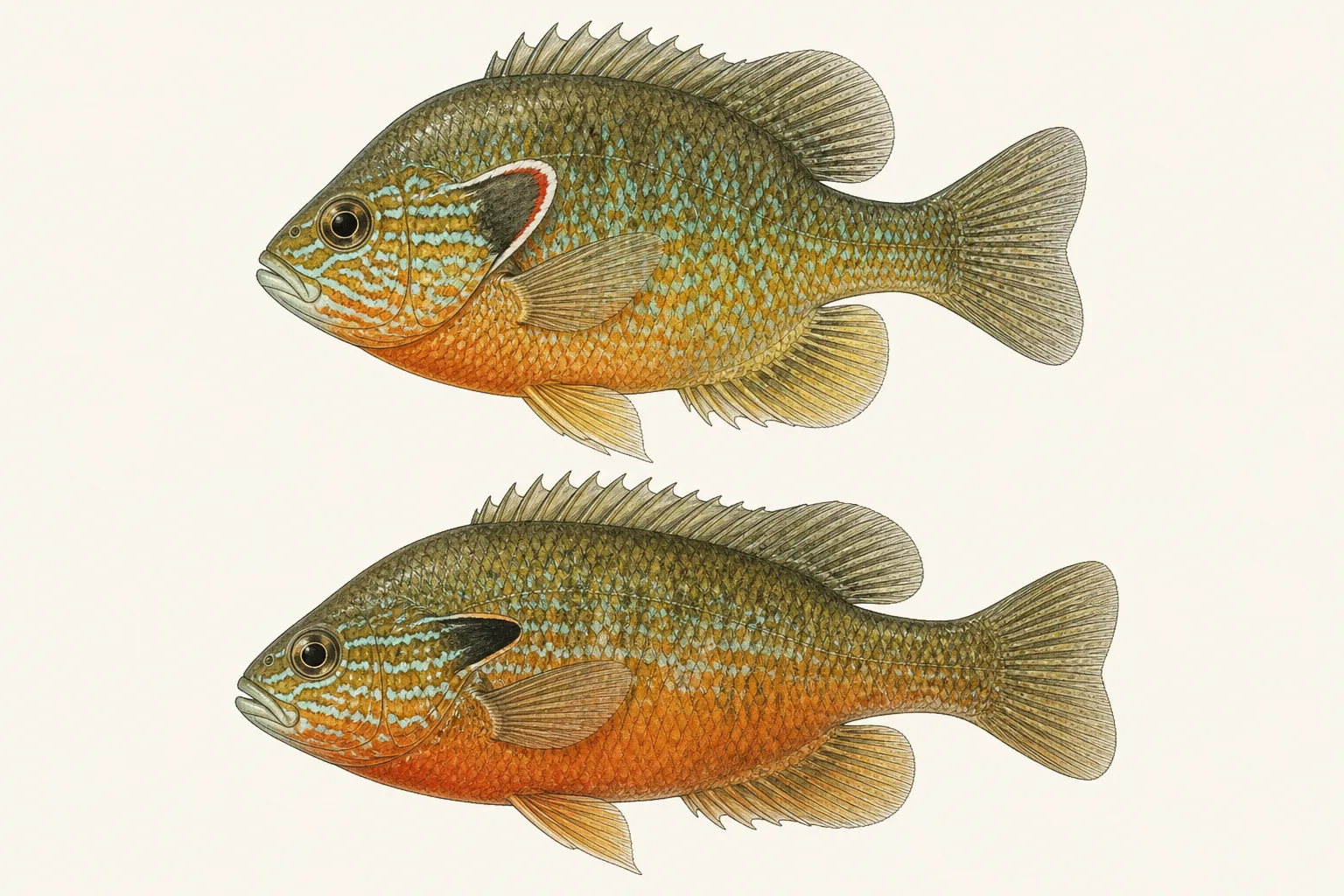
Side by side
| What to look at | Longear Sunfish | Redbreast Sunfish |
|---|---|---|
| Scientific name | Lepomis megalotis | Lepomis auritus |
| Ear flap edge | Pale white or red margin | Solid black to the edge |
| Ear flap shape | Broad, angled up and back | Long and narrow, narrower than the eye |
| Colour | Turquoise wavy lines over orange-red | Orange-red breast, blue-green cheek lines |
| Body | Short and deep | More elongate |
| Water | Clear streams and gravel-bottomed rivers | Undercut banks and slow current in Atlantic slope rivers |
Why the difference matters
Rarely a legal question, since almost every state pools them under one panfish bag. It is worth knowing because these two are among the most commonly misidentified sunfish in the country, and because a longear is a reliable sign of clean, clear, gravel-bottomed water.
Size limits, bag limits, slot limits and seasons are set by your state wildlife agency — and for many offshore and migratory species by federal regulators — and on many waters they differ from the statewide rule. They also change between seasons. Check the current regulations for the exact water you are fishing before you keep a fish — we do not republish limits here, because a number that is a season out of date is worse than no number.
Full entries
Each fish has its own page with every field mark, the rest of its look-alikes, where it holds and the conditions it feeds in: Longear Sunfish and Redbreast Sunfish.
Or skip the key entirely — photograph the fish and Global Fishing League names the species, returns the scientific name with it, and files the catch with the tide, pressure, water temperature and everything else it came from.