
Telling them apart
Mangrove Snapper vs Cubera Snapper
Open the mouth and look at the roof. A mangrove snapper's tooth patch has a distinct rearward extension behind the crescent; a cubera's patch is a crescent with no extension. Large mangroves and small cubera are otherwise very hard to separate.
Last updated
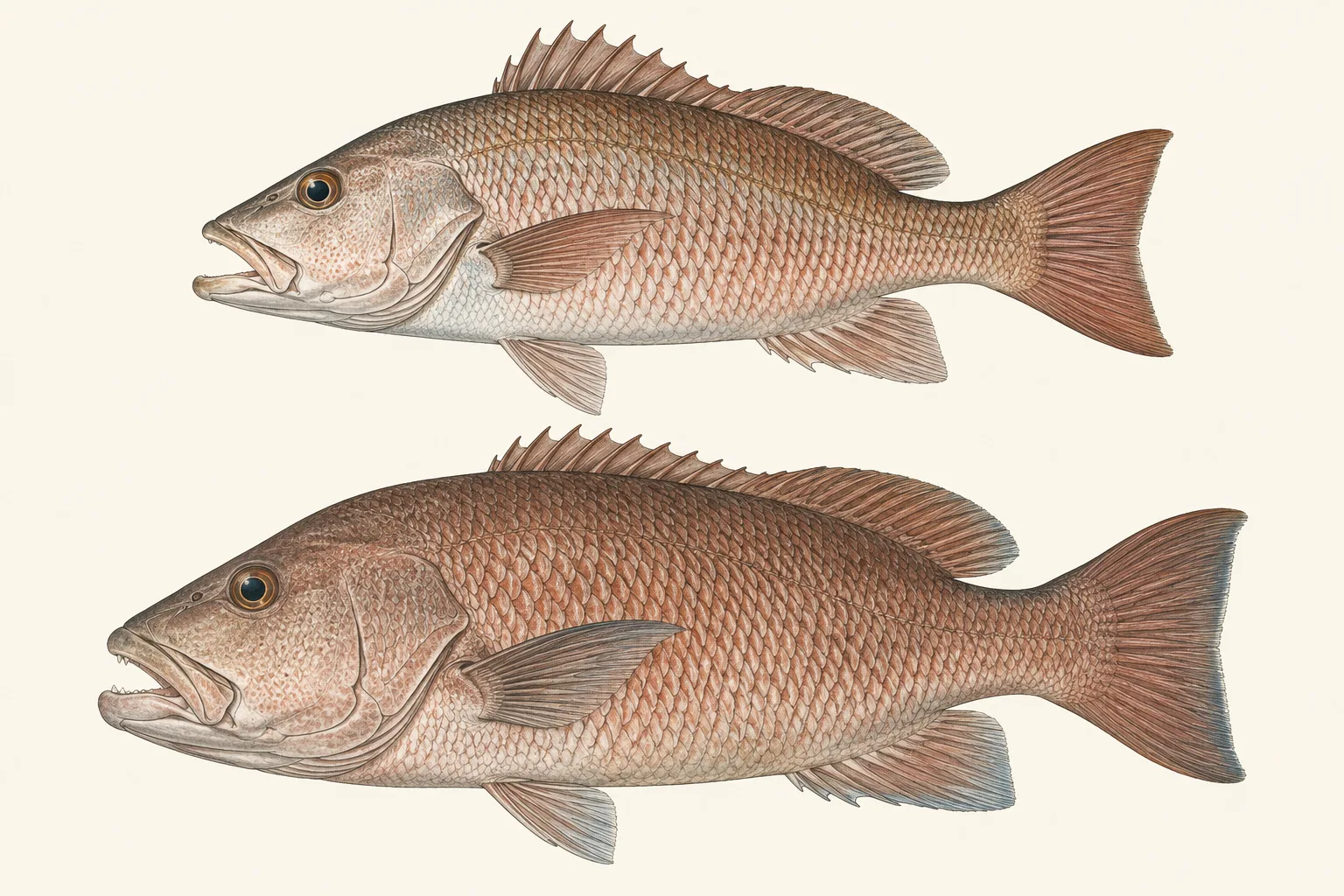
Side by side
| What to look at | Mangrove Snapper | Cubera Snapper |
|---|---|---|
| Scientific name | Lutjanus griseus | Lutjanus cyanopterus |
| Vomerine tooth patch | Crescent with a rearward extension | Crescent, no extension |
| Canine teeth | Two prominent at the front | Very large, visible with the mouth closed |
| Head | Triangular, pointed snout | Broad and heavy |
| Adult size | Moderate | By far the largest Atlantic snapper |
| Colour | Grey to coppery red | Dusky grey to reddish-brown |
| Where | Mangroves and docks inshore, reef and wrecks offshore | Deep wrecks, ledges and isolated structure |
Why the difference matters
The two overlap in size and colour at exactly the point where the limits diverge, and cubera carry special protections in Florida including a tight bag on larger fish. The tooth patch means opening the mouth, which is worth doing when the fish is big enough for the question to matter.
Size limits, bag limits, slot limits and seasons are set by your state wildlife agency — and for many offshore and migratory species by federal regulators — and on many waters they differ from the statewide rule. They also change between seasons. Check the current regulations for the exact water you are fishing before you keep a fish — we do not republish limits here, because a number that is a season out of date is worse than no number.
Full entries
Each fish has its own page with every field mark, the rest of its look-alikes, where it holds and the conditions it feeds in: Mangrove Snapper and Cubera Snapper.
Or skip the key entirely — photograph the fish and Global Fishing League names the species, returns the scientific name with it, and files the catch with the tide, pressure, water temperature and everything else it came from.