Telling them apart
Northern Pike vs Muskellunge
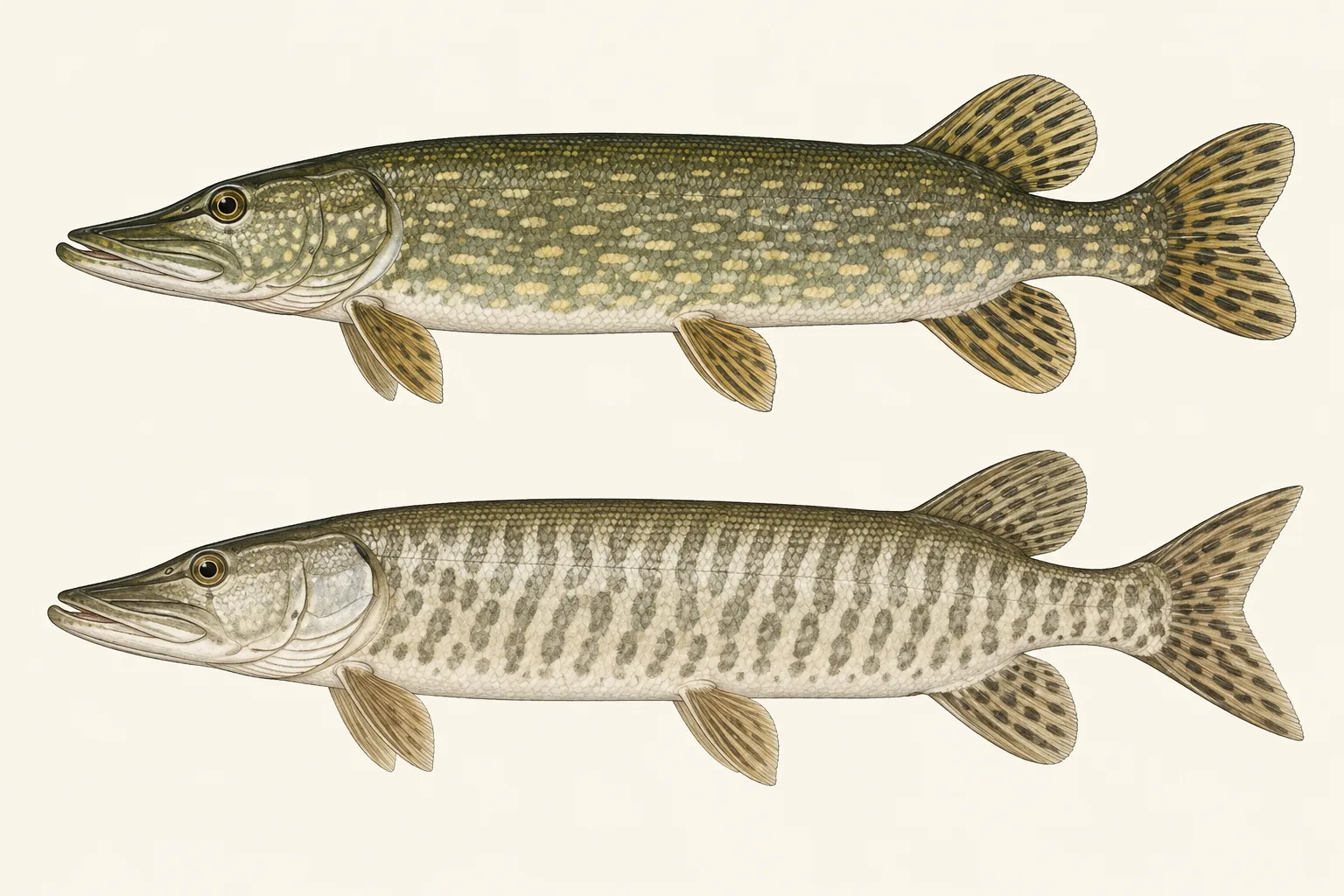
Northern pike show light bean-shaped spots on a dark body. Muskellunge show dark markings on a light body — the reverse. If you need certainty, count the sensory pores under one side of the lower jaw: five or fewer is a pike, six or more is a musky.
Last updated
Side by side
| What to look at | Northern Pike | Muskellunge |
|---|---|---|
| Scientific name | Esox lucius | Esox masquinongy |
| Markings | Light spots on a dark green background | Dark bars or spots on a light background, or none at all |
| Jaw pores (per side) | Five or fewer | Six or more |
| Cheek and gill cover | Cheek fully scaled; lower half of the gill cover bare | Lower halves of both the cheek and the gill cover bare |
| Tail lobes | Rounded | Pointed |
| Typical size | Common at modest sizes; a large pike is a good fish | Grows substantially larger and is far less numerous |
Why the difference matters
This is the most consequential identification error in freshwater. Muskellunge carry high minimum lengths, one-fish bags and catch-and-release-only status on many waters, while pike limits are often liberal. Killing a musky in the belief it was a pike is a serious violation on most systems that hold both. If the two marks disagree, count the pores and put the fish back while you do it.
Size limits, bag limits, slot limits and seasons are set by your state wildlife agency — and for many offshore and migratory species by federal regulators — and on many waters they differ from the statewide rule. They also change between seasons. Check the current regulations for the exact water you are fishing before you keep a fish — we do not republish limits here, because a number that is a season out of date is worse than no number.
Full entries
Each fish has its own page with every field mark, the rest of its look-alikes, where it holds and the conditions it feeds in: Northern Pike and Muskellunge.
Or skip the key entirely — photograph the fish and Global Fishing League names the species, returns the scientific name with it, and files the catch with the tide, pressure, water temperature and everything else it came from.