Paddlefish
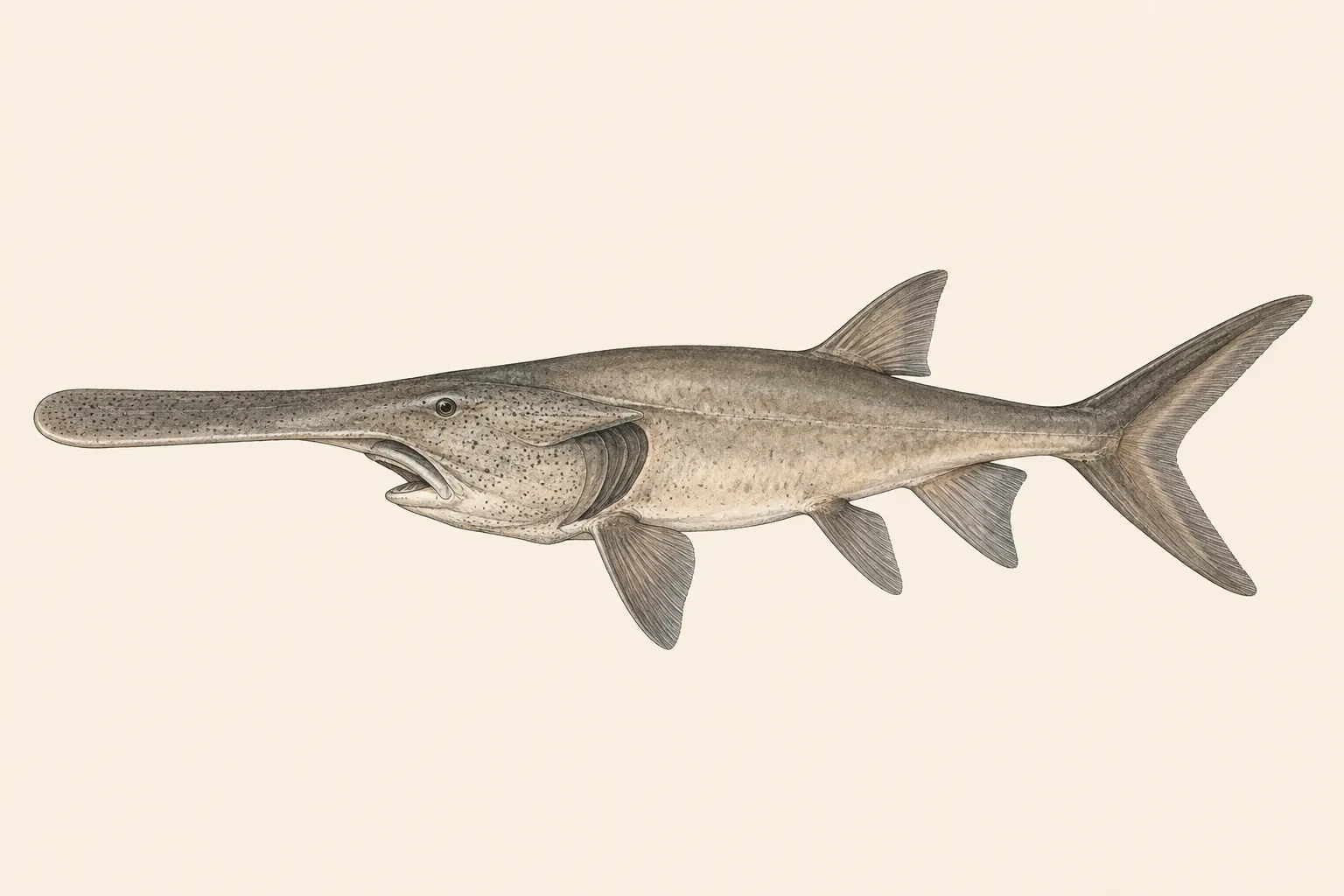
Paddlefish (Polyodon spathula) is a freshwater species. The first thing to check: a long, flat, paddle-shaped snout that can be a third of the fish's total length, covered in electroreceptors. The look-alike to rule out is Sturgeon: sturgeon have rows of bony scutes along the body, four barbels under the snout, and a protrusible sucker mouth.
Last updated
| Scientific name | Polyodon spathula |
|---|---|
| Also called | spoonbill, spoonbill catfish |
| Water | Freshwater |
| Group | Primitive fish |
| Temperature | Spawning runs are triggered at 50 to 60 °F on rising water in spring. |
How to identify a Paddlefish
- A long, flat, paddle-shaped snout that can be a third of the fish's total length, covered in electroreceptors.
- No scales, and a shark-like skeleton of cartilage with a deeply forked tail.
- A huge gill opening and an enormous mouth with no functional teeth — it filter-feeds on zooplankton.
Photograph the fish and the app will name it, though it returns this species as American Paddlefish rather than Paddlefish — the same fish under the label the app uses.
Fish it is mistaken for
| Species | How to tell them apart |
|---|---|
| Sturgeon | Sturgeon have rows of bony scutes along the body, four barbels under the snout, and a protrusible sucker mouth. |
| Shovelnose Sturgeon | The shovelnose has a flattened but short snout with barbels, and armoured scutes the paddlefish lacks entirely. |
Where it lives
The Mississippi river basin and connected reservoirs, from Montana to Louisiana. Roams open water in large rivers and impoundments, moving upstream to spawn over gravel bars.
Temperature
Spawning runs are triggered at 50 to 60 °F on rising water in spring.
The conditions that matter
Paddlefish do not feed by sight or scent — they filter plankton, which means chlorophyll and plankton concentration genuinely predict where they will be. River stage and water temperature together trigger the spawning run. Very few anglers can put plankton density against a catch record; if you can, paddlefish are the species where it pays.
Global Fishing League records 18 weather and water readings against every catch automatically — tide stage, barometric pressure, water temperature, salinity, dissolved oxygen, chlorophyll, swell, current, moon phase and more, taken at your GPS position at the moment you log the fish. Over a season that turns a hunch about paddlefish into a pattern you can read.
See every reading recorded with a catch, or the guides to what each reading means.
Size limits, bag limits and seasons
Size limits, bag limits, slot limits and seasons are set by your state wildlife agency — and for many offshore and migratory species by federal regulators — and on many waters they differ from the statewide rule. They also change between seasons. Check the current regulations for the exact water you are fishing before you keep a fish — we do not republish limits here, because a number that is a season out of date is worse than no number.
What the app does do is make your side of it accurate: every catch carries a length measured from the photograph, a GPS position and a timestamp, exportable if you ever need to show your work for a tournament or a record claim. It is also what a Global Fishing League entry is built from — a record that verifies itself, without publishing where you caught the fish.