
Telling them apart
Red Drum vs Black Drum
Look under the chin. Black drum have a row of short barbels; red drum have none. Red drum also carry at least one black eyespot at the base of the tail, which black drum never do.
Last updated
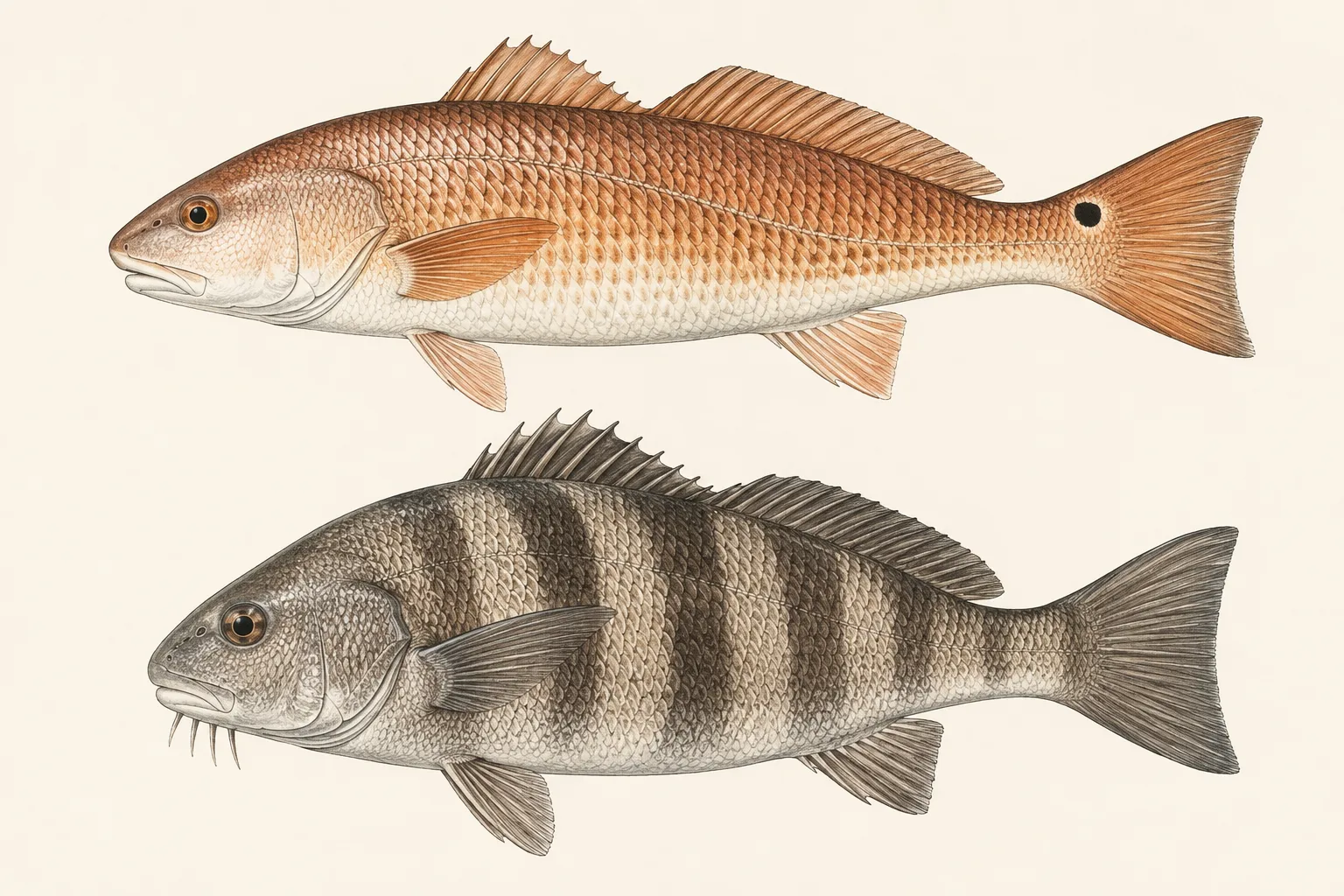
Side by side
| What to look at | Red Drum | Black Drum |
|---|---|---|
| Scientific name | Sciaenops ocellatus | Pogonias cromis |
| Chin barbels | None | A row of short barbels |
| Tail spot | At least one black eyespot at the tail base | None |
| Colour | Copper to bronze-red | Silver-grey to bronze, darker with age |
| Young fish | Plain, with the tail spot already present | Four or five broad dark vertical bars |
| Feeding | Roots the bottom but takes moving prey readily | Crushes shellfish with pharyngeal teeth |
Why the difference matters
Red drum are managed with a strict slot in most states — a minimum and a maximum, with bull reds above the slot protected as breeding stock — while black drum regulations are usually looser and shaped differently. They are also caught in different ways: redfish push onto a flat with the flooding tide, black drum work oyster and bridge structure by touch and keep feeding in dirty water and at night.
Size limits, bag limits, slot limits and seasons are set by your state wildlife agency — and for many offshore and migratory species by federal regulators — and on many waters they differ from the statewide rule. They also change between seasons. Check the current regulations for the exact water you are fishing before you keep a fish — we do not republish limits here, because a number that is a season out of date is worse than no number.
Full entries
Each fish has its own page with every field mark, the rest of its look-alikes, where it holds and the conditions it feeds in: Red Drum and Black Drum.
Or skip the key entirely — photograph the fish and Global Fishing League names the species, returns the scientific name with it, and files the catch with the tide, pressure, water temperature and everything else it came from.