Scup
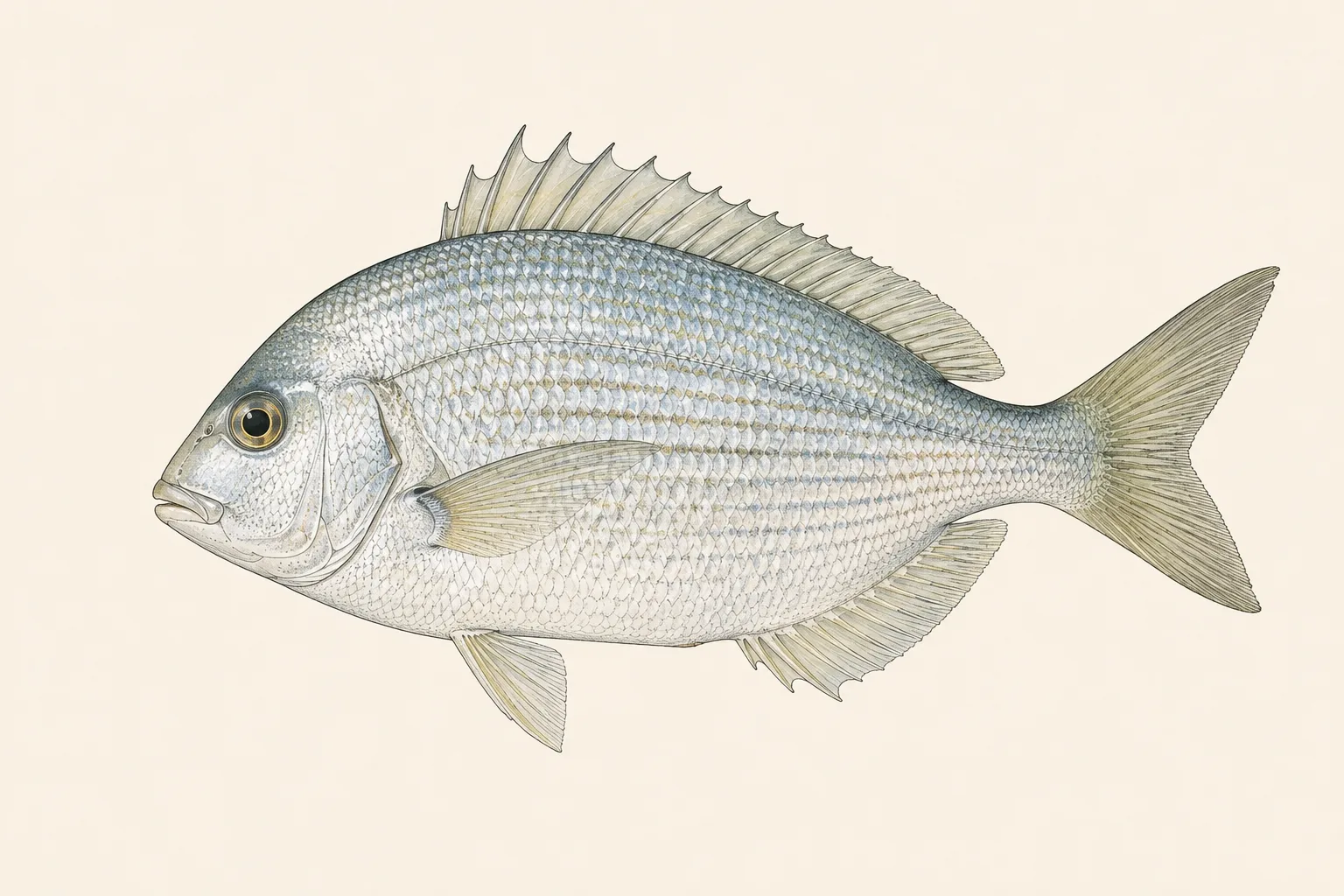
Scup (Stenotomus chrysops) is a saltwater species. The first thing to check: a deep, strongly compressed silver body with a steep forehead and a very small mouth. The look-alike to rule out is Pinfish: pinfish carry a distinct dark shoulder spot behind the gill cover and gold horizontal stripes; scup have neither.
Last updated
| Scientific name | Stenotomus chrysops |
|---|---|
| Also called | porgy, paugie, sea bream |
| Water | Saltwater |
| Group | Porgy |
| Temperature | Feeds well between 55 and 72 °F. |
How to identify a Scup
- A deep, strongly compressed silver body with a steep forehead and a very small mouth.
- Iridescent blue-silver flanks crossed by faint dusky horizontal lines, with no bold bars or blotches.
- A single continuous spiny dorsal fin with sharp, stiff forward spines.
If you would rather not work through a key on a wet deck, photograph the fish and let the app name it — you get the common and the scientific name back, and the record is filed before you release.
Fish it is mistaken for
| Species | How to tell them apart |
|---|---|
| Pinfish | Pinfish carry a distinct dark shoulder spot behind the gill cover and gold horizontal stripes; scup have neither. |
| Black Sea Bass | Sea bass are dark and smoky with a trailing filament on the top of the tail; scup are plain silver with a forked tail. |
Side-by-side comparisons
Read the full entry for Pinfish and Black Sea Bass.
Where it lives
The Atlantic coast from Cape Cod to the Carolinas, concentrated in southern New England. Schools hard over wrecks, rock piles, mussel beds and rubble, moving offshore for winter.
Temperature
Feeds well between 55 and 72 °F.
The conditions that matter
Scup are a structure-and-current fish: they sit on the piece and feed on moving water, and slack tide scatters them. The seasonal inshore–offshore migration tracks water temperature closely, which is why the same rock pile is loaded in June and empty in December.
Global Fishing League records 18 weather and water readings against every catch automatically — tide stage, barometric pressure, water temperature, salinity, dissolved oxygen, chlorophyll, swell, current, moon phase and more, taken at your GPS position at the moment you log the fish. Over a season that turns a hunch about scup into a pattern you can read.
See every reading recorded with a catch, or the guides to what each reading means.
Size limits, bag limits and seasons
Size limits, bag limits, slot limits and seasons are set by your state wildlife agency — and for many offshore and migratory species by federal regulators — and on many waters they differ from the statewide rule. They also change between seasons. Check the current regulations for the exact water you are fishing before you keep a fish — we do not republish limits here, because a number that is a season out of date is worse than no number.
What the app does do is make your side of it accurate: every catch carries a length measured from the photograph, a GPS position and a timestamp, exportable if you ever need to show your work for a tournament or a record claim. It is also what a Global Fishing League entry is built from — a record that verifies itself, without publishing where you caught the fish.