Telling them apart
Smallmouth Bass vs Shoal Bass
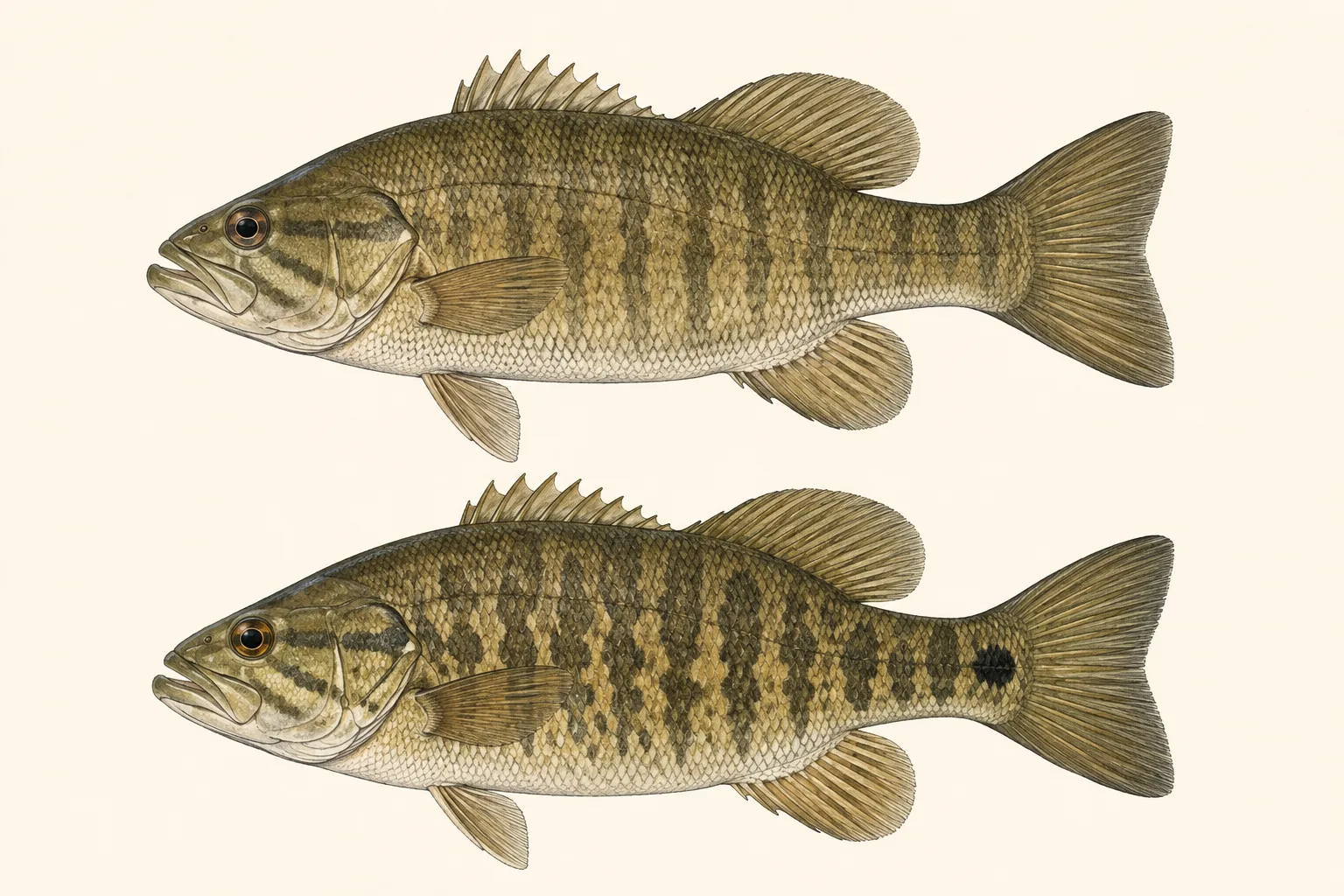
Range settles it faster than anything on the fish. Shoal bass live only in the Apalachicola, Chattahoochee and Flint river system; a bronze, barred bass anywhere else is a smallmouth. On the fish, a shoal bass usually carries a distinct dark spot at the base of the tail that a smallmouth does not.
Last updated
Side by side
| What to look at | Smallmouth Bass | Shoal Bass |
|---|---|---|
| Scientific name | Micropterus dolomieu | Micropterus cataractae |
| Range | Widespread across the eastern and central states | The ACF river system of Georgia, Alabama and Florida only |
| Tail-base spot | Absent or very faint | Usually distinct |
| Barring | Vertical bars, fading with mood | Blotchy tiger-stripe bars, boldest in fast water |
| Eye bars | Three radiating back from the eye | Three radiating back from the eye — no help here |
| Habitat | Rocky lakes, gravel shoals, river current seams | Bedrock shoals and swift runs, rarely still water |
Why the difference matters
Shoal bass have one of the smallest ranges of any American gamefish and are a species of conservation concern, squeezed by impoundment and now by introduced Alabama bass. Several ACF waters are catch-and-release for them while smallmouth elsewhere carry ordinary limits, so knowing which river system you are on is the first half of the identification.
Size limits, bag limits, slot limits and seasons are set by your state wildlife agency — and for many offshore and migratory species by federal regulators — and on many waters they differ from the statewide rule. They also change between seasons. Check the current regulations for the exact water you are fishing before you keep a fish — we do not republish limits here, because a number that is a season out of date is worse than no number.
Full entries
Each fish has its own page with every field mark, the rest of its look-alikes, where it holds and the conditions it feeds in: Smallmouth Bass and Shoal Bass.
Or skip the key entirely — photograph the fish and Global Fishing League names the species, returns the scientific name with it, and files the catch with the tide, pressure, water temperature and everything else it came from.