Snook
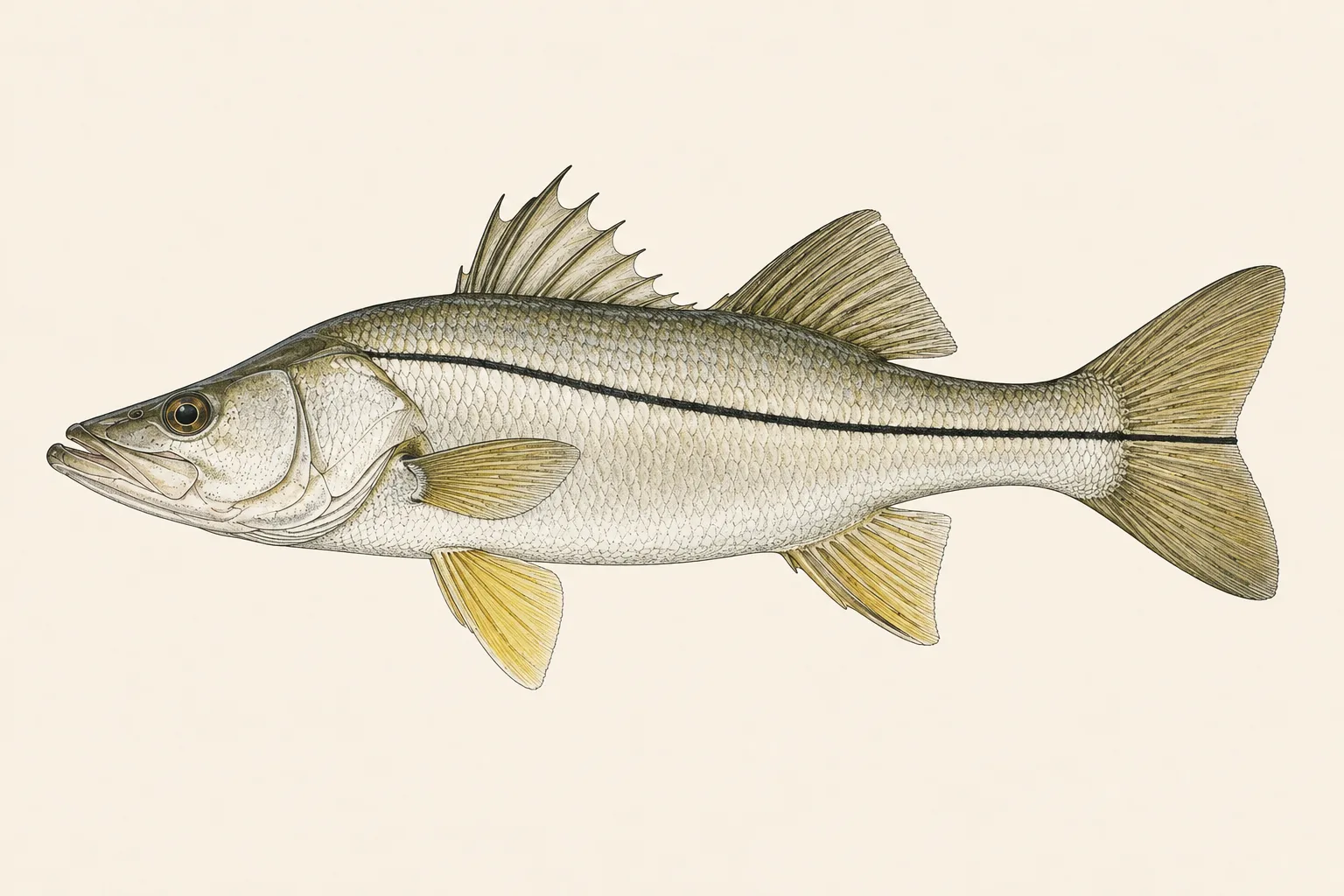
Snook (Centropomus undecimalis) is a saltwater species. The first thing to check: a hard black lateral line running the full length of the body and continuing onto the tail fin. The look-alike to rule out is Fat Snook: fat snook are deeper-bodied with smaller scales and a shorter snout, and stay much smaller.
Last updated
| Scientific name | Centropomus undecimalis |
|---|---|
| Also called | common snook, linesider, robalo |
| Water | Saltwater |
| Group | Snook |
| Temperature | Highly cold-sensitive: feeds well from 70 to 85 °F, is stressed below about 60 °F, and suffers kills below the low 50s. |
How to identify a Snook
- A hard black lateral line running the full length of the body and continuing onto the tail fin.
- A sharply sloped forehead over a large, protruding lower jaw — a distinctly pike-like profile.
- Yellow-tinged fins, especially the pelvics, and a razor-sharp gill plate edge.
If you would rather not work through a key on a wet deck, photograph the fish and let the app name it — you get the common and the scientific name back, and the record is filed before you release.
Fish it is mistaken for
| Species | How to tell them apart |
|---|---|
| Fat Snook | Fat snook are deeper-bodied with smaller scales and a shorter snout, and stay much smaller. |
| Tarpon | Tarpon are silver-plated with enormous scales, an upturned mouth and a trailing dorsal filament. |
Read the full entry for Tarpon.
Where it lives
Southern Florida, the Gulf and the Caribbean. Ambushes from mangrove roots, dock lights, bridge shadow lines, passes and beach troughs, moving between fresh, brackish and salt water freely.
Temperature
Highly cold-sensitive: feeds well from 70 to 85 °F, is stressed below about 60 °F, and suffers kills below the low 50s.
The conditions that matter
Snook are the clearest tide-and-structure fish on the coast. They sit on the up-current side of a bridge shadow or a mangrove point and let the tide bring food to them, which means a given mark has a stage and a direction that works and one that does not. Water temperature governs the seasonal move between beaches, passes and back-country creeks. Tide stage and water temperature per catch turn a good spot into a schedule.
Global Fishing League records 18 weather and water readings against every catch automatically — tide stage, barometric pressure, water temperature, salinity, dissolved oxygen, chlorophyll, swell, current, moon phase and more, taken at your GPS position at the moment you log the fish. Over a season that turns a hunch about snook into a pattern you can read.
See every reading recorded with a catch, or the guides to what each reading means.
Size limits, bag limits and seasons
Size limits, bag limits, slot limits and seasons are set by your state wildlife agency — and for many offshore and migratory species by federal regulators — and on many waters they differ from the statewide rule. They also change between seasons. Check the current regulations for the exact water you are fishing before you keep a fish — we do not republish limits here, because a number that is a season out of date is worse than no number.
What the app does do is make your side of it accurate: every catch carries a length measured from the photograph, a GPS position and a timestamp, exportable if you ever need to show your work for a tournament or a record claim. It is also what a Global Fishing League entry is built from — a record that verifies itself, without publishing where you caught the fish.