Tiger Muskie
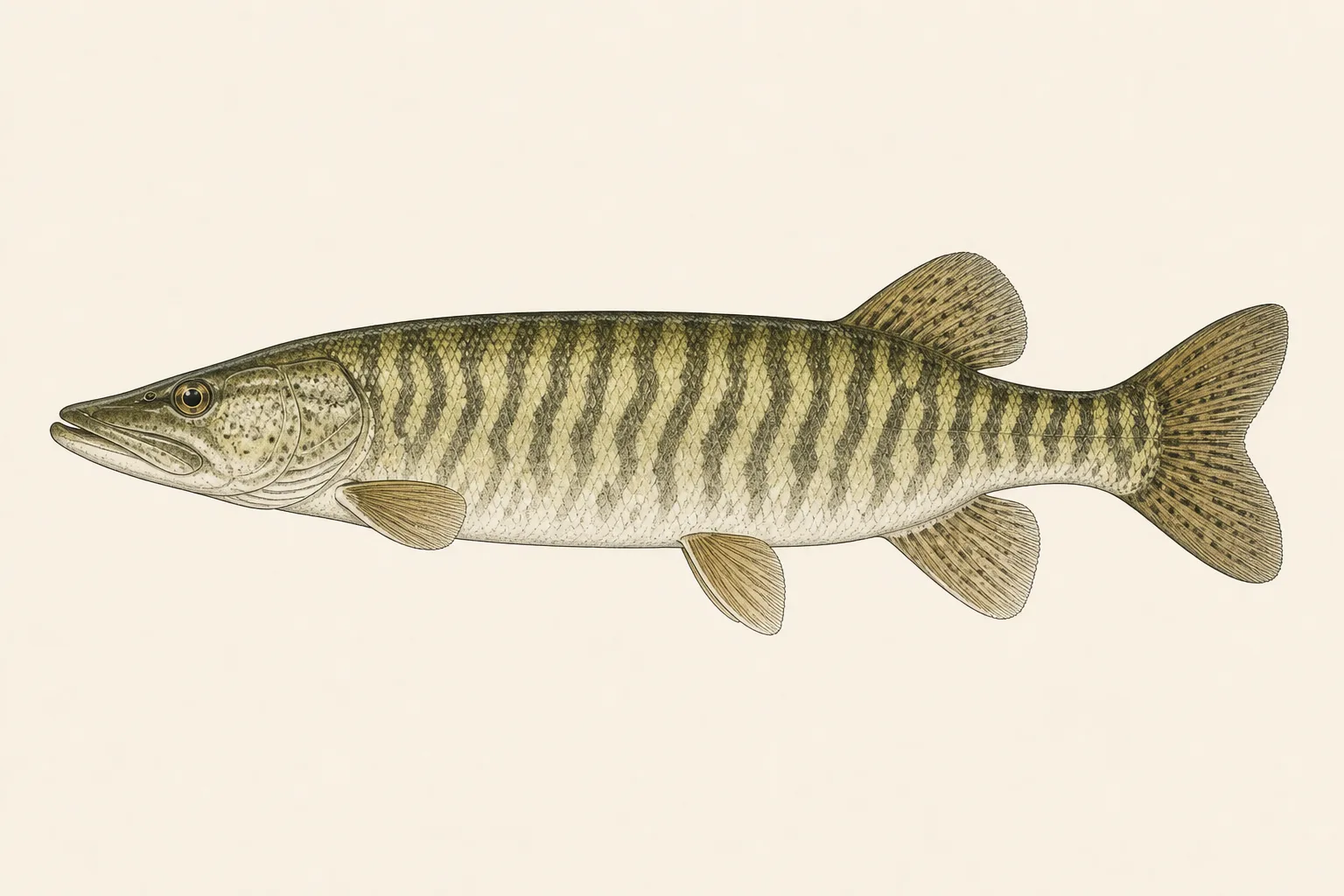
Tiger Muskie (Esox masquinongy × Esox lucius) is a freshwater species. The first thing to check: bold, wavy dark vertical bars over a light golden-green flank — more sharply defined than either parent species. The look-alike to rule out is Muskellunge: pure musky have pointed tail lobes and their barring, when present, is less bold and less regular.
Last updated
| Scientific name | Esox masquinongy × Esox lucius |
|---|---|
| Also called | tiger musky, norlunge |
| Water | Freshwater |
| Group | Pike |
| Temperature | Grows and feeds best between 60 and 70 °F, tolerating slightly warmer water than a pure musky. |
How to identify a Tiger Muskie
- Bold, wavy dark vertical bars over a light golden-green flank — more sharply defined than either parent species.
- Rounded tail fin lobes, where a pure muskellunge's are pointed.
- Cheek and gill cover scaling is intermediate: partly scaled, matching neither parent cleanly.
Global Fishing League's identification does not currently cover Tiger Muskie. This page is here because the fish is worth being able to name, and because getting it wrong has consequences — but do not expect the app to return it from a photograph. See what it does identify.
Fish it is mistaken for
| Species | How to tell them apart |
|---|---|
| Muskellunge | Pure musky have pointed tail lobes and their barring, when present, is less bold and less regular. |
| Northern Pike | Pike show light spots on dark, not dark bars on light, and have fully scaled cheeks. |
Read the full entry for Muskellunge and Northern Pike.
Where it lives
A sterile hybrid produced in hatcheries and stocked widely in reservoirs and lakes across the western and northern United States, often as a predator on stunted panfish populations.
Temperature
Grows and feeds best between 60 and 70 °F, tolerating slightly warmer water than a pure musky.
The conditions that matter
Because tiger muskie are stocked rather than naturally recruited, local stocking history matters as much as conditions. On the water they behave like a musky: structure-oriented, low-light-biased, and more active on falling pressure.
Global Fishing League records 18 weather and water readings against every catch automatically — tide stage, barometric pressure, water temperature, salinity, dissolved oxygen, chlorophyll, swell, current, moon phase and more, taken at your GPS position at the moment you log the fish. Over a season that turns a hunch about tiger muskie into a pattern you can read.
See every reading recorded with a catch, or the guides to what each reading means.
Size limits, bag limits and seasons
Size limits, bag limits, slot limits and seasons are set by your state wildlife agency — and for many offshore and migratory species by federal regulators — and on many waters they differ from the statewide rule. They also change between seasons. Check the current regulations for the exact water you are fishing before you keep a fish — we do not republish limits here, because a number that is a season out of date is worse than no number.
What the app does do is make your side of it accurate: every catch carries a length measured from the photograph, a GPS position and a timestamp, exportable if you ever need to show your work for a tournament or a record claim. It is also what a Global Fishing League entry is built from — a record that verifies itself, without publishing where you caught the fish.