Tripletail
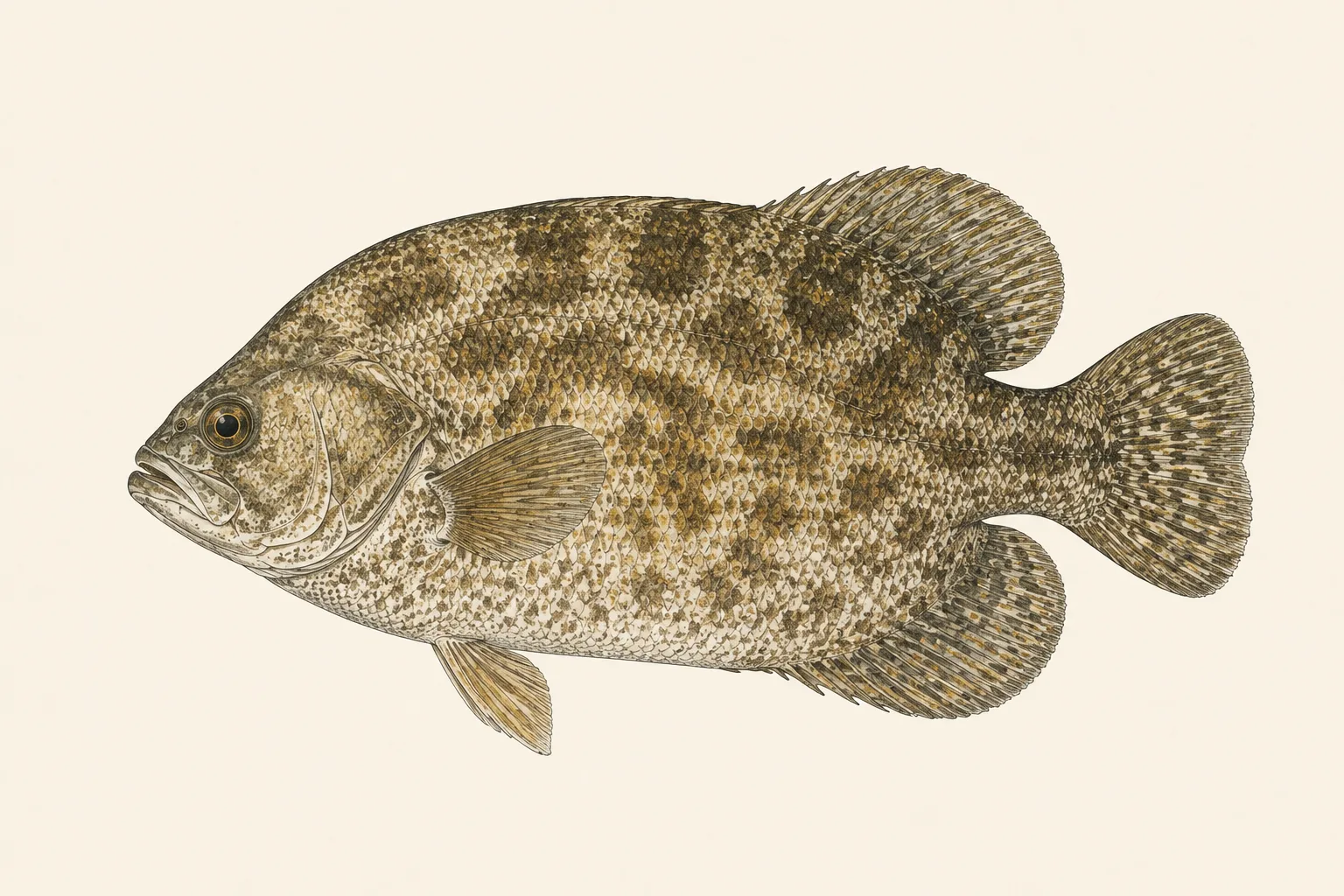
Tripletail (Lobotes surinamensis) is a saltwater species. The first thing to check: rounded dorsal and anal fins set far back beside the tail, giving the impression of three tails. The look-alike to rule out is Juvenile Grouper: grouper have a single continuous dorsal fin and do not float on their side under debris.
Last updated
| Scientific name | Lobotes surinamensis |
|---|---|
| Also called | blackfish, buoy fish, sea perch |
| Water | Saltwater |
| Group | Tripletail |
| Temperature | Found from about 68 to 88 °F, most reliably through the warm months. |
How to identify a Tripletail
- Rounded dorsal and anal fins set far back beside the tail, giving the impression of three tails.
- Mottled brown to yellow-grey blotching, often with the fish lying on its side at the surface.
- A deep, compressed body with a concave forehead profile.
Photograph the fish and the app will name it, though it returns this species as Atlantic Tripletail rather than Tripletail — the same fish under the label the app uses.
Fish it is mistaken for
| Species | How to tell them apart |
|---|---|
| Juvenile Grouper | Grouper have a single continuous dorsal fin and do not float on their side under debris. |
| Floating Debris | Not a joke — the fish's entire strategy is looking like a drifting leaf beside a buoy or weed line. Look for the eye. |
Where it lives
Warm Atlantic, Gulf and Caribbean water. Associates with anything floating: crab trap buoys, weed lines, channel markers, flotsam and rip lines, often in open water within sight of the beach.
Temperature
Found from about 68 to 88 °F, most reliably through the warm months.
The conditions that matter
Tripletail are a sight fishery tied to floating structure, so what matters is what puts structure and clean water together: a defined weed line or rip, light wind, and enough sun to see. Cloud cover and wind speed effectively decide whether the day is fishable at all.
Global Fishing League records 18 weather and water readings against every catch automatically — tide stage, barometric pressure, water temperature, salinity, dissolved oxygen, chlorophyll, swell, current, moon phase and more, taken at your GPS position at the moment you log the fish. Over a season that turns a hunch about tripletail into a pattern you can read.
See every reading recorded with a catch, or the guides to what each reading means.
Size limits, bag limits and seasons
Size limits, bag limits, slot limits and seasons are set by your state wildlife agency — and for many offshore and migratory species by federal regulators — and on many waters they differ from the statewide rule. They also change between seasons. Check the current regulations for the exact water you are fishing before you keep a fish — we do not republish limits here, because a number that is a season out of date is worse than no number.
What the app does do is make your side of it accurate: every catch carries a length measured from the photograph, a GPS position and a timestamp, exportable if you ever need to show your work for a tournament or a record claim. It is also what a Global Fishing League entry is built from — a record that verifies itself, without publishing where you caught the fish.