Telling them apart
Walleye vs Sauger
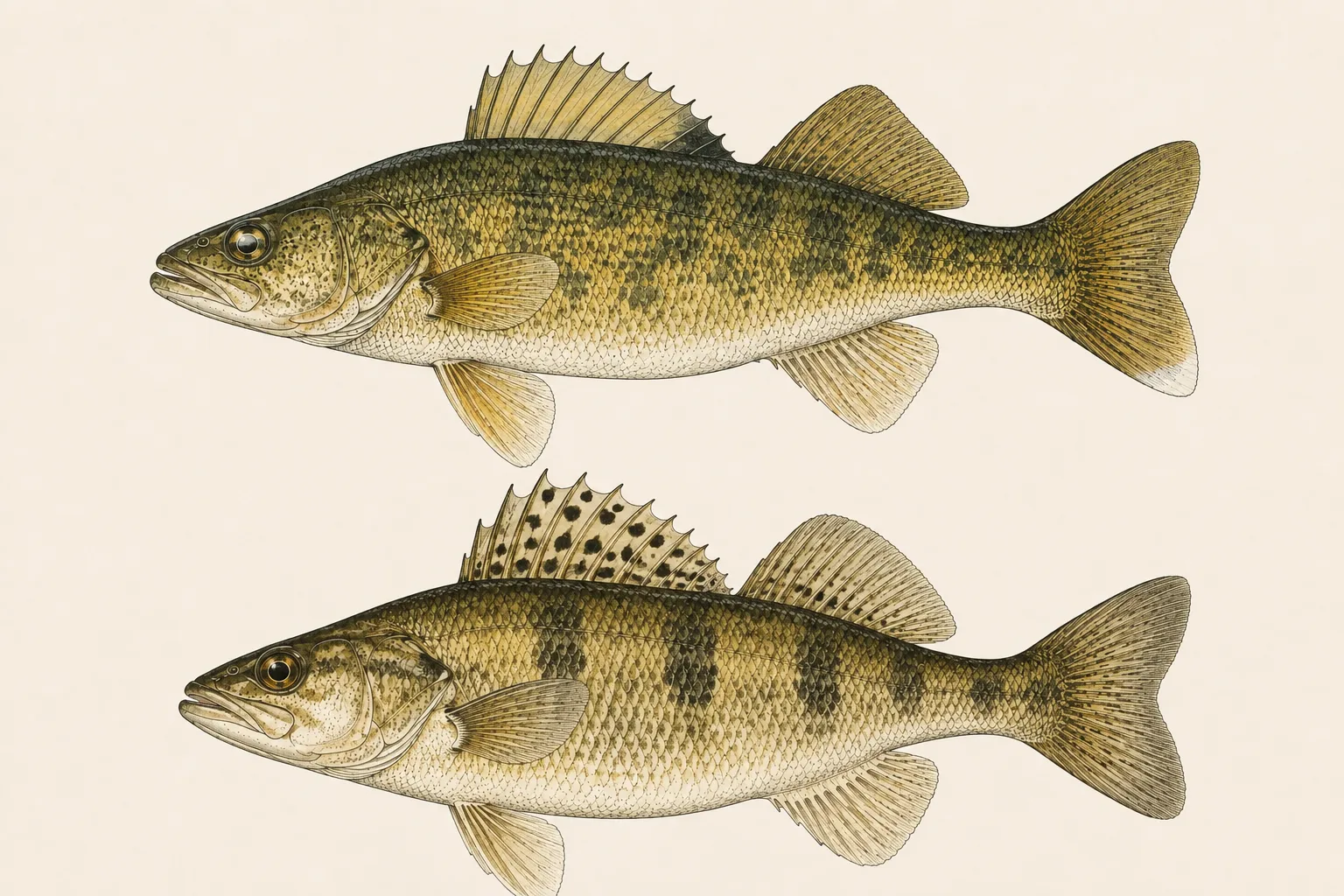
Look at the tail and the spiny dorsal fin. A walleye has a white tip on the lower tail lobe and a clean, unspotted spiny dorsal. A sauger has no white tail tip and distinct rows of black spots on the dorsal membranes.
Last updated
Side by side
| What to look at | Walleye | Sauger |
|---|---|---|
| Scientific name | Sander vitreus | Sander canadensis |
| Lower tail lobe | A clear white tip | No white tip |
| Spiny dorsal fin | Clean and unspotted, sometimes with a dark rear blotch | Rows of distinct black spots on the membranes |
| Flank | Olive-gold with dark mottling | Brassy brown with three or four dark saddle blotches |
| Water | Large clear lakes, reservoirs and rivers | Turbid rivers and tailraces; far more current-tolerant |
| Spawn temperature | 42 to 50 °F | 40 to 46 °F |
| Typical size | Grows considerably larger | Rarely reaches walleye size |
Why the difference matters
The two share water below dams and are managed differently in many states, sometimes with a combined bag and sometimes not. Saugeye, the hybrid, shows both signatures at once — a partly spotted dorsal with a partial white tail tip — so if you see both marks, it is neither parent. Sauger also keep feeding through high, coloured flows that push walleye off, which is useful to know when the river comes up.
Size limits, bag limits, slot limits and seasons are set by your state wildlife agency — and for many offshore and migratory species by federal regulators — and on many waters they differ from the statewide rule. They also change between seasons. Check the current regulations for the exact water you are fishing before you keep a fish — we do not republish limits here, because a number that is a season out of date is worse than no number.
Full entries
Each fish has its own page with every field mark, the rest of its look-alikes, where it holds and the conditions it feeds in: Walleye and Sauger.
Or skip the key entirely — photograph the fish and Global Fishing League names the species, returns the scientific name with it, and files the catch with the tide, pressure, water temperature and everything else it came from.