Alabama Bass
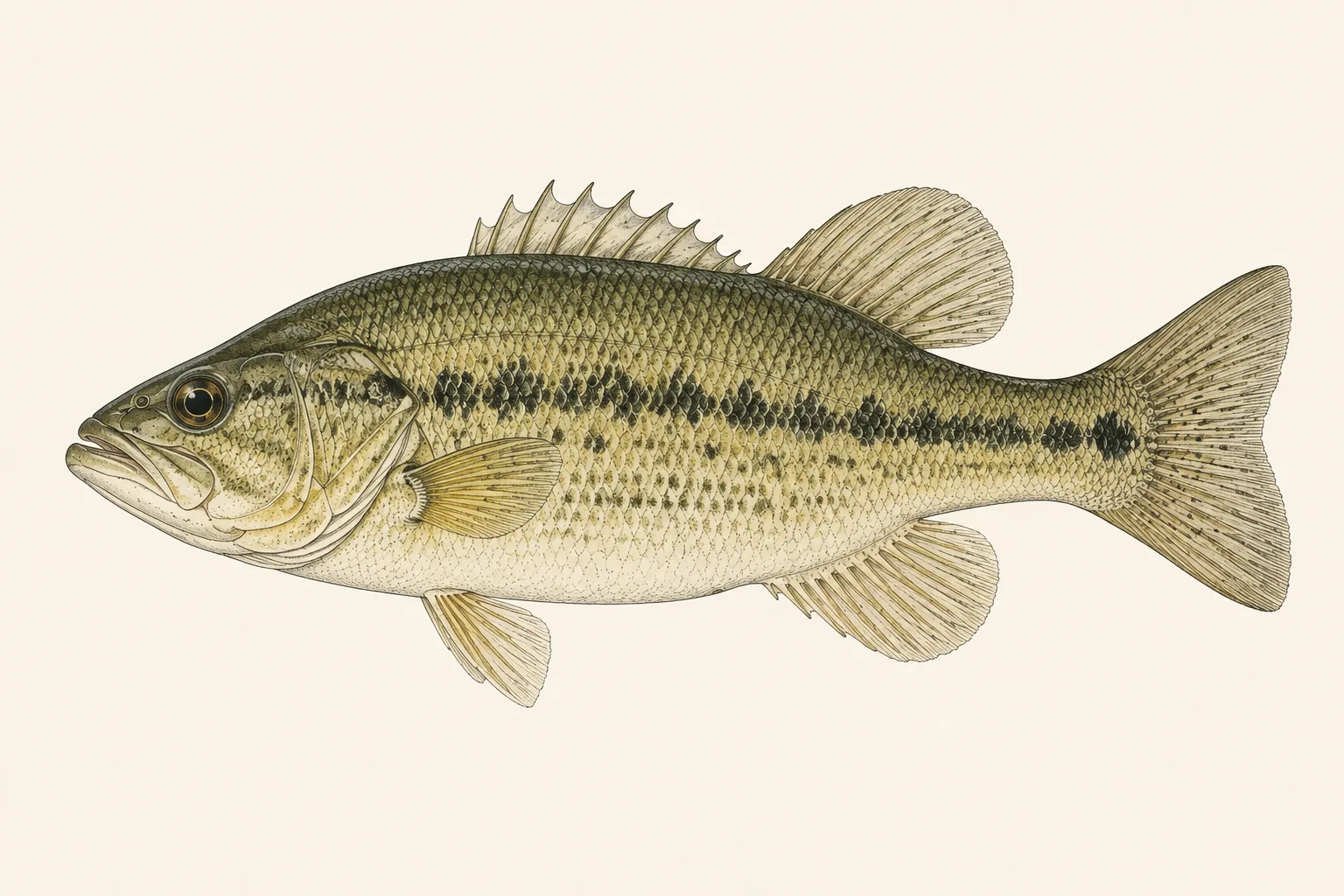
Alabama Bass (Micropterus henshalli) is a freshwater species. The first thing to check: a rough tooth patch on the tongue, as on a spotted bass, with the upper jaw ending level with the rear of the eye. The look-alike to rule out is Spotted Bass: very close, and often only separable by range and by scale counts — an Alabama bass has more scale rows around the caudal peduncle and a bolder tail spot. Where you are matters: outside the Mobile basin, an introduced Alabama bass is the likelier fish in many reservoirs.
Last updated
| Scientific name | Micropterus henshalli |
|---|---|
| Also called | spotted bass, Coosa bass, alabama spotted bass |
| Water | Freshwater |
| Group | Black bass |
| Temperature | Feeds best between 60 and 78 °F, tolerating more current than a largemouth. |
How to identify an Alabama Bass
- A rough tooth patch on the tongue, as on a spotted bass, with the upper jaw ending level with the rear of the eye.
- A row of dark blotches along the flank that stays tighter and more broken than a spotted bass's, over rows of spots below the lateral line.
- A larger, more clearly defined dark spot at the base of the tail than a spotted bass carries.
If you would rather not work through a key on a wet deck, photograph the fish and let the app name it — you get the common and the scientific name back, and the record is filed before you release.
Fish it is mistaken for
| Species | How to tell them apart |
|---|---|
| Spotted Bass | Very close, and often only separable by range and by scale counts — an Alabama bass has more scale rows around the caudal peduncle and a bolder tail spot. Where you are matters: outside the Mobile basin, an introduced Alabama bass is the likelier fish in many reservoirs. |
| Largemouth Bass | A largemouth's jaw runs past the eye, its tongue is smooth, and it carries a single ragged horizontal stripe rather than spot rows. |
Side-by-side comparisons
Read the full entry for Spotted Bass and Largemouth Bass.
Where it lives
Native to the Mobile River basin of Alabama and Georgia, and now illegally or accidentally introduced into reservoirs across the Southeast, the Carolinas and California.
Temperature
Feeds best between 60 and 78 °F, tolerating more current than a largemouth.
The conditions that matter
Alabama bass matter far beyond identification: where they are introduced they hybridise with and displace native smallmouth, redeye and shoal bass, and several states now ask anglers not to return them or to report captures. If you fish water where they are not native, an accurate, GPS-stamped, timestamped record of what you caught is genuinely useful data.
Global Fishing League records 18 weather and water readings against every catch automatically — tide stage, barometric pressure, water temperature, salinity, dissolved oxygen, chlorophyll, swell, current, moon phase and more, taken at your GPS position at the moment you log the fish. Over a season that turns a hunch about alabama bass into a pattern you can read.
See every reading recorded with a catch, or the guides to what each reading means.
Size limits, bag limits and seasons
Size limits, bag limits, slot limits and seasons are set by your state wildlife agency — and for many offshore and migratory species by federal regulators — and on many waters they differ from the statewide rule. They also change between seasons. Check the current regulations for the exact water you are fishing before you keep a fish — we do not republish limits here, because a number that is a season out of date is worse than no number.
What the app does do is make your side of it accurate: every catch carries a length measured from the photograph, a GPS position and a timestamp, exportable if you ever need to show your work for a tournament or a record claim. It is also what a Global Fishing League entry is built from — a record that verifies itself, without publishing where you caught the fish.