Telling them apart
Spotted Bass vs Alabama Bass
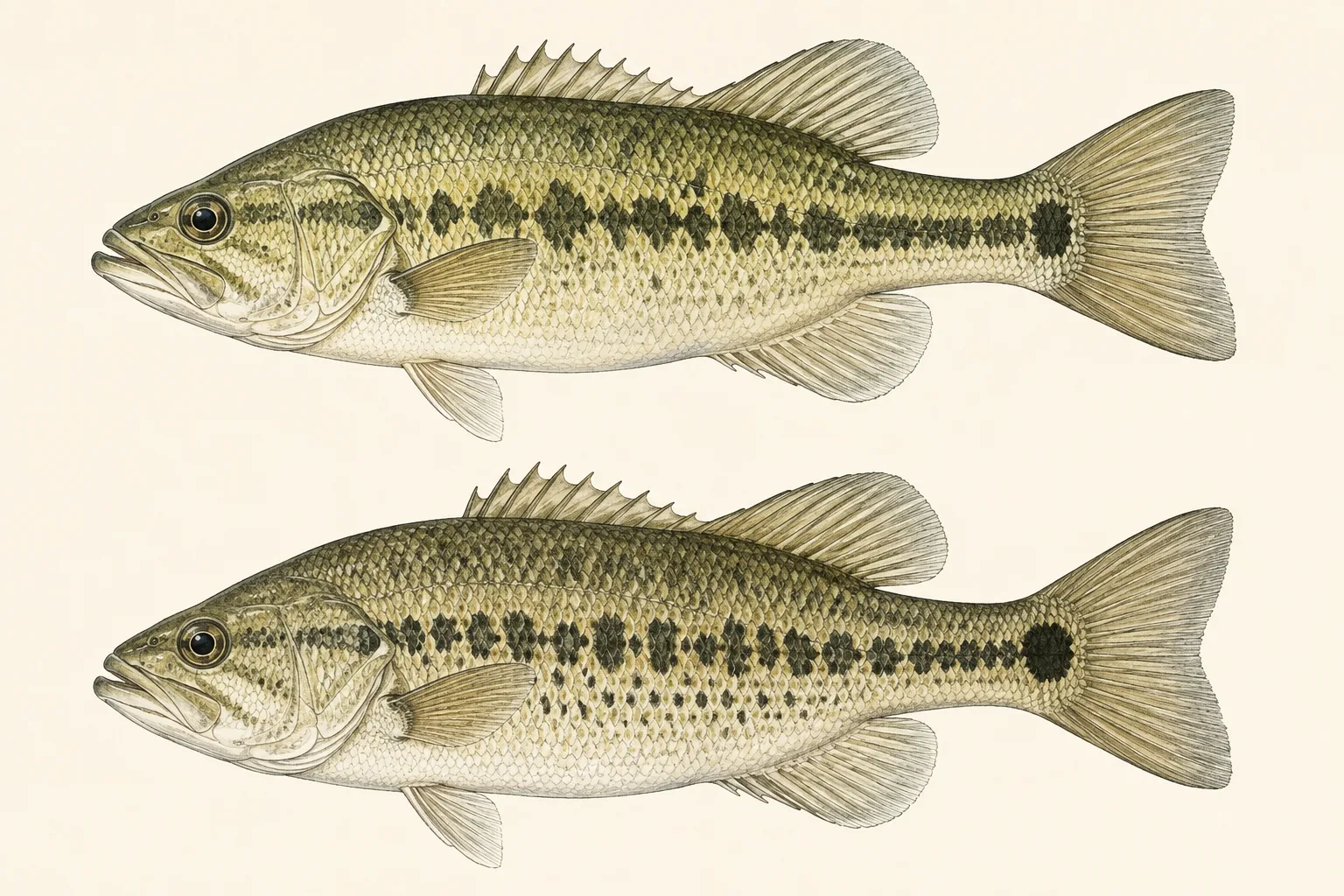
Start with where you are. Outside the Mobile River basin an Alabama bass is almost always an introduced fish, and inside it a spotted bass is the unlikely one. On the fish itself, an Alabama bass carries a bolder dark spot at the base of the tail and tighter, more broken flank blotching.
Last updated
Side by side
| What to look at | Spotted Bass | Alabama Bass |
|---|---|---|
| Scientific name | Micropterus punctulatus | Micropterus henshalli |
| Tongue tooth patch | Present | Present — no help here |
| Upper jaw | Ends level with the rear of the eye | Ends level with the rear of the eye — no help here |
| Tail-base spot | Present but often faint | Larger and more clearly defined |
| Flank blotches | A looser, more connected lateral band | Tighter and more broken |
| Native range | Ohio, Mississippi and Gulf drainages broadly | The Mobile basin of Alabama and Georgia only |
| Scale rows around the tail base | Fewer | More |
Why the difference matters
This is the hardest pair on the site and the one that matters most right now. Alabama bass have been moved into reservoirs across the Southeast, the Carolinas and California, where they hybridise with and displace native smallmouth, redeye and shoal bass. Several states now ask anglers not to release them, or to report captures. If the marks are ambiguous, the water you are standing in is the strongest evidence you have — and a GPS-stamped, timestamped photograph is worth more to a fisheries biologist than a guess.
Size limits, bag limits, slot limits and seasons are set by your state wildlife agency — and for many offshore and migratory species by federal regulators — and on many waters they differ from the statewide rule. They also change between seasons. Check the current regulations for the exact water you are fishing before you keep a fish — we do not republish limits here, because a number that is a season out of date is worse than no number.
Full entries
Each fish has its own page with every field mark, the rest of its look-alikes, where it holds and the conditions it feeds in: Spotted Bass and Alabama Bass.
Or skip the key entirely — photograph the fish and Global Fishing League names the species, returns the scientific name with it, and files the catch with the tide, pressure, water temperature and everything else it came from.