Telling them apart
Atlantic Cod vs Haddock
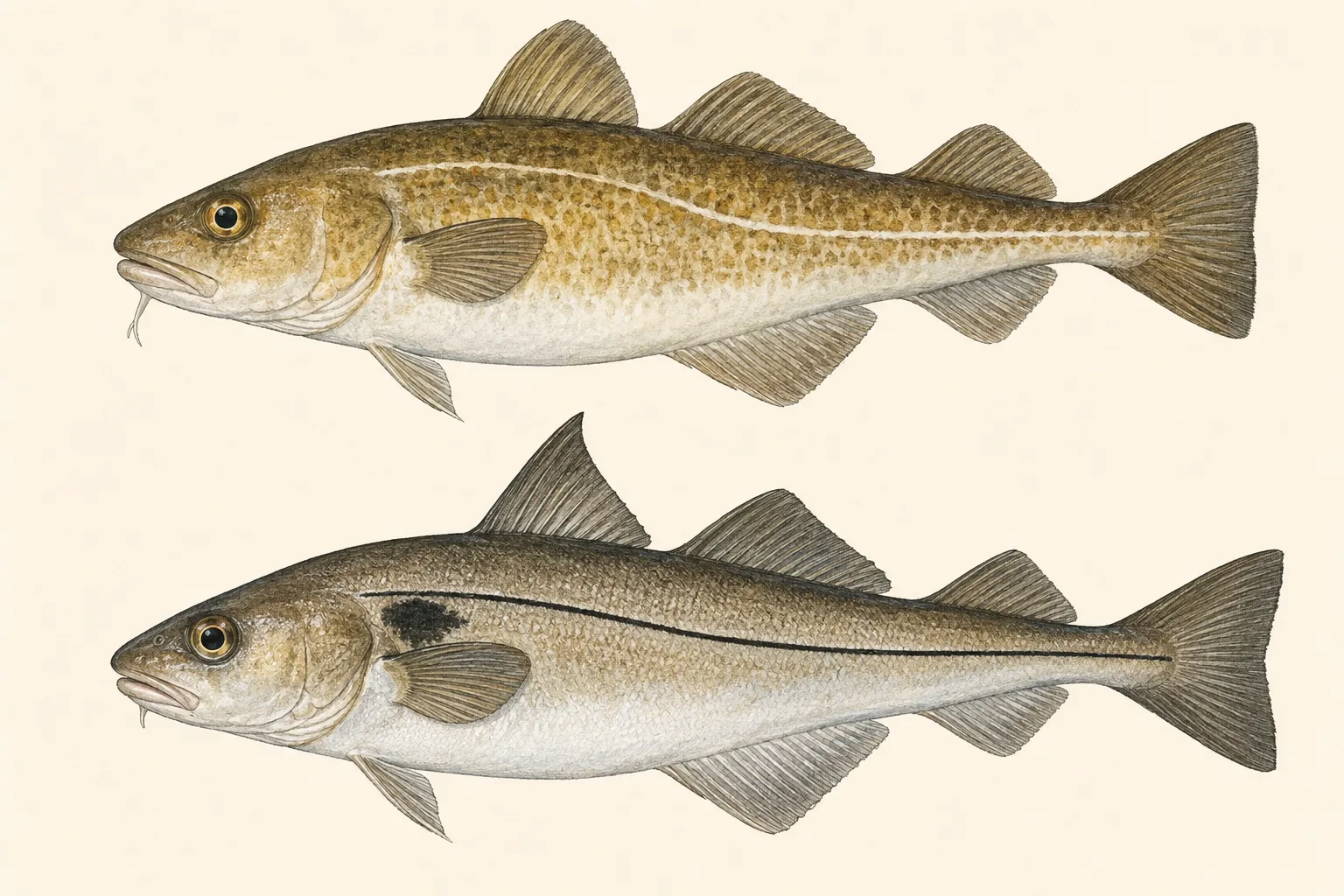
Follow the lateral line. On an Atlantic cod it is pale cream and arches over the pectoral fin. On a haddock it is black, and there is a dark thumbprint blotch on the shoulder above the pectoral.
Last updated
Side by side
| What to look at | Atlantic Cod | Haddock |
|---|---|---|
| Scientific name | Gadus morhua | Melanogrammus aeglefinus |
| Lateral line | Pale cream, clearly arched | Black |
| Shoulder | Plain | A dark thumbprint blotch — St Peter's mark |
| Chin barbel | Prominent | Much smaller |
| First dorsal fin | Rounded | Tall and sharply pointed |
| Where | Rocks, wrecks and broken bottom, often shallower | Gravel and pebble bottom, generally deeper and further out |
| Temperature | About 34 to 50 °F | About 36 to 50 °F |
Why the difference matters
Cod and haddock come over the same rail on the same trip under different limits, different minimum sizes and sometimes different seasons, and in the Gulf of Maine cod regulations have been severe for years while haddock have stayed comparatively open. Check the lateral line before the fish goes in the box, not at the dock.
Size limits, bag limits, slot limits and seasons are set by your state wildlife agency — and for many offshore and migratory species by federal regulators — and on many waters they differ from the statewide rule. They also change between seasons. Check the current regulations for the exact water you are fishing before you keep a fish — we do not republish limits here, because a number that is a season out of date is worse than no number.
Full entries
Each fish has its own page with every field mark, the rest of its look-alikes, where it holds and the conditions it feeds in: Atlantic Cod and Haddock.
Or skip the key entirely — photograph the fish and Global Fishing League names the species, returns the scientific name with it, and files the catch with the tide, pressure, water temperature and everything else it came from.