Telling them apart
Atlantic Cod vs Pollock
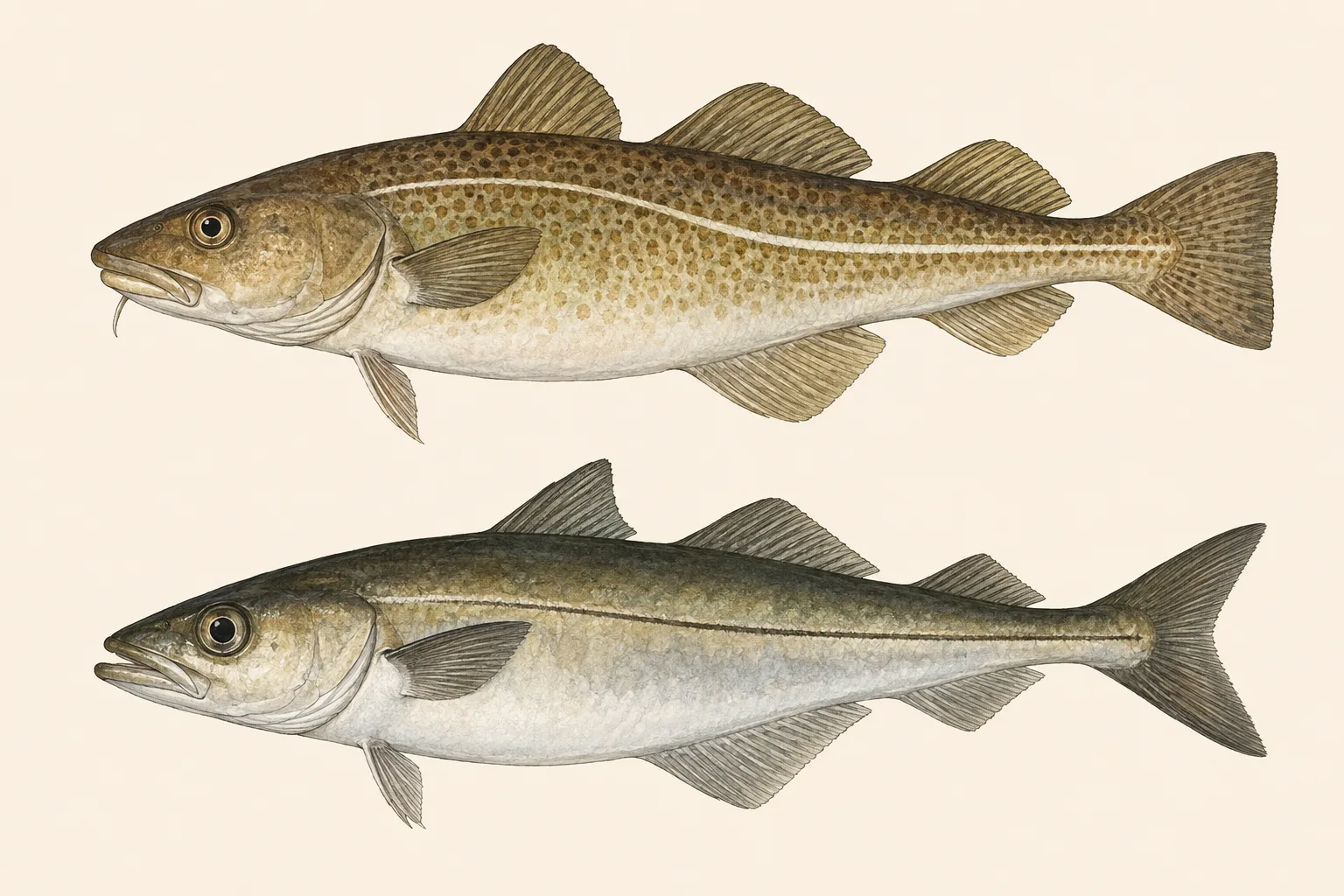
Look at the jaw. A pollock's lower jaw juts out past the upper; a cod's upper jaw overhangs. The lateral line confirms it — pale and arched on a cod, dark and nearly straight on a pollock.
Last updated
Side by side
| What to look at | Atlantic Cod | Pollock |
|---|---|---|
| Scientific name | Gadus morhua | Pollachius virens |
| Lower jaw | Overhung by the upper | Projects past the upper |
| Lateral line | Pale cream, clearly arched | Dark, nearly straight |
| Chin barbel | Prominent | Tiny or absent |
| Colour | Mottled brown, olive or reddish | Dark olive-green back, silvery belly |
| Tail | Squared to slightly forked | Distinctly forked |
| Feeding | Hard on the bottom | Up in the water column |
Why the difference matters
They share the same wrecks and rips under very different limits, and in the Gulf of Maine cod rules have been severe for years while pollock have stayed open. The behavioural difference is just as useful: a fish that hit halfway down was almost certainly a pollock, because cod rarely leave the bottom to take it.
Size limits, bag limits, slot limits and seasons are set by your state wildlife agency — and for many offshore and migratory species by federal regulators — and on many waters they differ from the statewide rule. They also change between seasons. Check the current regulations for the exact water you are fishing before you keep a fish — we do not republish limits here, because a number that is a season out of date is worse than no number.
Full entries
Each fish has its own page with every field mark, the rest of its look-alikes, where it holds and the conditions it feeds in: Atlantic Cod and Pollock.
Or skip the key entirely — photograph the fish and Global Fishing League names the species, returns the scientific name with it, and files the catch with the tide, pressure, water temperature and everything else it came from.