Telling them apart
Barred Surfperch vs Redtail Surfperch
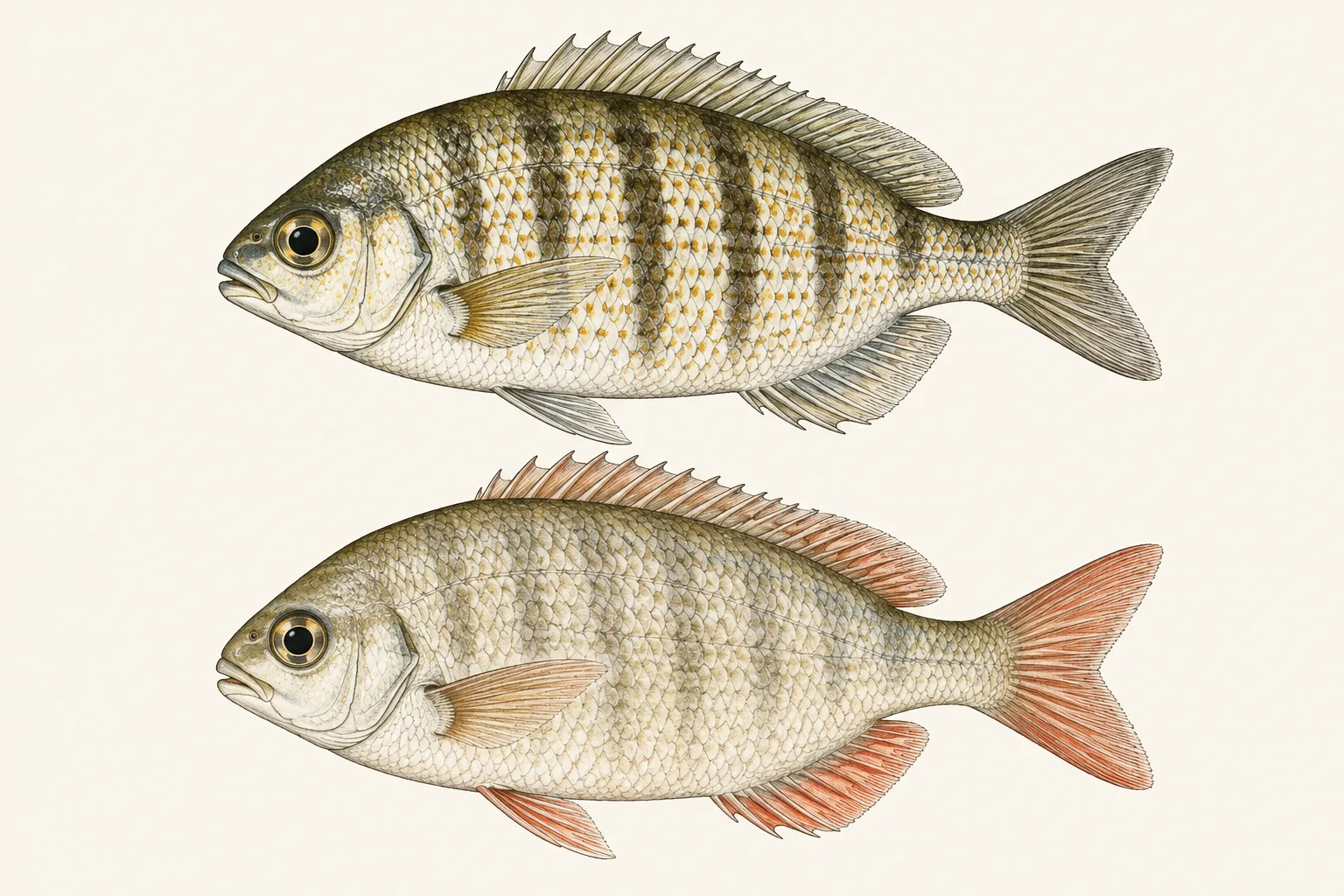
Look at the fins and the bars. A redtail surfperch has reddish fins and a red-tinged tail with softer, fainter bars. A barred surfperch has clean, sharply defined olive-brown bars with bronze spotting between them and no red in the fins.
Last updated
Side by side
| What to look at | Barred Surfperch | Redtail Surfperch |
|---|---|---|
| Scientific name | Amphistichus argenteus | Amphistichus rhodoterus |
| Fins | No red tinge | Reddish, with a red-tinged tail |
| Bars | Clean and sharply defined | Fainter and softer |
| Between the bars | Bronze-gold spotting | Little or no spotting |
| Range | Bodega Bay south into Baja | Central California north to Vancouver Island |
| Temperature | About 55 to 65 °F | About 48 to 60 °F |
Why the difference matters
Range does most of the work, with the overlap sitting around central California. Both are managed under surfperch rules that in places close the spring spawning season, and both are live-bearers, so a hooked female in spring is carrying young — a reason to know which fish you have and to handle it accordingly.
Size limits, bag limits, slot limits and seasons are set by your state wildlife agency — and for many offshore and migratory species by federal regulators — and on many waters they differ from the statewide rule. They also change between seasons. Check the current regulations for the exact water you are fishing before you keep a fish — we do not republish limits here, because a number that is a season out of date is worse than no number.
Full entries
Each fish has its own page with every field mark, the rest of its look-alikes, where it holds and the conditions it feeds in: Barred Surfperch and Redtail Surfperch.
Or skip the key entirely — photograph the fish and Global Fishing League names the species, returns the scientific name with it, and files the catch with the tide, pressure, water temperature and everything else it came from.