Redtail Surfperch
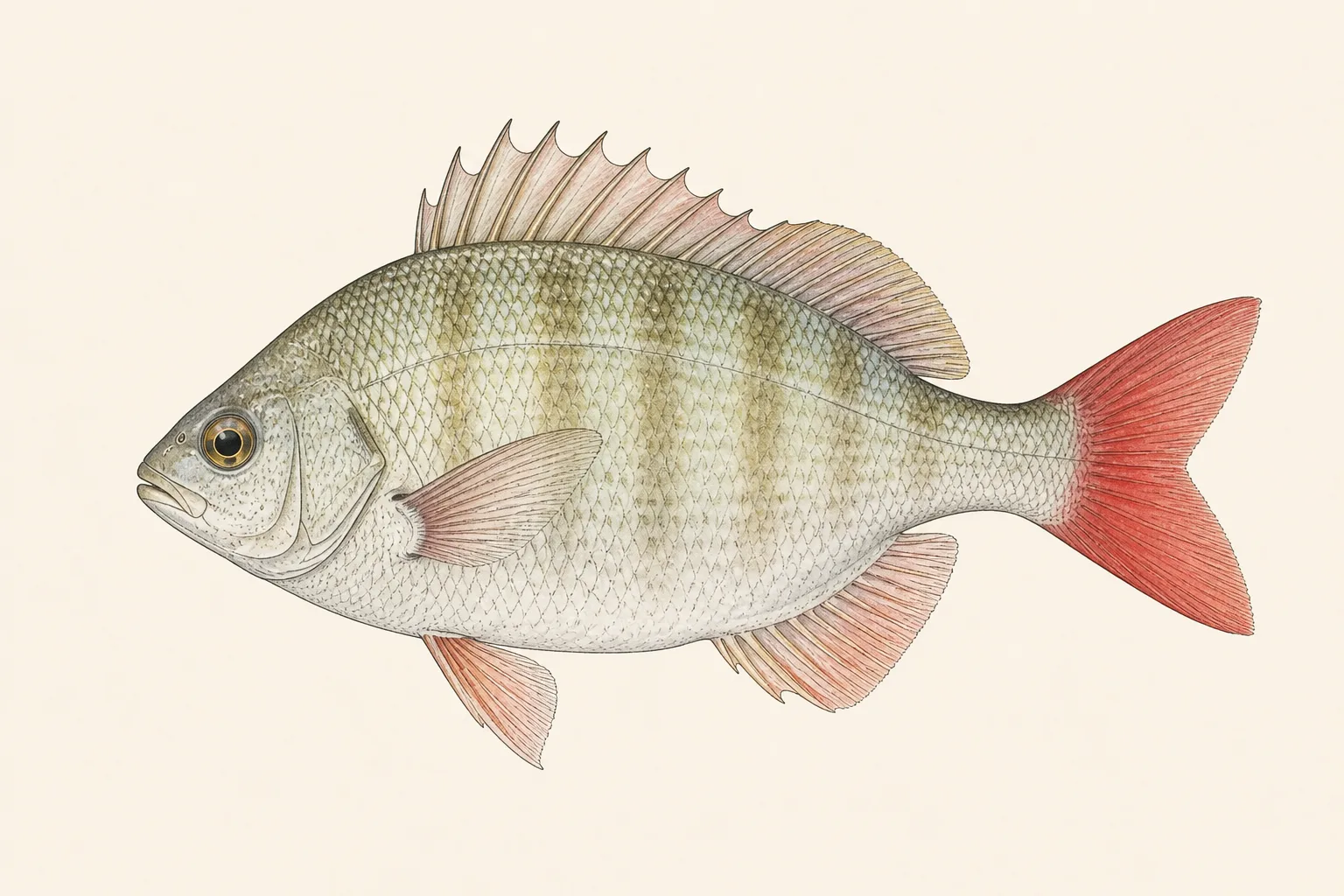
Redtail Surfperch (Amphistichus rhodoterus) is a saltwater species. The first thing to check: reddish to rose-tinged fins, and a distinctly red tail — the mark the fish is named for. The look-alike to rule out is Barred Surfperch: barred surfperch have clean, sharply defined olive-brown bars with bronze spotting between them, and their fins are not red-tinged.
Last updated
| Scientific name | Amphistichus rhodoterus |
|---|---|
| Also called | redtail, porgie |
| Water | Saltwater |
| Group | Surfperch |
| Temperature | Common between about 48 and 60 °F, cooler than a barred surfperch. |
How to identify a Redtail Surfperch
- Reddish to rose-tinged fins, and a distinctly red tail — the mark the fish is named for.
- Faint olive vertical bars on a silver flank, less crisp and less contrasty than a barred surfperch's.
- A deep compressed body with a small mouth, and the spiny dorsal noticeably taller than the soft portion.
If you would rather not work through a key on a wet deck, photograph the fish and let the app name it — you get the common and the scientific name back, and the record is filed before you release.
Fish it is mistaken for
| Species | How to tell them apart |
|---|---|
| Barred Surfperch | Barred surfperch have clean, sharply defined olive-brown bars with bronze spotting between them, and their fins are not red-tinged. |
| Calico Surfperch | Calico are mottled and blotched rather than barred, and hold closer to rock than open sand. |
Side-by-side comparisons
Read the full entry for Barred Surfperch.
Where it lives
The Pacific surf zone from central California north to Vancouver Island — the northern counterpart to the barred surfperch, on open sand beaches and in the mouths of coastal rivers.
Temperature
Common between about 48 and 60 °F, cooler than a barred surfperch.
The conditions that matter
Redtail hold in the trough and the rip channels exactly as barred surfperch do, but on colder northern beaches, and the spring spawning run into the shallows is the fishery. Swell shapes the trough, so the same beach fishes completely differently after a big swell moves the sand — swell height and tide stage per catch are the two readings that make sense of it.
Global Fishing League records 18 weather and water readings against every catch automatically — tide stage, barometric pressure, water temperature, salinity, dissolved oxygen, chlorophyll, swell, current, moon phase and more, taken at your GPS position at the moment you log the fish. Over a season that turns a hunch about redtail surfperch into a pattern you can read.
See every reading recorded with a catch, or the guides to what each reading means.
Size limits, bag limits and seasons
Size limits, bag limits, slot limits and seasons are set by your state wildlife agency — and for many offshore and migratory species by federal regulators — and on many waters they differ from the statewide rule. They also change between seasons. Check the current regulations for the exact water you are fishing before you keep a fish — we do not republish limits here, because a number that is a season out of date is worse than no number.
What the app does do is make your side of it accurate: every catch carries a length measured from the photograph, a GPS position and a timestamp, exportable if you ever need to show your work for a tournament or a record claim. It is also what a Global Fishing League entry is built from — a record that verifies itself, without publishing where you caught the fish.