Telling them apart
Black Crappie vs White Crappie
Count the spines in the front dorsal fin. Seven or eight means black crappie; five or six means white crappie. The pattern confirms it — black crappie are speckled irregularly, white crappie carry faint vertical bars.
Last updated
Identification diagram: where to look
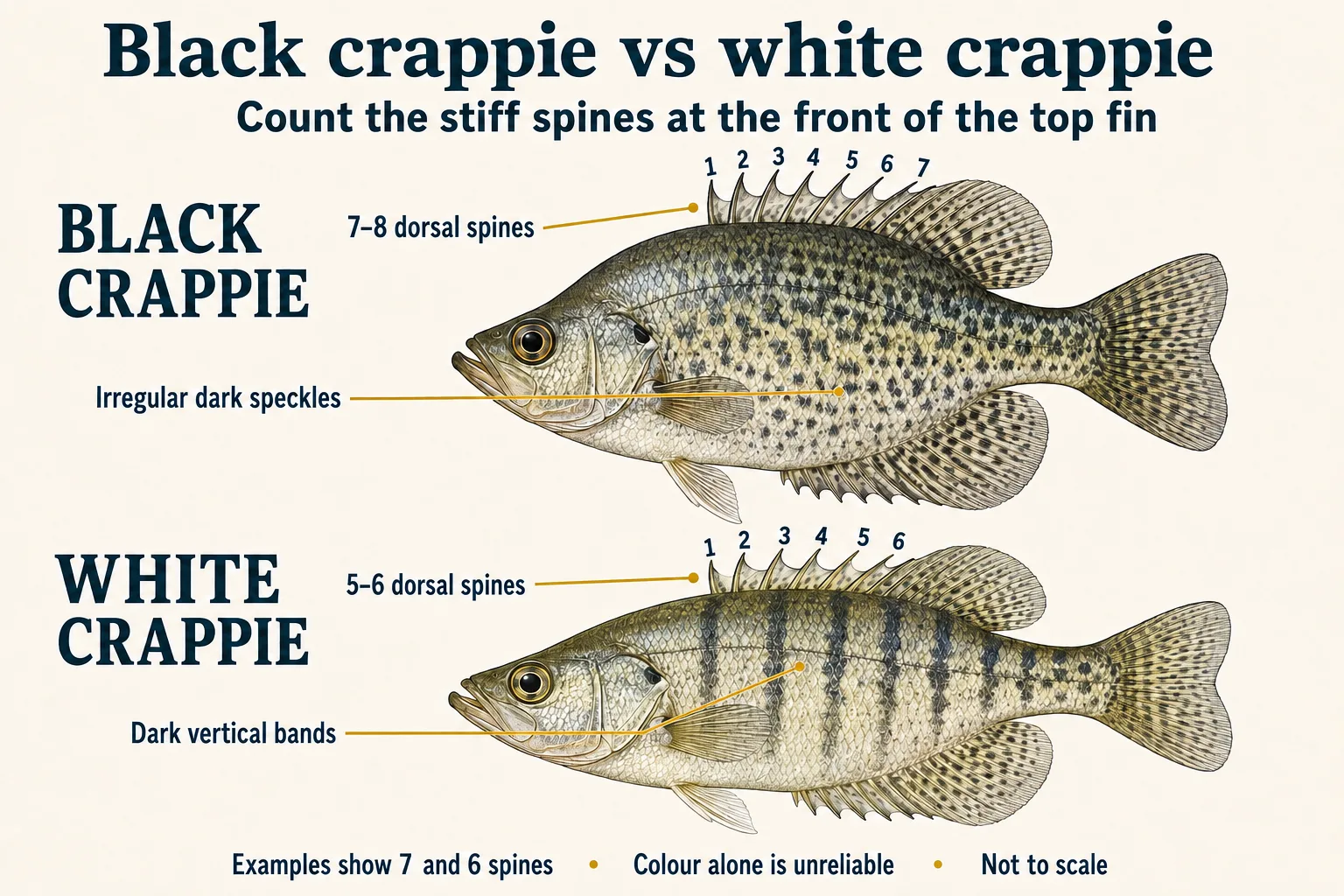
- Top fin — count only the stiff front spines. Start at the front of the dorsal fin, nearest the head. Count the individual stiff, unbranched spines: 7–8 for black crappie and 5–6 for white crappie. Do not include the soft rays in the rounded rear section.
- Side of the body — check how the dark marks are arranged. Black crappie have scattered speckles and blotches; white crappie have vertical bands. Both can darken during spawning, so use the spine count rather than overall darkness.
Illustrated field marks checked on against Texas Parks & Wildlife: illustrated crappie identification guide (PDF). Original illustrations; typical features shown, not to scale.
Side by side
| What to look at | Black Crappie | White Crappie |
|---|---|---|
| Scientific name | Pomoxis nigromaculatus | Pomoxis annularis |
| Dorsal spines | Seven or eight | Five or six |
| Pattern | Dark speckling scattered irregularly | Seven to nine faint vertical bars |
| Body | Deep, almost round | Slightly longer and shallower |
| Dorsal fin base | About as long as the distance from the dorsal origin to the eye | Noticeably shorter than that distance |
| Water | Clearer, weedier lakes and reservoirs | Tolerates turbid, silty, stained water |
| Spawn temperature | 58 to 65 °F | 60 to 65 °F |
Why the difference matters
Some states set a combined crappie limit and some separate the two, and a few apply a minimum length to one and not the other. Practically, which species dominates tells you what kind of water you are on: white crappie take over as clarity drops, which is why they keep biting after heavy rain when the black crappie bite falls away.
Size limits, bag limits, slot limits and seasons are set by your state wildlife agency — and for many offshore and migratory species by federal regulators — and on many waters they differ from the statewide rule. They also change between seasons. Check the current regulations for the exact water you are fishing before you keep a fish — we do not republish limits here, because a number that is a season out of date is worse than no number.
Full entries
Each fish has its own page with every field mark, the rest of its look-alikes, where it holds and the conditions it feeds in: Black Crappie and White Crappie.
Or skip the key entirely — photograph the fish and Global Fishing League names the species, returns the scientific name with it, and files the catch with the tide, pressure, water temperature and everything else it came from.