White Crappie
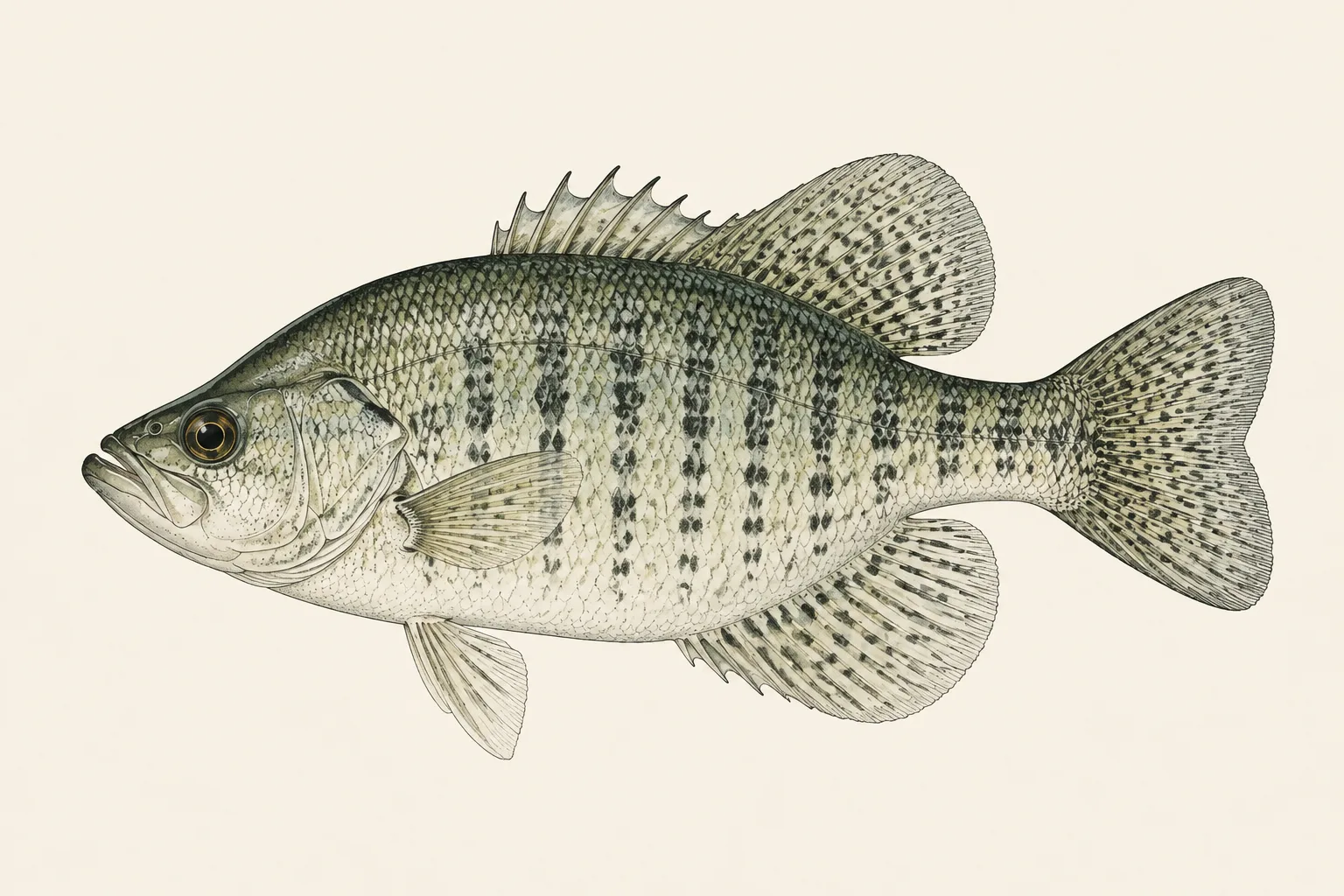
White Crappie (Pomoxis annularis) is a freshwater species. The first thing to check: five or six dorsal spines — one or two fewer than a black crappie, and the reliable mark. The look-alike to rule out is Black Crappie: black crappie have seven or eight dorsal spines and scattered speckling instead of vertical bars.
Last updated
| Scientific name | Pomoxis annularis |
|---|---|
| Also called | papermouth, sac-a-lait |
| Water | Freshwater |
| Group | Crappie |
| Temperature | Spawns at 60 to 65 °F; feeds through a broad band from the low 50s to the high 70s. |
How to identify a White Crappie
- Five or six dorsal spines — one or two fewer than a black crappie, and the reliable mark.
- Dark markings organised into seven to nine faint vertical bars down the flank.
- A slightly longer, shallower body than a black crappie, and a dorsal fin base noticeably shorter than the distance from the dorsal origin to the eye.
Photograph the fish and the app will name it, though it returns this species as Crappie rather than White Crappie — the same fish under the label the app uses.
Fish it is mistaken for
| Species | How to tell them apart |
|---|---|
| Black Crappie | Black crappie have seven or eight dorsal spines and scattered speckling instead of vertical bars. |
Side-by-side comparisons
Read the full entry for Black Crappie.
Where it lives
More tolerant of turbid, silty water than black crappie, so it dominates in muddy reservoirs, river systems and flood-control lakes through the central and southern United States.
Temperature
Spawns at 60 to 65 °F; feeds through a broad band from the low 50s to the high 70s.
The conditions that matter
White crappie tolerate stained water, so the bite holds up after rain when clarity drops and other species go quiet. Water temperature drives the spawn timing; wind-blown banks concentrate the bait they follow.
Global Fishing League records 18 weather and water readings against every catch automatically — tide stage, barometric pressure, water temperature, salinity, dissolved oxygen, chlorophyll, swell, current, moon phase and more, taken at your GPS position at the moment you log the fish. Over a season that turns a hunch about white crappie into a pattern you can read.
See every reading recorded with a catch, or the guides to what each reading means.
Size limits, bag limits and seasons
Size limits, bag limits, slot limits and seasons are set by your state wildlife agency — and for many offshore and migratory species by federal regulators — and on many waters they differ from the statewide rule. They also change between seasons. Check the current regulations for the exact water you are fishing before you keep a fish — we do not republish limits here, because a number that is a season out of date is worse than no number.
What the app does do is make your side of it accurate: every catch carries a length measured from the photograph, a GPS position and a timestamp, exportable if you ever need to show your work for a tournament or a record claim. It is also what a Global Fishing League entry is built from — a record that verifies itself, without publishing where you caught the fish.