Telling them apart
Brook Trout vs Brown Trout
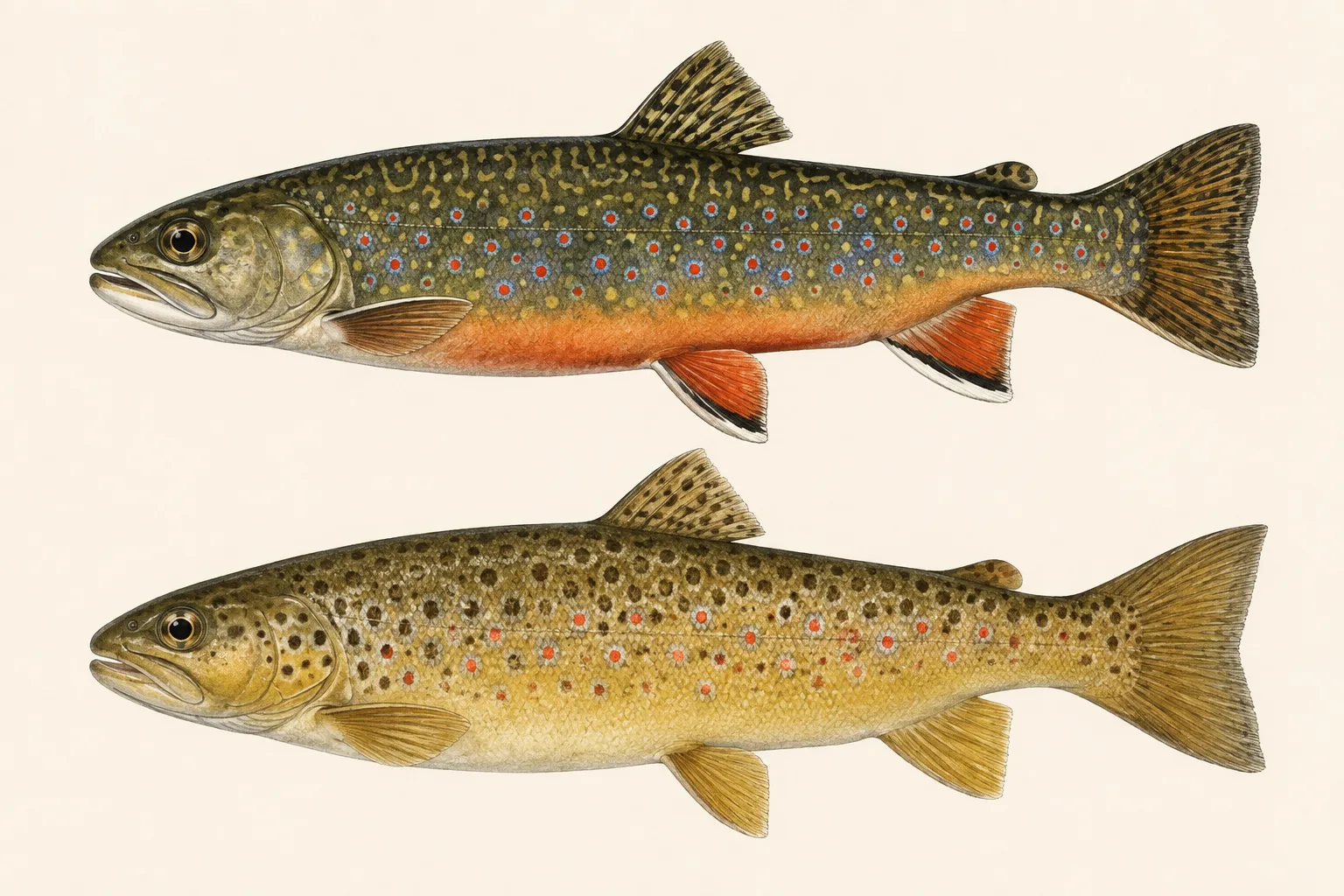
Look at the back and the lower fins. A brook trout has pale worm-like vermiculation across a dark back and crisp white leading edges backed by black on the lower fins. A brown trout has dark and red spots on a gold-brown body and no fin edging.
Last updated
Side by side
| What to look at | Brook Trout | Brown Trout |
|---|---|---|
| Scientific name | Salvelinus fontinalis | Salmo trutta |
| Back | Pale wavy vermiculation on dark green | Plain gold-brown, spotted |
| Spots | Red spots ringed with blue halos | Black and rust-red spots, many with pale halos |
| Lower fins | White leading edge backed by a black line | No white edging |
| Tail | Squared | Squared to slightly forked |
| Family | A char, not a true trout | A true trout, introduced from Europe |
| Temperature | Optimal 52 to 61 °F; stressed above 68 °F | Optimal 54 to 67 °F; tolerates warmer water |
Why the difference matters
Brook trout are native across their eastern range and often carry protective regulations, reduced bags or wild-trout water designations that browns do not. Temperature is the other reason to know which you have: brook trout abandon reaches that warm past the high 60s and stack at cold seeps, so a brookie tells you that you have found colder water than the reach around it.
Size limits, bag limits, slot limits and seasons are set by your state wildlife agency — and for many offshore and migratory species by federal regulators — and on many waters they differ from the statewide rule. They also change between seasons. Check the current regulations for the exact water you are fishing before you keep a fish — we do not republish limits here, because a number that is a season out of date is worse than no number.
Full entries
Each fish has its own page with every field mark, the rest of its look-alikes, where it holds and the conditions it feeds in: Brook Trout and Brown Trout.
Or skip the key entirely — photograph the fish and Global Fishing League names the species, returns the scientific name with it, and files the catch with the tide, pressure, water temperature and everything else it came from.