Brown Trout
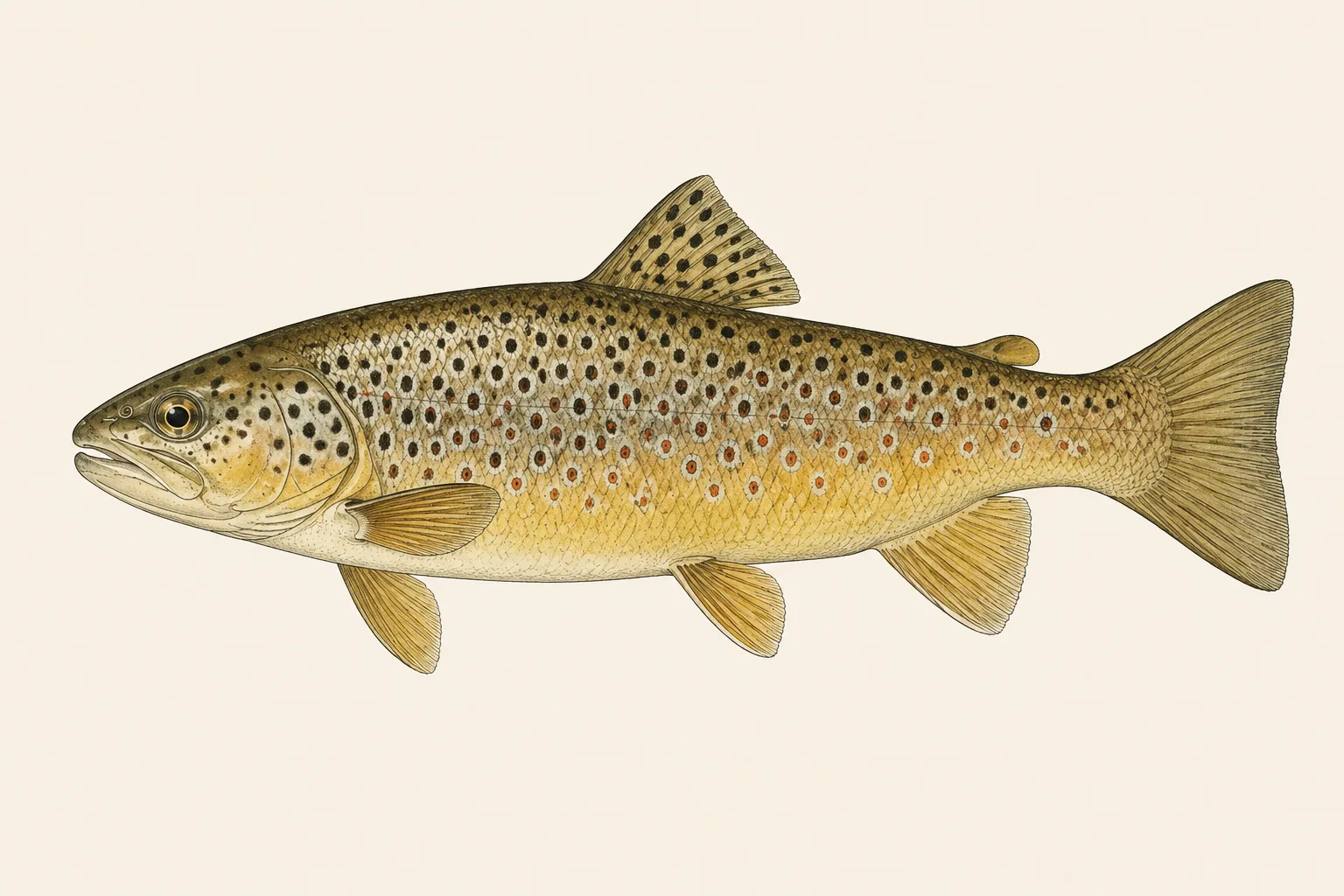
Brown Trout (Salmo trutta) is a freshwater and saltwater species. The first thing to check: black and rust-red spots, many ringed with pale halos, scattered over a buttery gold-brown flank. The look-alike to rule out is Rainbow Trout: rainbows have a heavily spotted tail and a pink lateral stripe; browns have a clean tail and no stripe.
Last updated
| Scientific name | Salmo trutta |
|---|---|
| Also called | brownie, German brown, sea trout |
| Water | Freshwater and saltwater |
| Group | Trout |
| Temperature | Optimal between 54 and 67 °F, tolerating warmer water than brook trout and cooler than most warmwater fish. |
How to identify a Brown Trout
- Black and rust-red spots, many ringed with pale halos, scattered over a buttery gold-brown flank.
- Few or no spots on the tail fin — the reliable separation from a rainbow.
- A squared to slightly forked tail and no white leading edges on the lower fins.
If you would rather not work through a key on a wet deck, photograph the fish and let the app name it — you get the common and the scientific name back, and the record is filed before you release.
Fish it is mistaken for
| Species | How to tell them apart |
|---|---|
| Rainbow Trout | Rainbows have a heavily spotted tail and a pink lateral stripe; browns have a clean tail and no stripe. |
| Atlantic Salmon | Salmon have a narrower tail base you can grip, spots mostly above the lateral line, and no red spotting. |
Side-by-side comparisons
Read the full entry for Rainbow Trout and Atlantic Salmon.
Where it lives
Introduced from Europe and now established across North America in rivers, spring creeks, tailwaters and lakes. Sea-run populations enter estuaries and salt water in parts of the range.
Temperature
Optimal between 54 and 67 °F, tolerating warmer water than brook trout and cooler than most warmwater fish.
The conditions that matter
Large brown trout are strongly nocturnal and strongly low-light, and the biggest fish in a river are disproportionately caught at night, at dawn, and under heavy cloud on rising water. Time of capture, cloud cover and water temperature logged together separate the small-fish pattern from the big-fish one.
Global Fishing League records 18 weather and water readings against every catch automatically — tide stage, barometric pressure, water temperature, salinity, dissolved oxygen, chlorophyll, swell, current, moon phase and more, taken at your GPS position at the moment you log the fish. Over a season that turns a hunch about brown trout into a pattern you can read.
See every reading recorded with a catch, or the guides to what each reading means.
Size limits, bag limits and seasons
Size limits, bag limits, slot limits and seasons are set by your state wildlife agency — and for many offshore and migratory species by federal regulators — and on many waters they differ from the statewide rule. They also change between seasons. Check the current regulations for the exact water you are fishing before you keep a fish — we do not republish limits here, because a number that is a season out of date is worse than no number.
What the app does do is make your side of it accurate: every catch carries a length measured from the photograph, a GPS position and a timestamp, exportable if you ever need to show your work for a tournament or a record claim. It is also what a Global Fishing League entry is built from — a record that verifies itself, without publishing where you caught the fish.