Burbot
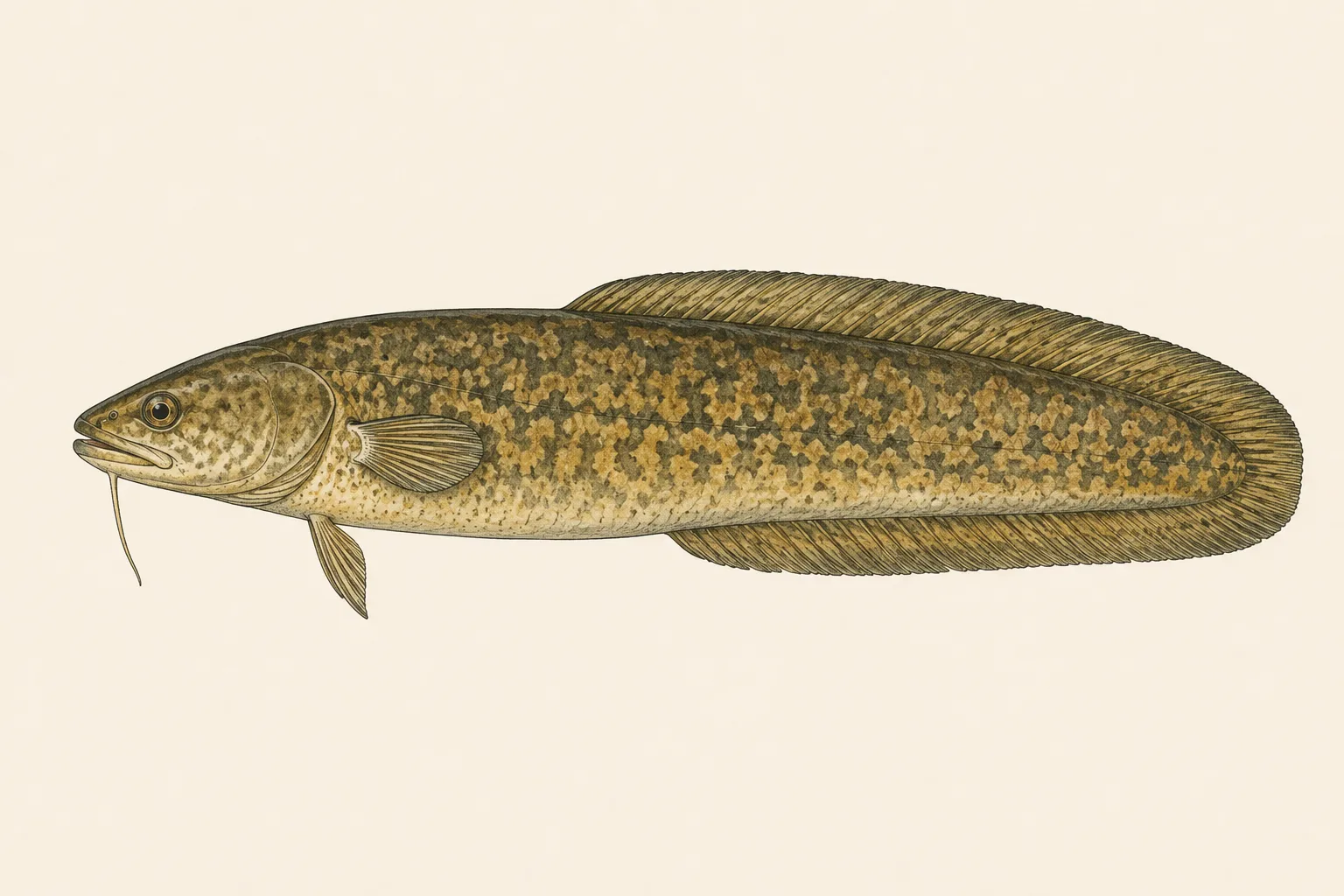
Burbot (Lota lota) is a freshwater species. The first thing to check: a single long barbel hanging from the centre of the chin — the only freshwater fish in North America with one. The look-alike to rule out is Bowfin: bowfin have a bony gular plate between the halves of the lower jaw, a short anal fin, and no chin barbel at all.
Last updated
| Scientific name | Lota lota |
|---|---|
| Also called | eelpout, lawyer, ling, freshwater cod |
| Water | Freshwater |
| Group | Cod |
| Temperature | Spawns under the ice at 33 to 39 °F and feeds best below about 50 °F. |
How to identify a Burbot
- A single long barbel hanging from the centre of the chin — the only freshwater fish in North America with one.
- A long, eel-like rear body with a very long second dorsal fin and a long anal fin, both running back to a rounded tail.
- Mottled yellow-brown to olive marbling over a slippery, almost scaleless-looking skin.
If you would rather not work through a key on a wet deck, photograph the fish and let the app name it — you get the common and the scientific name back, and the record is filed before you release.
Fish it is mistaken for
| Species | How to tell them apart |
|---|---|
| Bowfin | Bowfin have a bony gular plate between the halves of the lower jaw, a short anal fin, and no chin barbel at all. |
| American Eel | Eels have no pelvic fins and a single continuous fin around the tail; a burbot has normal paired fins and a distinct tail. |
Side-by-side comparisons
Read the full entry for Bowfin.
Where it lives
Cold, deep lakes and large rivers across the northern United States, Canada and Alaska — the only freshwater member of the cod family.
Temperature
Spawns under the ice at 33 to 39 °F and feeds best below about 50 °F.
The conditions that matter
Burbot are the reverse of almost everything else in fresh water: they spawn in midwinter under ice and feed hardest at night in the coldest water of the year. The famous fishery is a night bite in January over rock in a frozen lake, which is exactly the pattern a logbook holding water temperature and time of capture makes obvious.
Global Fishing League records 18 weather and water readings against every catch automatically — tide stage, barometric pressure, water temperature, salinity, dissolved oxygen, chlorophyll, swell, current, moon phase and more, taken at your GPS position at the moment you log the fish. Over a season that turns a hunch about burbot into a pattern you can read.
See every reading recorded with a catch, or the guides to what each reading means.
Size limits, bag limits and seasons
Size limits, bag limits, slot limits and seasons are set by your state wildlife agency — and for many offshore and migratory species by federal regulators — and on many waters they differ from the statewide rule. They also change between seasons. Check the current regulations for the exact water you are fishing before you keep a fish — we do not republish limits here, because a number that is a season out of date is worse than no number.
What the app does do is make your side of it accurate: every catch carries a length measured from the photograph, a GPS position and a timestamp, exportable if you ever need to show your work for a tournament or a record claim. It is also what a Global Fishing League entry is built from — a record that verifies itself, without publishing where you caught the fish.