California Halibut
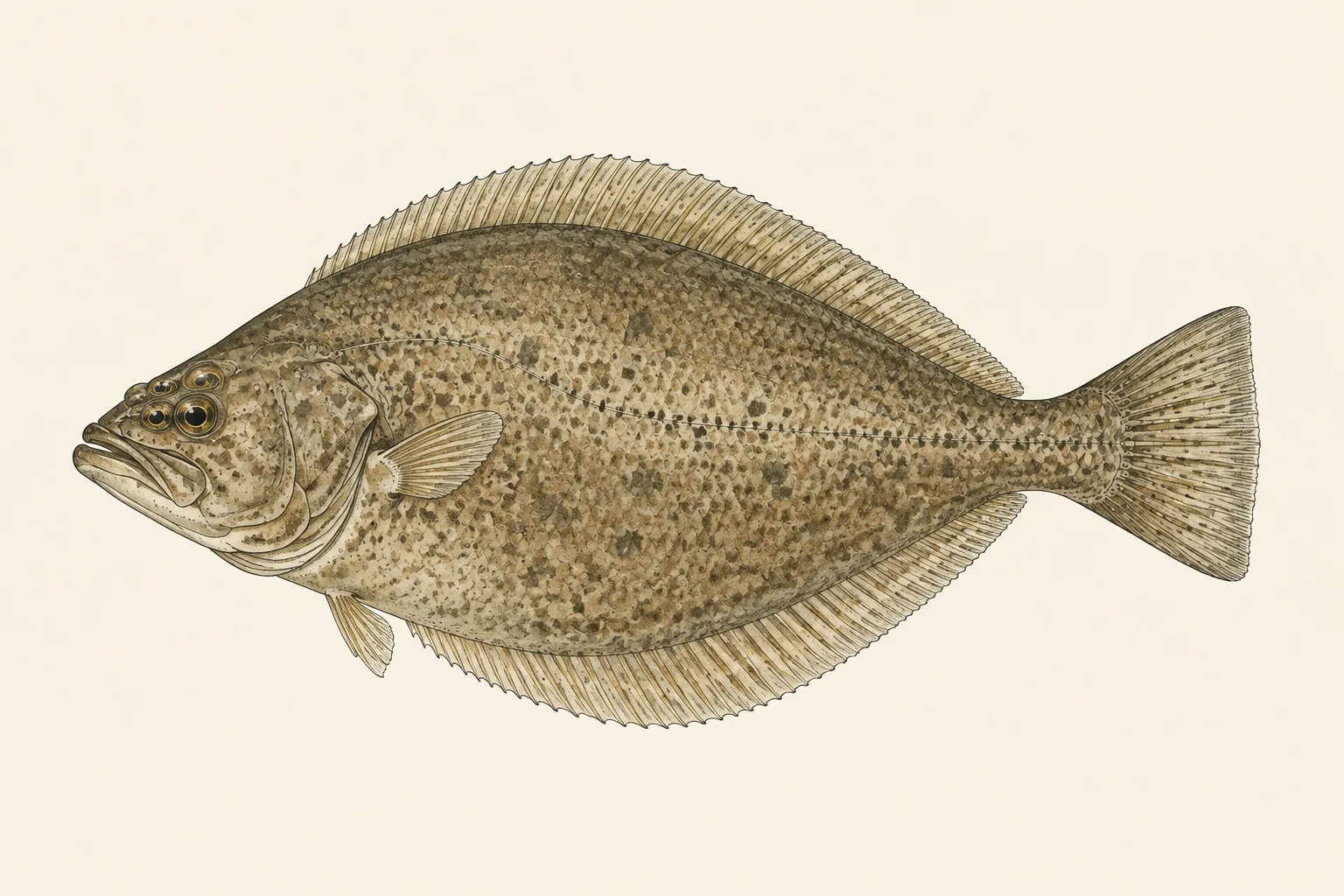
California Halibut (Paralichthys californicus) is a saltwater species. The first thing to check: roughly half of all fish are left-eyed and half right-eyed — unusual among flatfish, and a good clue on its own. The look-alike to rule out is Pacific Halibut: pacific halibut grow far larger, are almost always right-eyed, have a diamond-shaped body and a distinctly forked tail.
Last updated
| Scientific name | Paralichthys californicus |
|---|---|
| Also called | cal hali, flattie |
| Water | Saltwater |
| Group | Flatfish |
| Temperature | Feeds between about 58 and 68 °F. |
How to identify a California Halibut
- Roughly half of all fish are left-eyed and half right-eyed — unusual among flatfish, and a good clue on its own.
- A very large mouth with sharp teeth, the jaw reaching back past the eye.
- A high arch in the lateral line above the pectoral fin.
If you would rather not work through a key on a wet deck, photograph the fish and let the app name it — you get the common and the scientific name back, and the record is filed before you release.
Fish it is mistaken for
| Species | How to tell them apart |
|---|---|
| Pacific Halibut | Pacific halibut grow far larger, are almost always right-eyed, have a diamond-shaped body and a distinctly forked tail. |
| Rock Sole | Sole and sanddabs have small mouths that do not reach past the eye, and no high arch in the lateral line. |
Side-by-side comparisons
Read the full entry for Pacific Halibut.
Where it lives
Sandy bottom from central California to Baja — bays, harbour mouths, beach troughs and the sand edges beside reef and structure.
Temperature
Feeds between about 58 and 68 °F.
The conditions that matter
Halibut bury in sand and ambush upward, so they sit where current sweeps bait across an edge — the lip of a channel, the sand beside a reef, the trough behind a bar. Tide is what turns a spot on, and a drift that works on the flood will often be dead on the ebb.
Global Fishing League records 18 weather and water readings against every catch automatically — tide stage, barometric pressure, water temperature, salinity, dissolved oxygen, chlorophyll, swell, current, moon phase and more, taken at your GPS position at the moment you log the fish. Over a season that turns a hunch about california halibut into a pattern you can read.
See every reading recorded with a catch, or the guides to what each reading means.
Size limits, bag limits and seasons
Size limits, bag limits, slot limits and seasons are set by your state wildlife agency — and for many offshore and migratory species by federal regulators — and on many waters they differ from the statewide rule. They also change between seasons. Check the current regulations for the exact water you are fishing before you keep a fish — we do not republish limits here, because a number that is a season out of date is worse than no number.
What the app does do is make your side of it accurate: every catch carries a length measured from the photograph, a GPS position and a timestamp, exportable if you ever need to show your work for a tournament or a record claim. It is also what a Global Fishing League entry is built from — a record that verifies itself, without publishing where you caught the fish.