
Telling them apart
California Halibut vs Pacific Halibut
Lay the fish belly-down facing you. A Pacific halibut is almost always right-eyed with a forked tail. A California halibut is left-eyed about half the time and has a much larger, toothier mouth and a barely forked tail.
Last updated
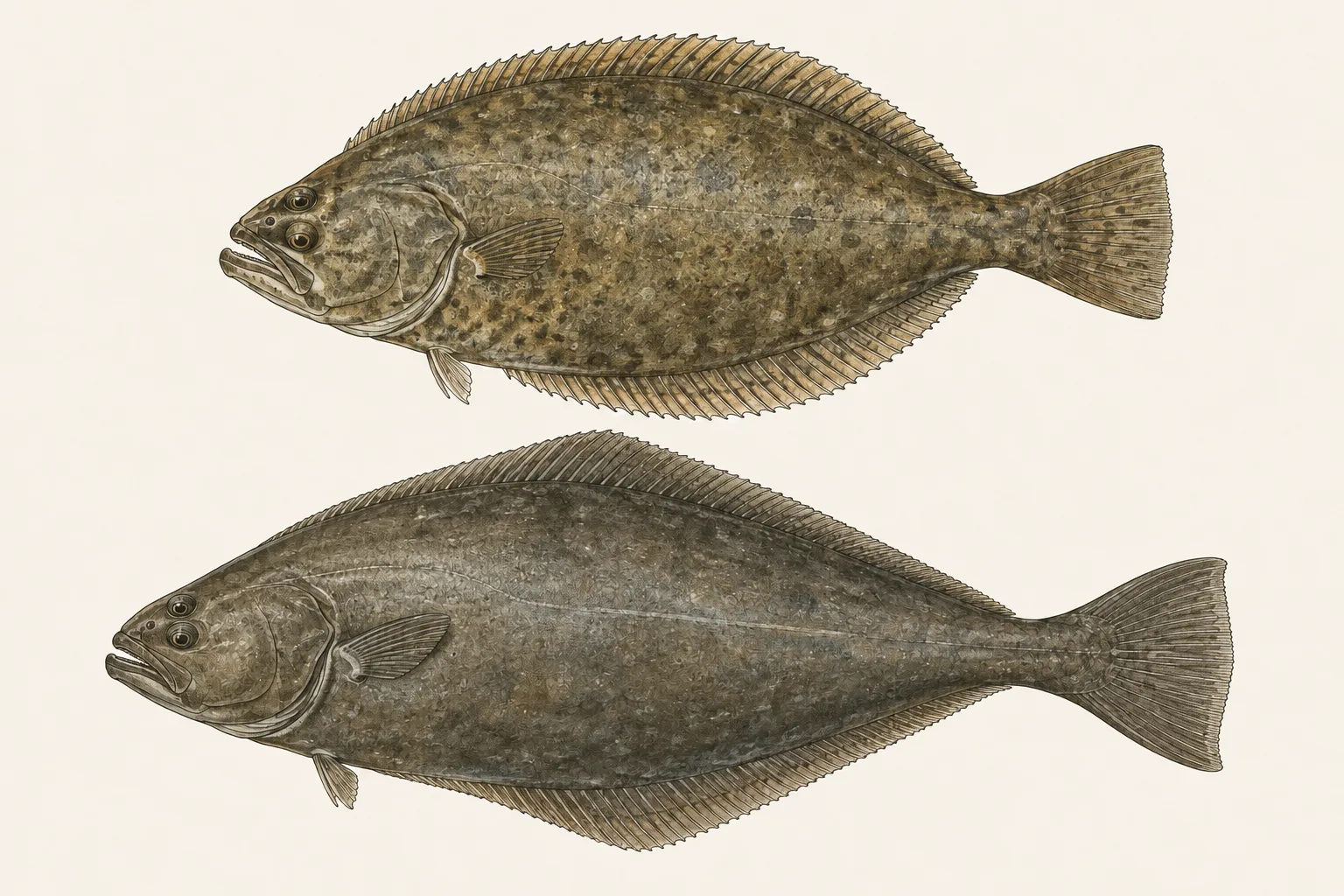
Side by side
| What to look at | California Halibut | Pacific Halibut |
|---|---|---|
| Scientific name | Paralichthys californicus | Hippoglossus stenolepis |
| Eyed side | Left about half the time | Almost always right |
| Mouth | Very large, reaching past the eye | Smaller relative to the head |
| Tail | Barely forked | Distinctly forked, crescent-shaped |
| Body shape | Oval | Diamond-shaped |
| Size | Large | Very much larger |
| Where | Sand in bays, surf and shallow coast | Deep sand, gravel and mud offshore, cold water |
Why the difference matters
Their ranges overlap along the northern California coast, and the two are managed completely separately — Pacific halibut sit under an international quota with season closures and strict catch reporting, while California halibut fall under state rules. Getting it wrong is a serious problem, and the tail shape is visible before the fish is even in the net.
Size limits, bag limits, slot limits and seasons are set by your state wildlife agency — and for many offshore and migratory species by federal regulators — and on many waters they differ from the statewide rule. They also change between seasons. Check the current regulations for the exact water you are fishing before you keep a fish — we do not republish limits here, because a number that is a season out of date is worse than no number.
Full entries
Each fish has its own page with every field mark, the rest of its look-alikes, where it holds and the conditions it feeds in: California Halibut and Pacific Halibut.
Or skip the key entirely — photograph the fish and Global Fishing League names the species, returns the scientific name with it, and files the catch with the tide, pressure, water temperature and everything else it came from.