
Telling them apart
Channel Catfish vs Blue Catfish
Count the rays in the anal fin. A channel catfish has 24 to 29 on a rounded fin; a blue catfish has 30 to 36 on a straight-edged fin. Ignore colour — large channel cats lose their spots and turn slate grey, which is where the mistake comes from.
Last updated
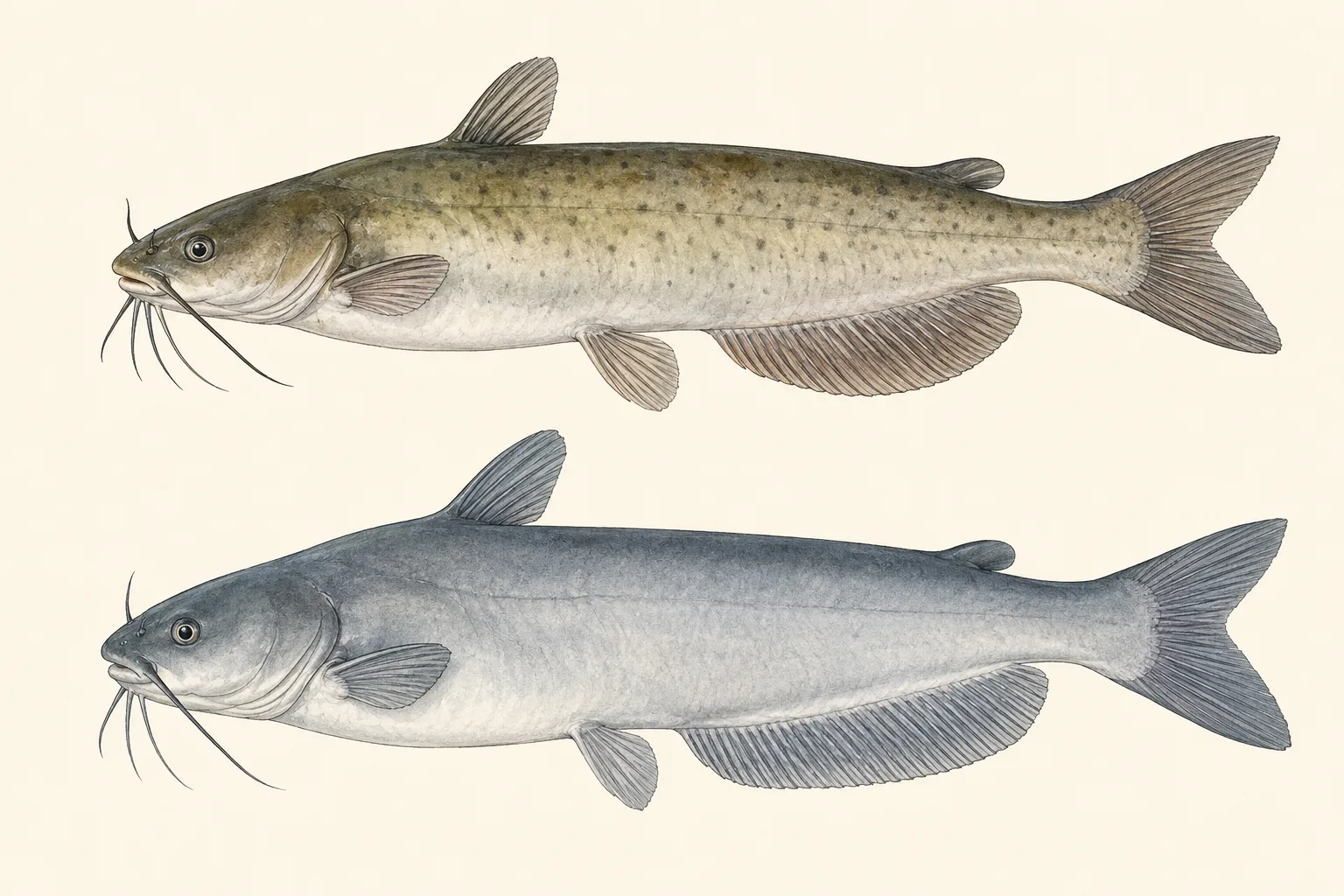
Side by side
| What to look at | Channel Catfish | Blue Catfish |
|---|---|---|
| Scientific name | Ictalurus punctatus | Ictalurus furcatus |
| Anal fin rays | 24 to 29 | 30 to 36 |
| Anal fin shape | Rounded | Straight-edged |
| Spots | Scattered dark spots when young, lost with age | None at any age |
| Colour | Olive to slate, often silvery | Uniform slate blue to silver-grey |
| Back profile | Evenly sloped | Distinctly humped ahead of the dorsal on large fish |
| Cold tolerance | Feeds best 70 to 85 °F | Feeds well from the high 40s up — the winter catfish |
Why the difference matters
Blue catfish grow far larger, and several states cap how many large fish you may keep or protect trophy blues specifically, so the ray count can decide a legal question. It also changes your plan: blue cats stay on the feed through winter and run into brackish tidal water, while channel cats are a warm-water, scent-driven fish that peaks after a summer rain.
Size limits, bag limits, slot limits and seasons are set by your state wildlife agency — and for many offshore and migratory species by federal regulators — and on many waters they differ from the statewide rule. They also change between seasons. Check the current regulations for the exact water you are fishing before you keep a fish — we do not republish limits here, because a number that is a season out of date is worse than no number.
Full entries
Each fish has its own page with every field mark, the rest of its look-alikes, where it holds and the conditions it feeds in: Channel Catfish and Blue Catfish.
Or skip the key entirely — photograph the fish and Global Fishing League names the species, returns the scientific name with it, and files the catch with the tide, pressure, water temperature and everything else it came from.