Telling them apart
Channel Catfish vs Brown Bullhead Catfish
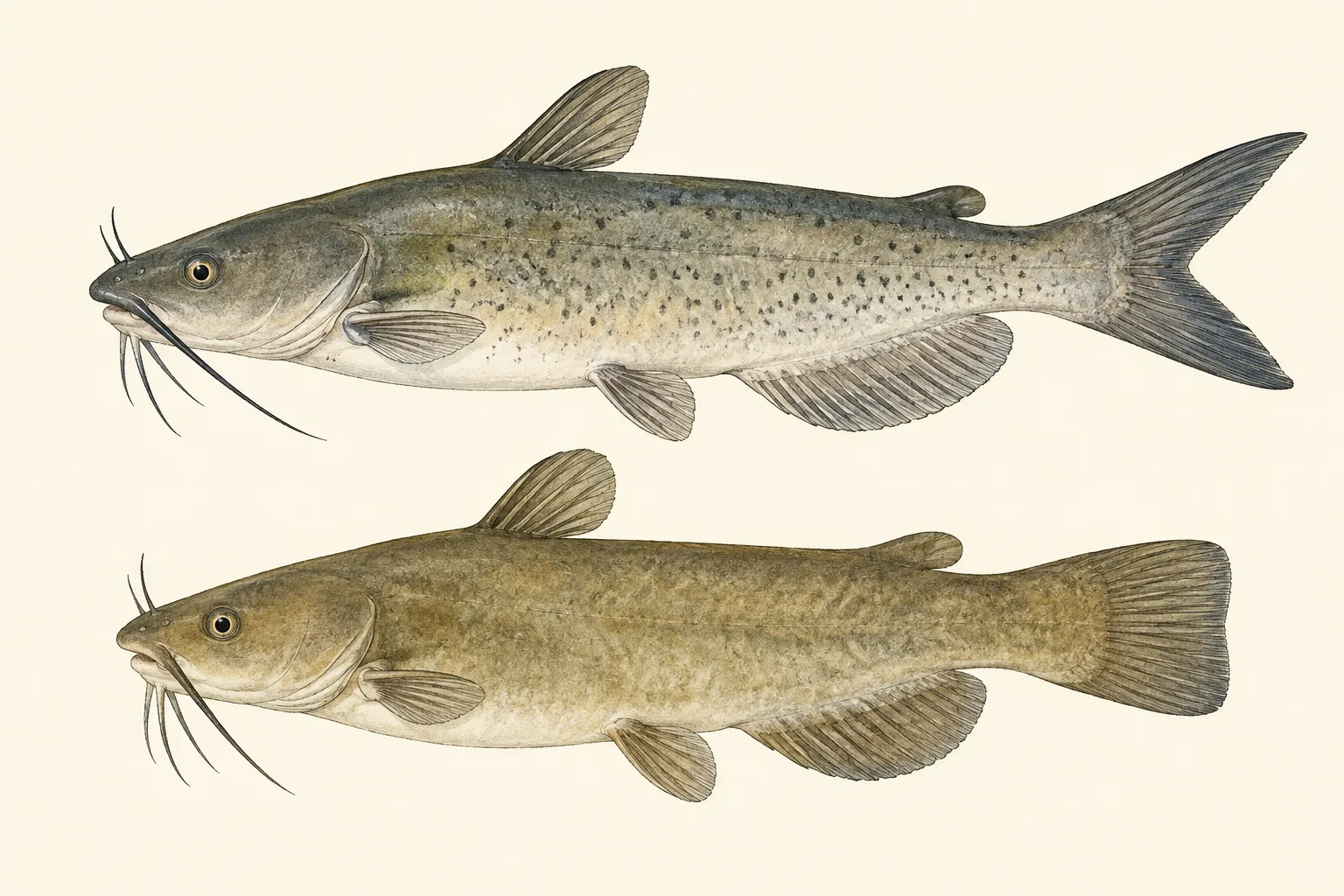
Look at the tail. A channel catfish's is deeply forked; every bullhead's is squared or barely notched. That single mark settles it at any size, whatever the colour of the fish.
Last updated
Side by side
| What to look at | Channel Catfish | Brown Bullhead Catfish |
|---|---|---|
| Scientific name | Ictalurus punctatus | Ameiurus nebulosus |
| Tail | Deeply forked | Squared or slightly notched |
| Adult size | Grows large | Stays small |
| Chin barbels | Dark | Dark — no help here |
| Spots | Scattered dark spots when young | None |
| Anal fin | Rounded, 24 to 29 rays | 21 to 24 rays |
| Water | Rivers, reservoirs and ponds with some flow | Mucky ponds, backwaters and sluggish water |
Why the difference matters
Small channel catfish and large bullheads overlap in size and are constantly confused, and the difference is worth knowing because channel cats carry real limits in many states while bullheads usually do not. The forked tail is visible from across the boat.
Size limits, bag limits, slot limits and seasons are set by your state wildlife agency — and for many offshore and migratory species by federal regulators — and on many waters they differ from the statewide rule. They also change between seasons. Check the current regulations for the exact water you are fishing before you keep a fish — we do not republish limits here, because a number that is a season out of date is worse than no number.
Full entries
Each fish has its own page with every field mark, the rest of its look-alikes, where it holds and the conditions it feeds in: Channel Catfish and Brown Bullhead Catfish.
Or skip the key entirely — photograph the fish and Global Fishing League names the species, returns the scientific name with it, and files the catch with the tide, pressure, water temperature and everything else it came from.