Crappie
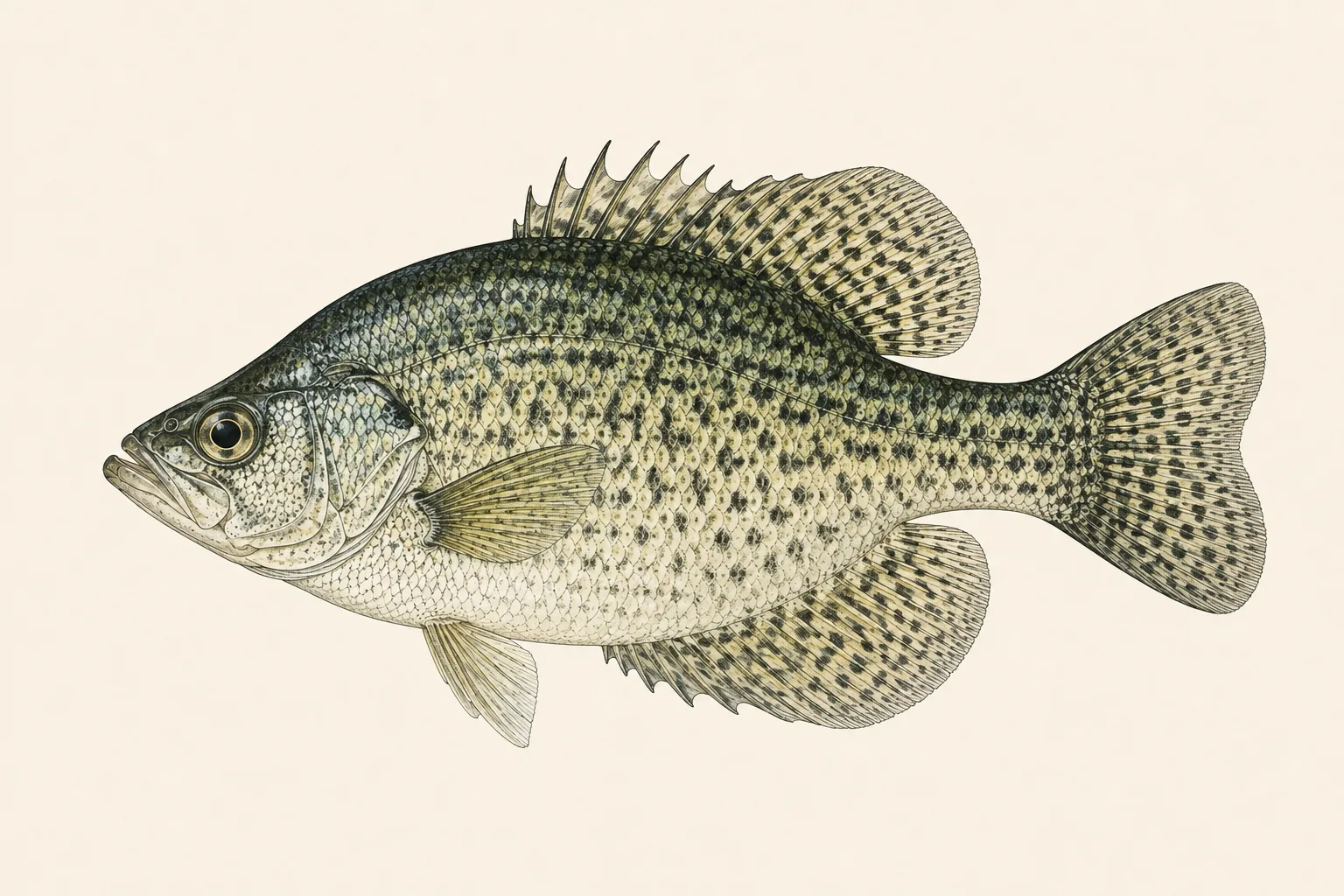
Two species share the name crappie: black crappie (Pomoxis nigromaculatus) and white crappie (Pomoxis annularis). Both are deep-bodied, silver, thin-lipped freshwater panfish. Count the dorsal spines to tell them apart — seven or eight means black crappie, five or six means white crappie.
Last updated
| Scientific name | Pomoxis spp. |
|---|---|
| Also called | papermouth, speckled perch, sac-a-lait, calico bass |
| Water | Freshwater |
| Group | Crappie |
| Temperature | Both spawn between about 58 and 65 °F and feed through a wide band either side of it. |
How to identify a Crappie
- Two species carry the name: black crappie (Pomoxis nigromaculatus) and white crappie (Pomoxis annularis). Both are deep-bodied, silver, thin-lipped panfish.
- Count the dorsal spines to separate them: seven or eight means black, five or six means white.
- Look at the pattern: scattered speckles means black, faint vertical bars means white.
If you would rather not work through a key on a wet deck, photograph the fish and let the app name it — you get the common and the scientific name back, and the record is filed before you release.
Fish it is mistaken for
| Species | How to tell them apart |
|---|---|
| Black Crappie | See the black crappie page — seven or eight dorsal spines, speckled rather than barred, and a preference for clearer, weedier water. |
| White Crappie | See the white crappie page — five or six dorsal spines, faintly barred, and far more tolerant of stained water. |
Read the full entry for Black Crappie and White Crappie.
Where it lives
Between them the two species cover almost every warmwater lake, reservoir and slow river in the United States, and they frequently share the same water.
Temperature
Both spawn between about 58 and 65 °F and feed through a wide band either side of it.
The conditions that matter
Whichever species you have, crappie are a suspended, schooling fish, and the two readings that matter most are water temperature and depth. Photograph the fish and log it — over a season the record shows which species dominates your water and at what temperature each moved shallow.
Global Fishing League records 18 weather and water readings against every catch automatically — tide stage, barometric pressure, water temperature, salinity, dissolved oxygen, chlorophyll, swell, current, moon phase and more, taken at your GPS position at the moment you log the fish. Over a season that turns a hunch about crappie into a pattern you can read.
See every reading recorded with a catch, or the guides to what each reading means.
Size limits, bag limits and seasons
Size limits, bag limits, slot limits and seasons are set by your state wildlife agency — and for many offshore and migratory species by federal regulators — and on many waters they differ from the statewide rule. They also change between seasons. Check the current regulations for the exact water you are fishing before you keep a fish — we do not republish limits here, because a number that is a season out of date is worse than no number.
What the app does do is make your side of it accurate: every catch carries a length measured from the photograph, a GPS position and a timestamp, exportable if you ever need to show your work for a tournament or a record claim. It is also what a Global Fishing League entry is built from — a record that verifies itself, without publishing where you caught the fish.