Little Tunny
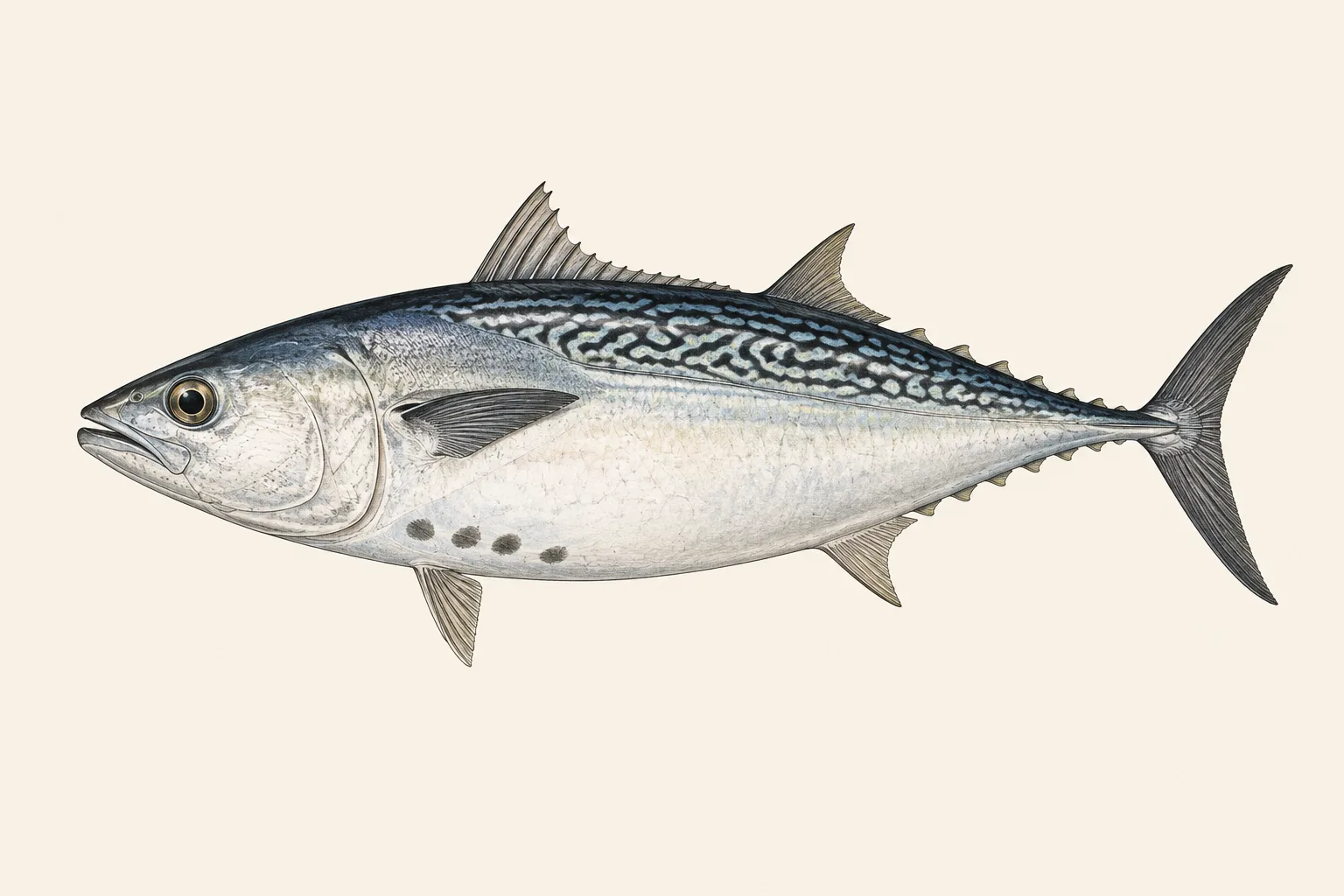
Little Tunny (Euthynnus alletteratus) is a saltwater species. The first thing to check: three to five dark fingerprint-like spots on the belly below the pectoral fin — no other small tuna in the Atlantic has them. The look-alike to rule out is Atlantic Bonito: bonito have straight oblique stripes running forward and down onto the upper flank, small conical teeth, and no belly spots.
Last updated
| Scientific name | Euthynnus alletteratus |
|---|---|
| Also called | false albacore, albie, fat albert, bonita |
| Water | Saltwater |
| Group | Tuna |
| Temperature | Concentrates between 68 and 82 °F, arriving and leaving with those bands. |
How to identify a Little Tunny
- Three to five dark fingerprint-like spots on the belly below the pectoral fin — no other small tuna in the Atlantic has them.
- Wavy, worm-like dark markings on the back, confined above the lateral line and to the rear half of the body.
- A scaleless body apart from the corselet around the shoulder and a line along the lateral line.
If you would rather not work through a key on a wet deck, photograph the fish and let the app name it — you get the common and the scientific name back, and the record is filed before you release.
Fish it is mistaken for
| Species | How to tell them apart |
|---|---|
| Atlantic Bonito | Bonito have straight oblique stripes running forward and down onto the upper flank, small conical teeth, and no belly spots. |
| Skipjack Tuna | Skipjack carry bold horizontal stripes on the belly rather than fingerprint spots, and wavy marks on the back are absent. |
Side-by-side comparisons
Read the full entry for Atlantic Bonito and Skipjack Tuna.
Where it lives
The Atlantic and Gulf coasts, from inlets and beachfronts out to nearshore structure. Appears in fast-moving surface blitzes wherever bait is pinned.
Temperature
Concentrates between 68 and 82 °F, arriving and leaving with those bands.
The conditions that matter
Albies are the definition of a conditions fish: they follow bait, they want clean water, and a hard onshore blow that dirties the beach ends the fishing overnight. Wind and tide together decide where bait piles up. Water temperature logged against arrival dates predicts the run on your stretch within days from one year to the next.
Global Fishing League records 18 weather and water readings against every catch automatically — tide stage, barometric pressure, water temperature, salinity, dissolved oxygen, chlorophyll, swell, current, moon phase and more, taken at your GPS position at the moment you log the fish. Over a season that turns a hunch about little tunny into a pattern you can read.
See every reading recorded with a catch, or the guides to what each reading means.
Size limits, bag limits and seasons
Size limits, bag limits, slot limits and seasons are set by your state wildlife agency — and for many offshore and migratory species by federal regulators — and on many waters they differ from the statewide rule. They also change between seasons. Check the current regulations for the exact water you are fishing before you keep a fish — we do not republish limits here, because a number that is a season out of date is worse than no number.
What the app does do is make your side of it accurate: every catch carries a length measured from the photograph, a GPS position and a timestamp, exportable if you ever need to show your work for a tournament or a record claim. It is also what a Global Fishing League entry is built from — a record that verifies itself, without publishing where you caught the fish.