Telling them apart
Little Tunny vs Atlantic Bonito
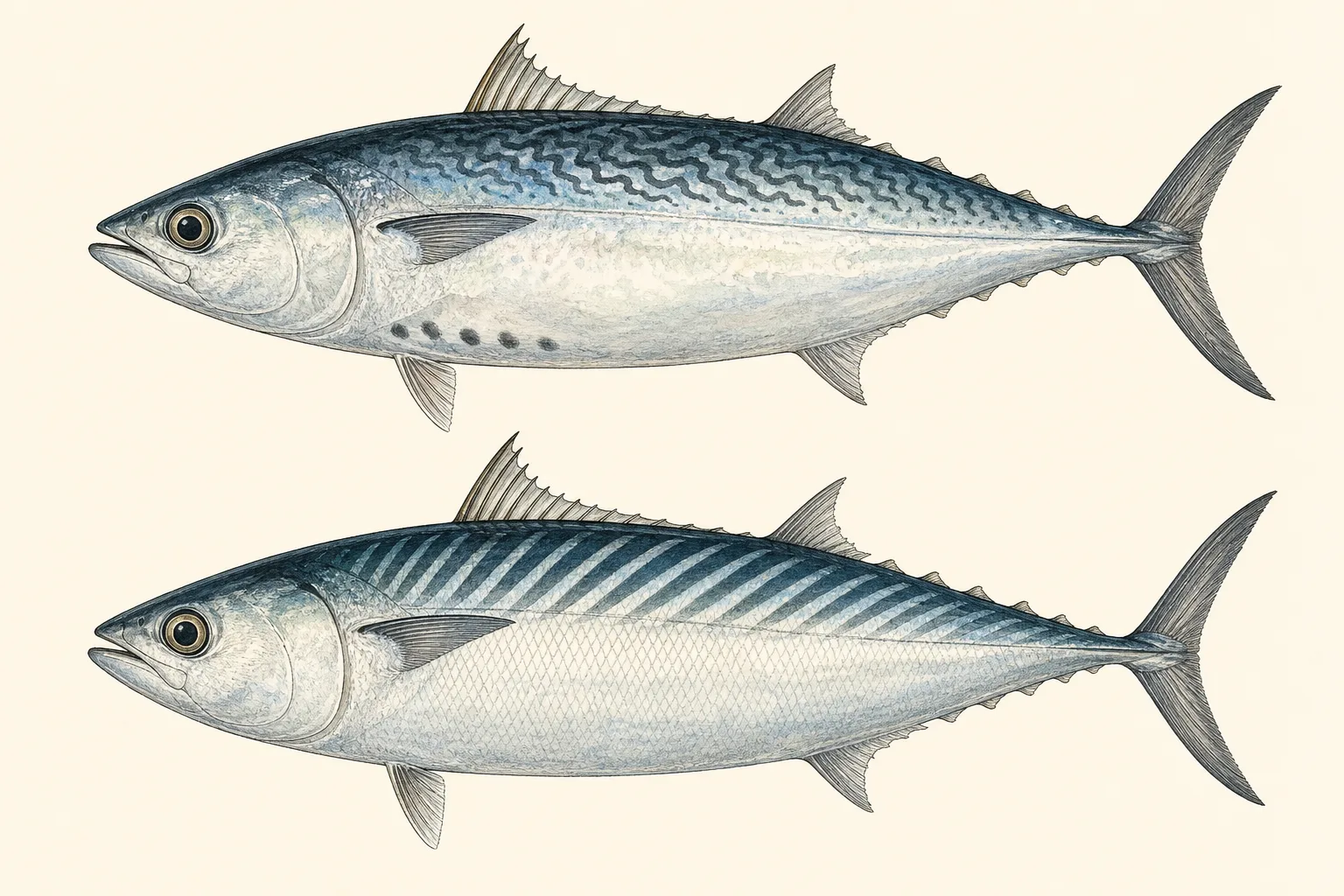
Check the belly below the pectoral fin. A little tunny has three to five dark fingerprint-like spots there. A bonito has none, and its back carries straight oblique stripes rather than the little tunny's wavy scribbles.
Last updated
Side by side
| What to look at | Little Tunny | Atlantic Bonito |
|---|---|---|
| Scientific name | Euthynnus alletteratus | Sarda sarda |
| Belly spots | Three to five dark fingerprint spots | None |
| Back markings | Wavy worm-like marks, above the lateral line only | Straight oblique stripes running forward and down |
| Teeth | Effectively none you would notice | Small but distinct conical teeth |
| Scales | Bare except the shoulder corselet | Fully scaled |
| Temperature band | 68 to 82 °F | 63 to 77 °F |
| On the table | Dark, strong, usually released or used as bait | Pale, mild and genuinely good eating |
Why the difference matters
They mix in the same autumn blitzes off the same beaches and are constantly called the same thing, but they are not remotely the same on a plate — bonito are excellent eating and little tunny are not, which is why so many albies get killed and wasted by mistake. The belly spots take one second to check and are the whole answer.
Size limits, bag limits, slot limits and seasons are set by your state wildlife agency — and for many offshore and migratory species by federal regulators — and on many waters they differ from the statewide rule. They also change between seasons. Check the current regulations for the exact water you are fishing before you keep a fish — we do not republish limits here, because a number that is a season out of date is worse than no number.
Full entries
Each fish has its own page with every field mark, the rest of its look-alikes, where it holds and the conditions it feeds in: Little Tunny and Atlantic Bonito.
Or skip the key entirely — photograph the fish and Global Fishing League names the species, returns the scientific name with it, and files the catch with the tide, pressure, water temperature and everything else it came from.