Nassau Grouper
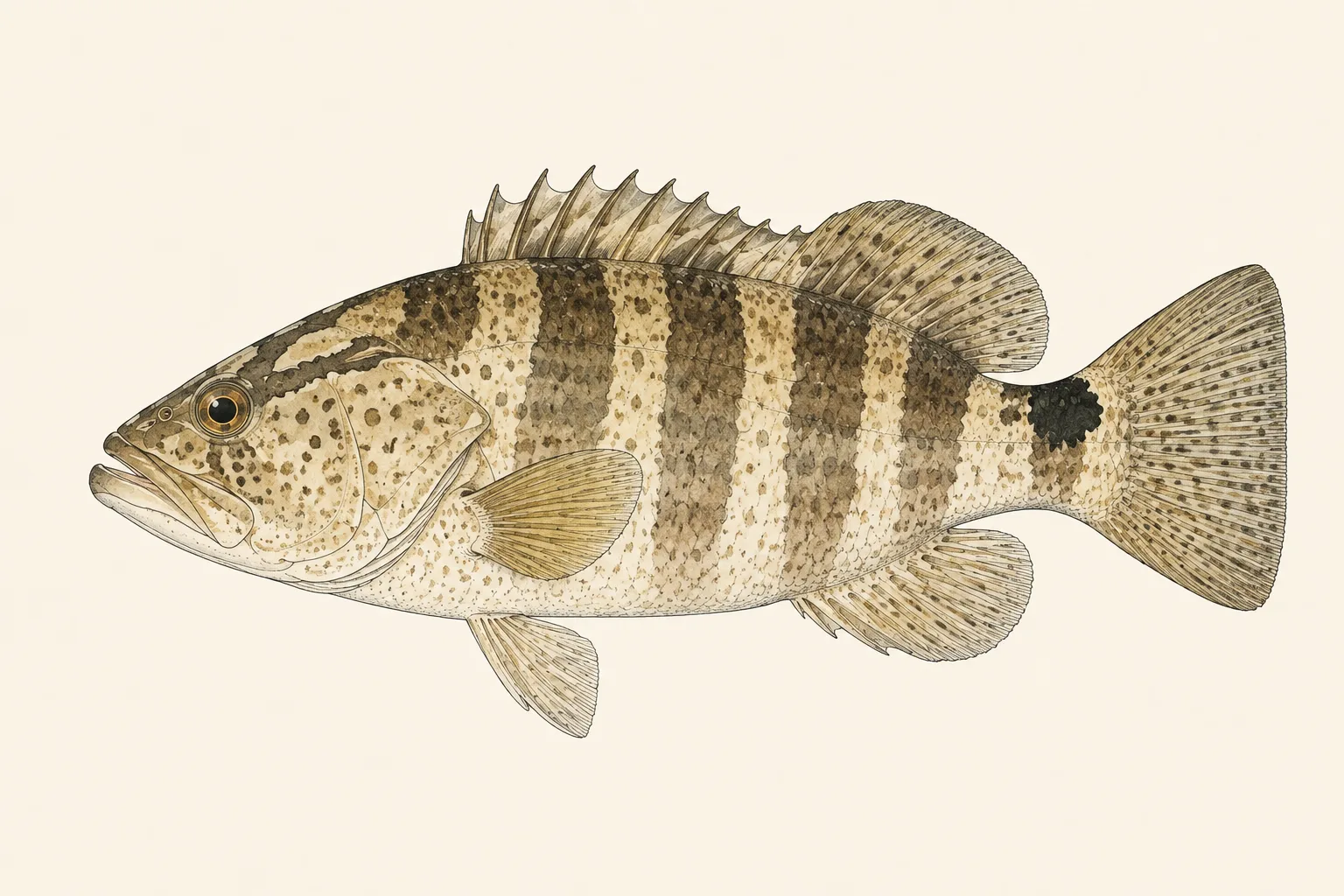
Nassau Grouper (Epinephelus striatus) is a saltwater species. The first thing to check: a distinct black saddle blotch on top of the tail base, present at every size and in every colour phase. The look-alike to rule out is Red Grouper: red grouper are rusty red-brown with a straight-topped spiny dorsal and no black saddle on the tail base.
Last updated
| Scientific name | Epinephelus striatus |
|---|---|
| Also called | hamlet, cherna criolla |
| Water | Saltwater |
| Group | Grouper |
| Temperature | Common between 70 and 84 °F. |
How to identify a Nassau Grouper
- A distinct black saddle blotch on top of the tail base, present at every size and in every colour phase.
- A dark tuning-fork mark on top of the head, running forward from between the eyes.
- Five broad dark vertical bars over a pale body, which the fish can switch on and off within seconds.
If you would rather not work through a key on a wet deck, photograph the fish and let the app name it — you get the common and the scientific name back, and the record is filed before you release.
Fish it is mistaken for
| Species | How to tell them apart |
|---|---|
| Red Grouper | Red grouper are rusty red-brown with a straight-topped spiny dorsal and no black saddle on the tail base. |
| Black Grouper | Black grouper carry rectangular chain-link blotches in rows, and no tail saddle or head tuning-fork. |
Side-by-side comparisons
Read the full entry for Red Grouper and Black Grouper.
Where it lives
Coral reef and high-relief structure in south Florida, the Keys, the Bahamas and the Caribbean, generally shallower than most large groupers.
Temperature
Common between 70 and 84 °F.
The conditions that matter
Nassau grouper are protected across most of their range — fully closed to harvest in US federal waters and in Florida — because their spawning aggregations were fished out decades ago and have not recovered. The saddle on the tail base is the check that keeps a legal box legal, and it is visible even on a fish in full pale phase.
Global Fishing League records 18 weather and water readings against every catch automatically — tide stage, barometric pressure, water temperature, salinity, dissolved oxygen, chlorophyll, swell, current, moon phase and more, taken at your GPS position at the moment you log the fish. Over a season that turns a hunch about nassau grouper into a pattern you can read.
See every reading recorded with a catch, or the guides to what each reading means.
Size limits, bag limits and seasons
Size limits, bag limits, slot limits and seasons are set by your state wildlife agency — and for many offshore and migratory species by federal regulators — and on many waters they differ from the statewide rule. They also change between seasons. Check the current regulations for the exact water you are fishing before you keep a fish — we do not republish limits here, because a number that is a season out of date is worse than no number.
What the app does do is make your side of it accurate: every catch carries a length measured from the photograph, a GPS position and a timestamp, exportable if you ever need to show your work for a tournament or a record claim. It is also what a Global Fishing League entry is built from — a record that verifies itself, without publishing where you caught the fish.