
Telling them apart
Red Grouper vs Nassau Grouper
Look at the base of the tail. A Nassau grouper has a distinct black saddle blotch on top of it, at every size and in every colour phase. A red grouper has none, and is rusty red-brown with a straight-topped spiny dorsal.
Last updated
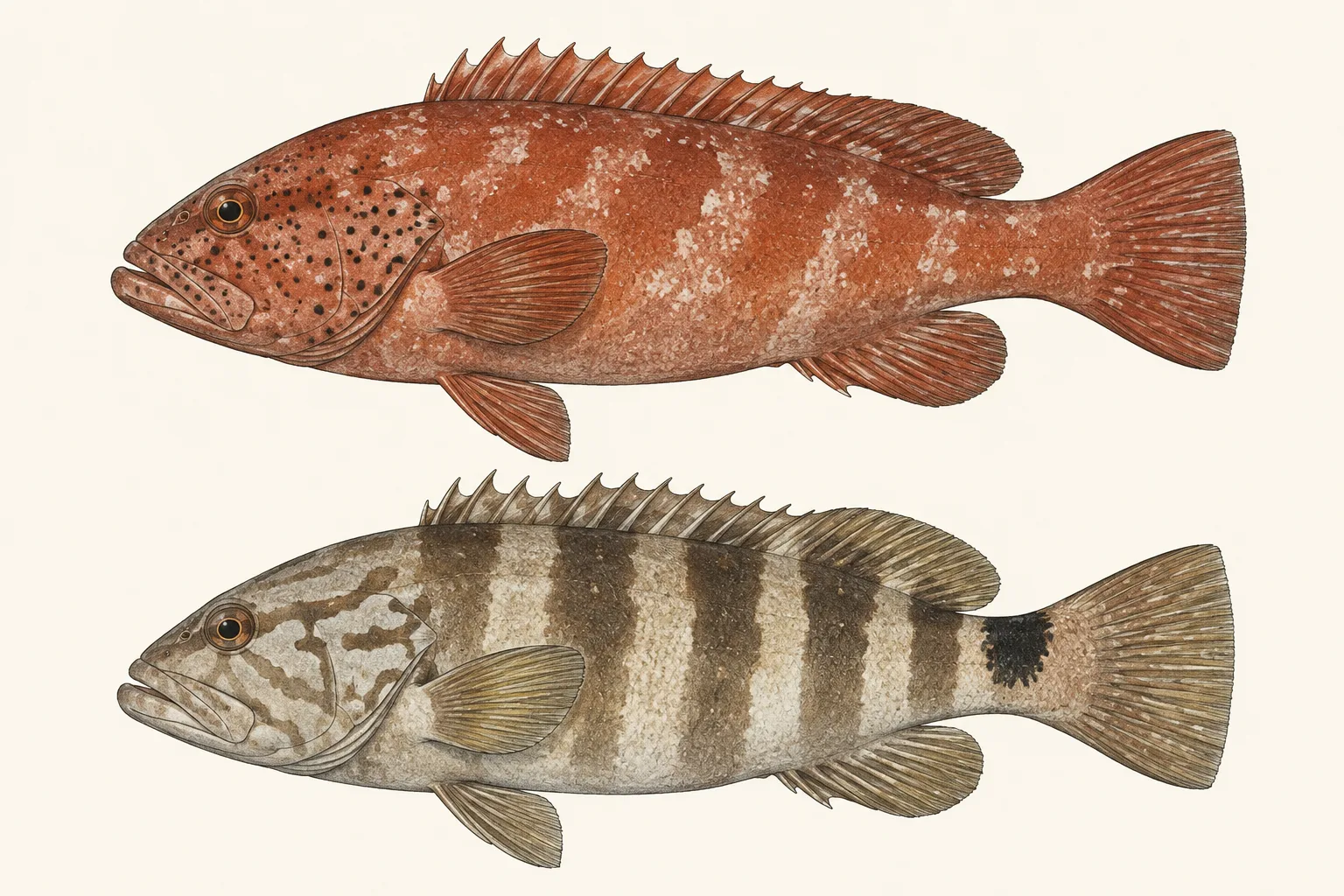
Side by side
| What to look at | Red Grouper | Nassau Grouper |
|---|---|---|
| Scientific name | Epinephelus morio | Epinephelus striatus |
| Tail-base saddle | None | A distinct black saddle on top |
| Head | Black spots around the cheek | A dark tuning-fork mark forward from between the eyes |
| Colour | Rusty red-brown with pale blotches | Pale with five broad dark bars, switched on and off at will |
| Spiny dorsal edge | Straight; second spine longest | Not straight-topped |
| Where | Bottom depressions on hard and live bottom | High-relief coral reef, generally shallower |
Why the difference matters
This one is a hard closure rather than a bag limit. Nassau grouper may not be harvested at all in US federal waters or in Florida — their spawning aggregations were fished out decades ago and have not recovered. The saddle on the tail base is visible even when the fish has gone pale, and it is the check that keeps a legal box legal.
Size limits, bag limits, slot limits and seasons are set by your state wildlife agency — and for many offshore and migratory species by federal regulators — and on many waters they differ from the statewide rule. They also change between seasons. Check the current regulations for the exact water you are fishing before you keep a fish — we do not republish limits here, because a number that is a season out of date is worse than no number.
Full entries
Each fish has its own page with every field mark, the rest of its look-alikes, where it holds and the conditions it feeds in: Red Grouper and Nassau Grouper.
Or skip the key entirely — photograph the fish and Global Fishing League names the species, returns the scientific name with it, and files the catch with the tide, pressure, water temperature and everything else it came from.