Telling them apart
Rainbow Trout vs Steelhead
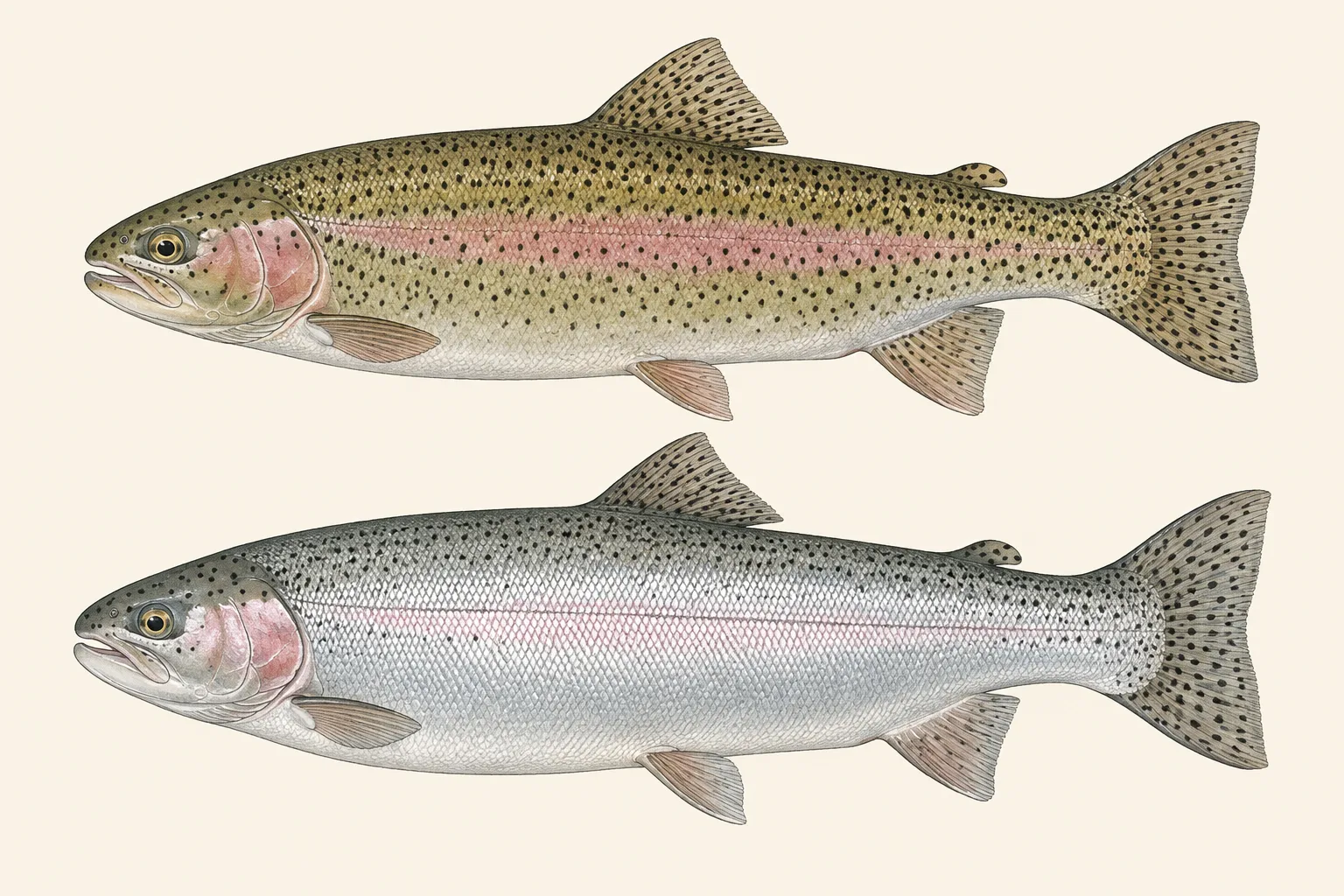
They are the same species, Oncorhynchus mykiss. A steelhead is the sea-run or lake-run form — chrome-bright, thick through the shoulder and built for migration. A rainbow is the resident form, coloured, with a pink lateral stripe.
Last updated
Side by side
| What to look at | Rainbow Trout | Steelhead |
|---|---|---|
| Scientific name | Oncorhynchus mykiss | Oncorhynchus mykiss |
| Life history | Resident: lives its whole life in the river or lake | Migratory: feeds in salt water or a big lake, returns to spawn |
| Colour | Olive back, pink lateral stripe, clear spotting | Chrome silver when fresh; the stripe returns after time in the river |
| Body | Stream-proportioned | Heavier shoulder, thicker wrist ahead of the tail |
| Tail | Spotted across the whole fin | Spotted across the whole fin — the same fish |
| Where you meet it | Rivers, tailwaters, mountain lakes, stocked fisheries | Coastal rivers on a run, and Great Lakes tributaries |
Why the difference matters
The regulations treat them as different fish even though biology does not. Steelhead water routinely carries its own season, its own gear rules and a hatchery-only retention rule enforced by a clipped adipose fin — the small fleshy fin between the dorsal and the tail. A missing adipose means a hatchery fish; an intact one on many rivers must go back regardless of size. Check the fin before you check the length.
Size limits, bag limits, slot limits and seasons are set by your state wildlife agency — and for many offshore and migratory species by federal regulators — and on many waters they differ from the statewide rule. They also change between seasons. Check the current regulations for the exact water you are fishing before you keep a fish — we do not republish limits here, because a number that is a season out of date is worse than no number.
Full entries
Each fish has its own page with every field mark, the rest of its look-alikes, where it holds and the conditions it feeds in: Rainbow Trout and Steelhead.
Or skip the key entirely — photograph the fish and Global Fishing League names the species, returns the scientific name with it, and files the catch with the tide, pressure, water temperature and everything else it came from.