Telling them apart
Rainbow Trout vs Cutthroat Trout
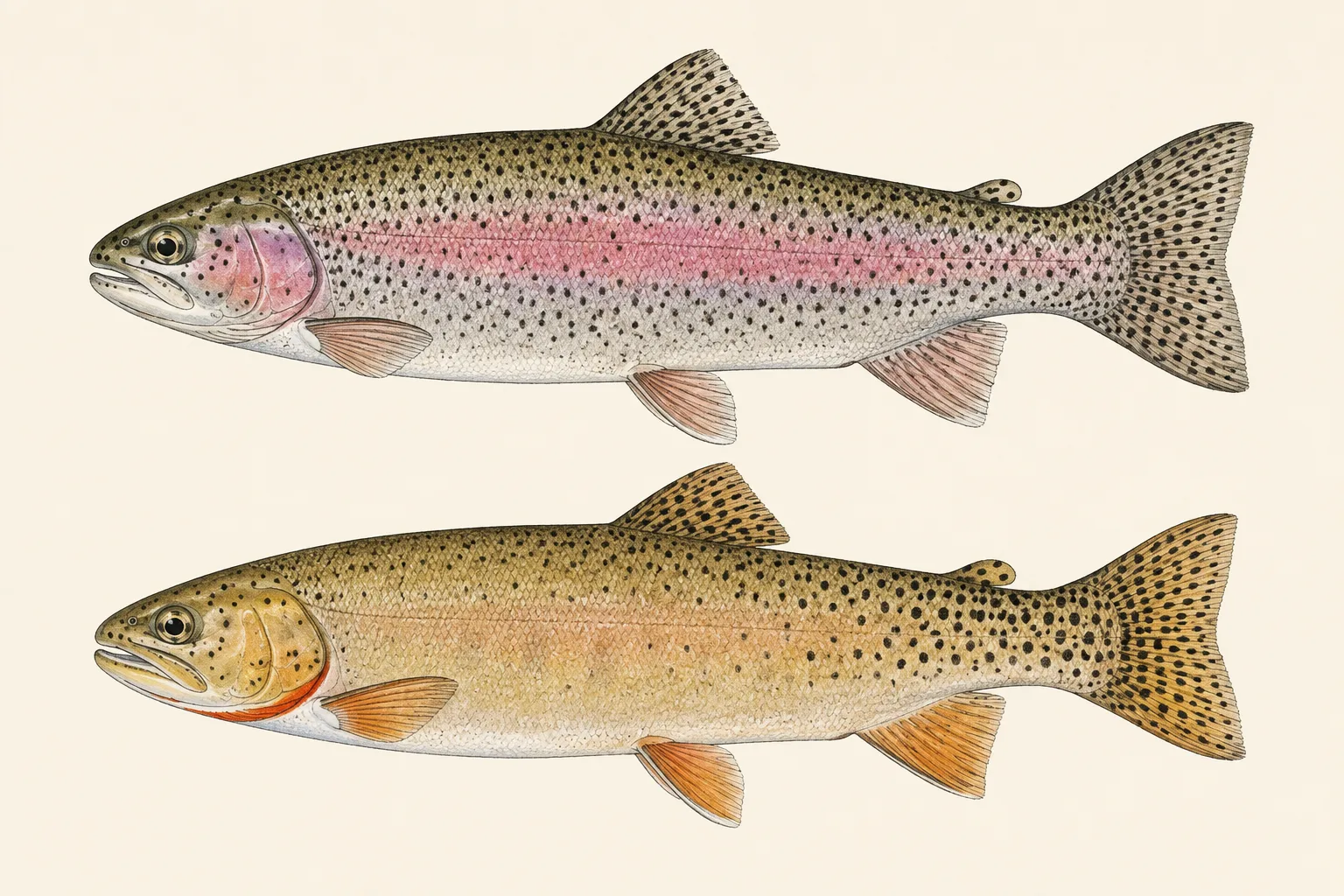
Look under the lower jaw. A cutthroat has a red to orange slash along each side of it. A rainbow has none, and carries a pink stripe along the flank instead. Where the two overlap, hybrids called cutbows show a faint slash with rainbow spotting.
Last updated
Side by side
| What to look at | Rainbow Trout | Cutthroat Trout |
|---|---|---|
| Scientific name | Oncorhynchus mykiss | Oncorhynchus clarkii |
| Under the jaw | No slash | A red to orange slash on each side |
| Flank | A pink to red lateral stripe | No lateral stripe; often a golden or rosy wash |
| Spotting | Spread fairly evenly over the body and tail | Concentrated towards the tail |
| Tongue | No basibranchial teeth at the back | A patch of small teeth at the back of the tongue |
| Status | Introduced almost everywhere; often the stocked fish | Frequently the native trout, in many distinct subspecies |
Why the difference matters
This one genuinely matters. Cutthroat are native across much of the West and many waters protect them with reduced bags, catch-and-release rules or native-trout designations that do not apply to introduced rainbows. Hybridisation with rainbows is one of the main threats to remaining cutthroat populations, so a fish showing both a faint slash and rainbow spotting is worth photographing and recording rather than guessing at.
Size limits, bag limits, slot limits and seasons are set by your state wildlife agency — and for many offshore and migratory species by federal regulators — and on many waters they differ from the statewide rule. They also change between seasons. Check the current regulations for the exact water you are fishing before you keep a fish — we do not republish limits here, because a number that is a season out of date is worse than no number.
Full entries
Each fish has its own page with every field mark, the rest of its look-alikes, where it holds and the conditions it feeds in: Rainbow Trout and Cutthroat Trout.
Or skip the key entirely — photograph the fish and Global Fishing League names the species, returns the scientific name with it, and files the catch with the tide, pressure, water temperature and everything else it came from.