Telling them apart
Spotted Sea Trout vs Sand Weakfish
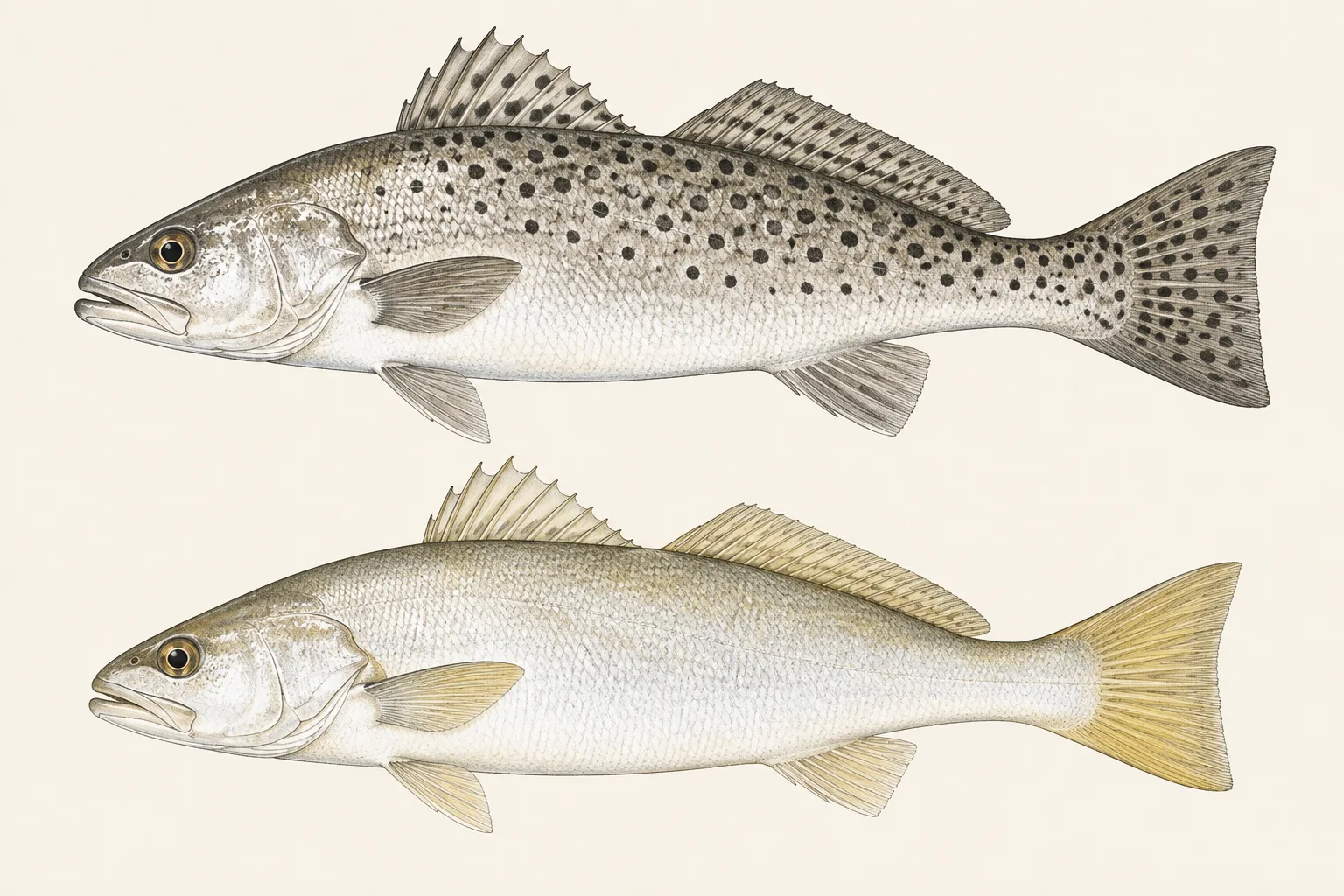
Look for spots. A spotted sea trout carries distinct round black spots that run onto the second dorsal and across the whole tail. A sand seatrout has none at all — plain silvery-yellow flanks with nothing on them.
Last updated
Side by side
| What to look at | Spotted Sea Trout | Sand Weakfish |
|---|---|---|
| Scientific name | Cynoscion nebulosus | Cynoscion arenarius |
| Spots | Distinct round black spots onto the tail | None anywhere |
| Back markings | Spots only | Plain, unmarked |
| Fin colour | Dusky | Pale yellow wash, especially the tail |
| Canine teeth | Two prominent | Two, smaller |
| Size | Grows considerably larger | Stays small |
| Where | Grass flats, potholes, drop-offs | Open sand and mud, bays and passes |
Why the difference matters
In the Gulf these two fill the same coolers and carry different limits in most states — spotted seatrout are usually slotted with a modest bag while sand seatrout are far more liberally managed. A cooler of what somebody believes are small specks is very often sand seatrout, and the absence of spots is not subtle once you look.
Size limits, bag limits, slot limits and seasons are set by your state wildlife agency — and for many offshore and migratory species by federal regulators — and on many waters they differ from the statewide rule. They also change between seasons. Check the current regulations for the exact water you are fishing before you keep a fish — we do not republish limits here, because a number that is a season out of date is worse than no number.
Full entries
Each fish has its own page with every field mark, the rest of its look-alikes, where it holds and the conditions it feeds in: Spotted Sea Trout and Sand Weakfish.
Or skip the key entirely — photograph the fish and Global Fishing League names the species, returns the scientific name with it, and files the catch with the tide, pressure, water temperature and everything else it came from.