Telling them apart
Spotted Sea Trout vs Weakfish
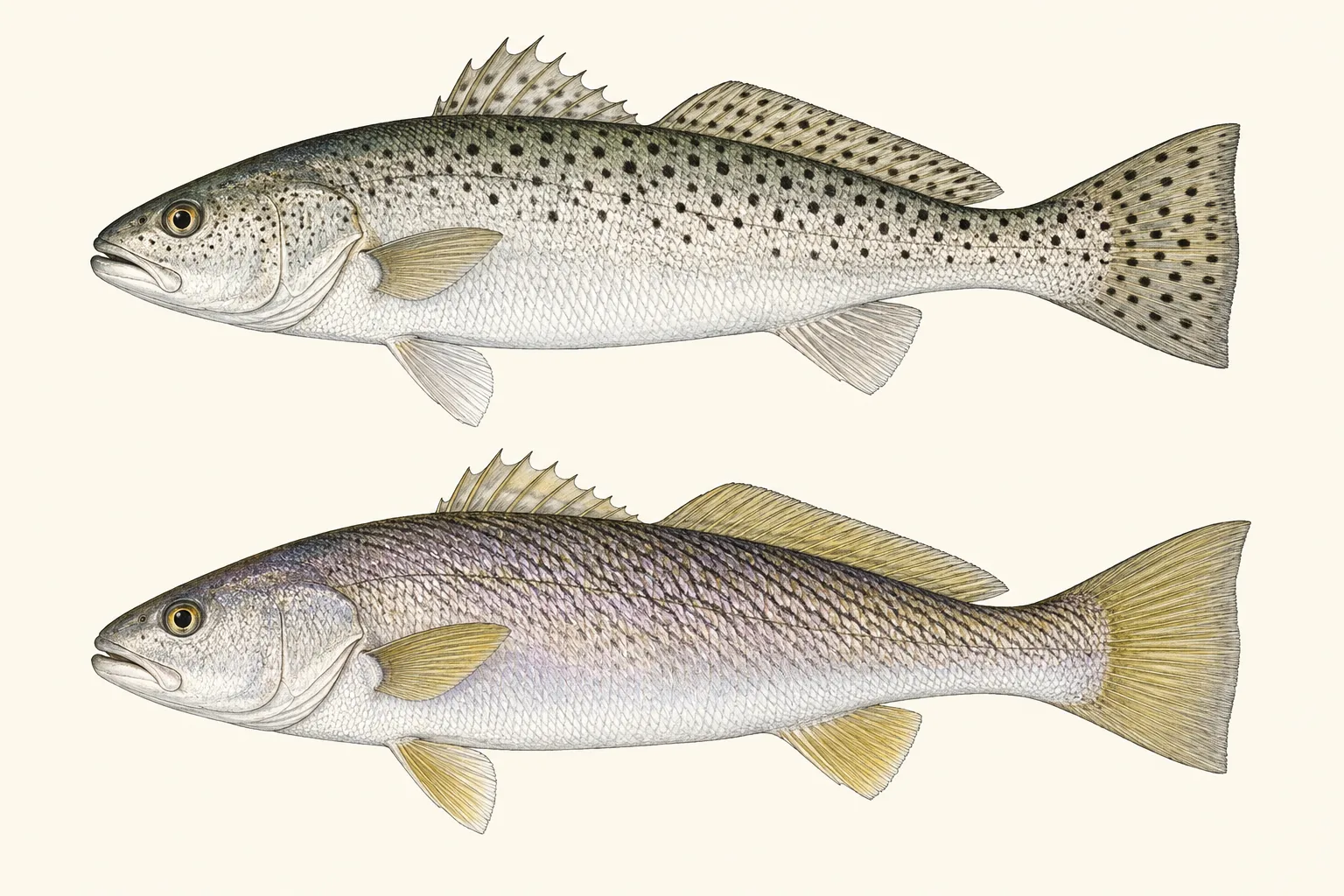
Look at the tail. A spotted sea trout's distinct round black spots run onto the second dorsal and right across the tail fin. A weakfish has a clean, unspotted tail, and its back carries wavy diagonal lines rather than round spots.
Last updated
Side by side
| What to look at | Spotted Sea Trout | Weakfish |
|---|---|---|
| Scientific name | Cynoscion nebulosus | Cynoscion regalis |
| Tail | Spotted | Clean and unspotted |
| Back markings | Distinct round black spots | Dark wavy diagonal lines running together |
| Colour | Silver with a dark grey-green back | Iridescent purple-olive back, yellow-tinged fins |
| Canine teeth | Two prominent ones in the upper jaw | Two prominent ones in the upper jaw |
| Range | Chesapeake to Texas, strongest in the South | Massachusetts to Florida, strongest in the mid-Atlantic |
Why the difference matters
They overlap through the mid-Atlantic and carry different limits in most states that hold both — weakfish in particular have been under severe restriction for years while seatrout limits stayed generous. The tail is the check: spots on it means seatrout, every time.
Size limits, bag limits, slot limits and seasons are set by your state wildlife agency — and for many offshore and migratory species by federal regulators — and on many waters they differ from the statewide rule. They also change between seasons. Check the current regulations for the exact water you are fishing before you keep a fish — we do not republish limits here, because a number that is a season out of date is worse than no number.
Full entries
Each fish has its own page with every field mark, the rest of its look-alikes, where it holds and the conditions it feeds in: Spotted Sea Trout and Weakfish.
Or skip the key entirely — photograph the fish and Global Fishing League names the species, returns the scientific name with it, and files the catch with the tide, pressure, water temperature and everything else it came from.