
Telling them apart
Striped Bass vs White Bass
Run a thumb over the tongue. A striped bass has two tooth patches, a white bass has one. Stripers are also far more elongate, with seven or eight sharp stripes running unbroken to the tail; white bass are deep-bodied with only one unbroken stripe.
Last updated
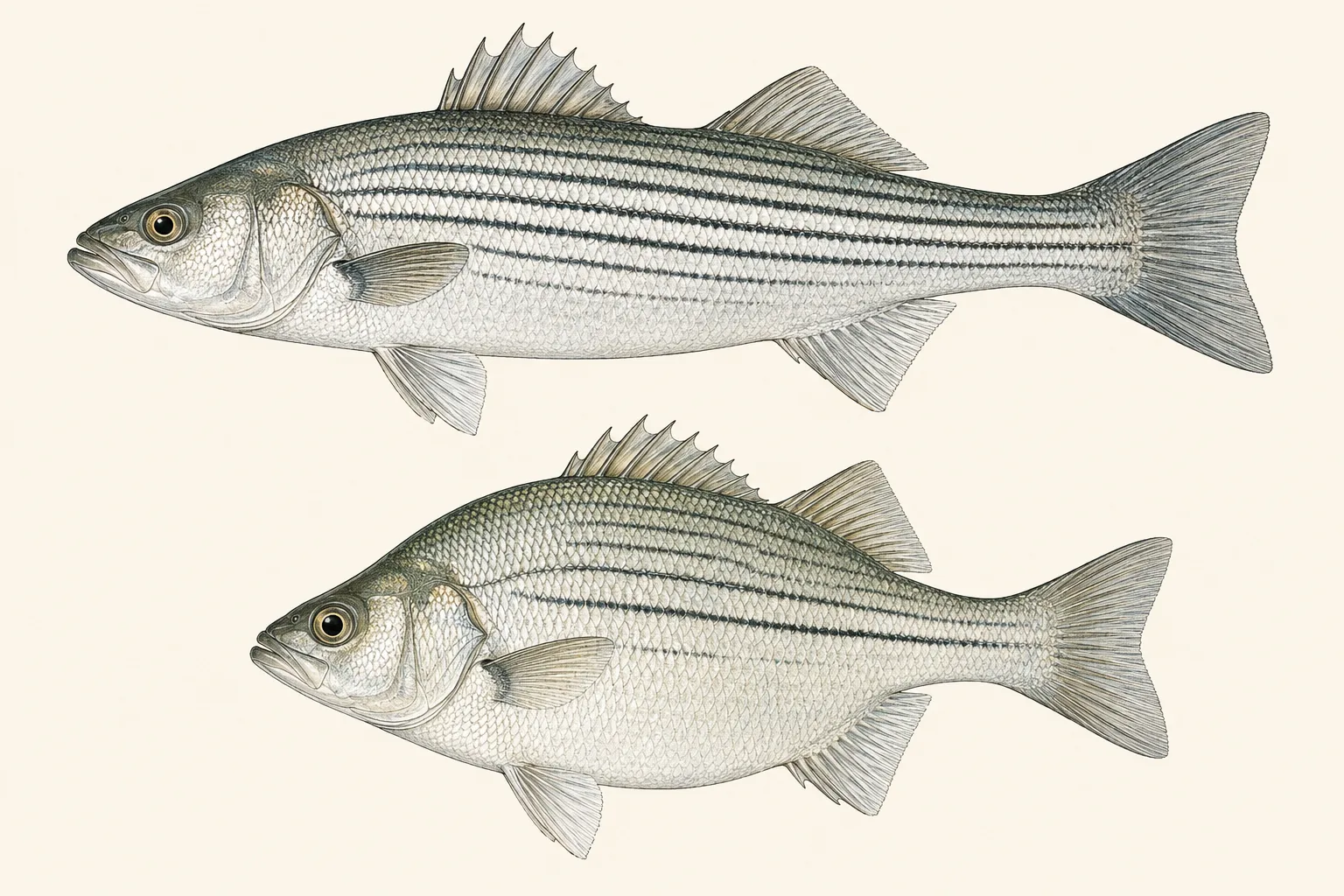
Side by side
| What to look at | Striped Bass | White Bass |
|---|---|---|
| Scientific name | Morone saxatilis | Morone chrysops |
| Tongue tooth patches | Two | One |
| Stripes | Seven or eight, sharp and mostly unbroken to the tail | Several, with usually only one reaching the tail |
| Body | Long and streamlined | Deep and compressed, with an arched back |
| Size | Grows very large | Rarely more than a few pounds |
| Water | Coastal rips and structure, plus landlocked reservoirs | Reservoirs and large rivers of the central states |
Why the difference matters
Where both live, the limits differ sharply — stripers carry slots and small bags, white bass usually do not. The hybrid, often called a wiper, muddies it further: it has two tongue patches like a striper but broken, offset stripes and a body deeper than a striper's. If the stripes are broken and the fish is chunky, treat it as a hybrid and check the hybrid rule.
Size limits, bag limits, slot limits and seasons are set by your state wildlife agency — and for many offshore and migratory species by federal regulators — and on many waters they differ from the statewide rule. They also change between seasons. Check the current regulations for the exact water you are fishing before you keep a fish — we do not republish limits here, because a number that is a season out of date is worse than no number.
Full entries
Each fish has its own page with every field mark, the rest of its look-alikes, where it holds and the conditions it feeds in: Striped Bass and White Bass.
Or skip the key entirely — photograph the fish and Global Fishing League names the species, returns the scientific name with it, and files the catch with the tide, pressure, water temperature and everything else it came from.