Cutthroat Trout
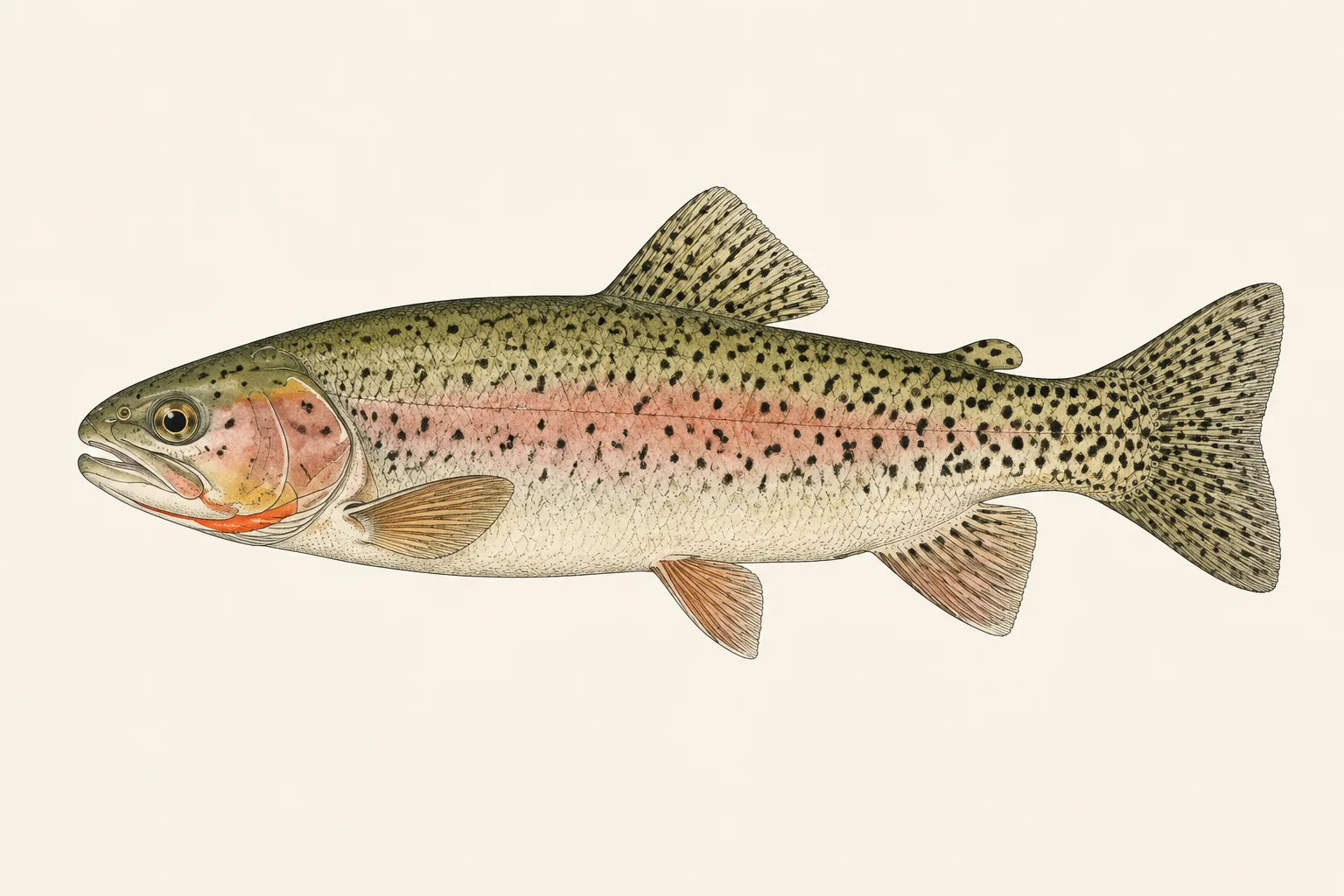
Cutthroat Trout (Oncorhynchus clarkii) is a freshwater species. The first thing to check: a red to orange slash under each side of the lower jaw — the mark the fish is named for, though it fades on some fish and some subspecies. The look-alike to rule out is Rainbow Trout: rainbows have no throat slash, carry a pink lateral stripe, and spot evenly across the body rather than crowding the tail.
Last updated
| Scientific name | Oncorhynchus clarkii |
|---|---|
| Also called | cutt, native trout |
| Water | Freshwater |
| Group | Trout |
| Temperature | Optimal between 55 and 62 °F, and intolerant of sustained warmth. |
How to identify a Cutthroat Trout
- A red to orange slash under each side of the lower jaw — the mark the fish is named for, though it fades on some fish and some subspecies.
- Heavy black spotting that concentrates towards the tail rather than spreading evenly.
- A patch of small basibranchial teeth at the back of the tongue, which a rainbow lacks.
If you would rather not work through a key on a wet deck, photograph the fish and let the app name it — you get the common and the scientific name back, and the record is filed before you release.
Fish it is mistaken for
| Species | How to tell them apart |
|---|---|
| Rainbow Trout | Rainbows have no throat slash, carry a pink lateral stripe, and spot evenly across the body rather than crowding the tail. |
| Golden Trout | Golden trout have bold parr marks retained into adulthood and brilliant red-gold flanks, with spotting restricted to the back and tail. |
Side-by-side comparisons
Read the full entry for Rainbow Trout.
Where it lives
Western mountain streams, rivers and lakes, in many distinct subspecies — Yellowstone, Westslope, Lahontan, Bonneville and coastal among them. Often the native trout where a rainbow is the introduced one.
Temperature
Optimal between 55 and 62 °F, and intolerant of sustained warmth.
The conditions that matter
Cutthroat are a cold, clean water fish that feed opportunistically on the surface, so the day is shaped by hatch timing and water temperature. Where cutthroat and rainbow overlap they hybridise into cutbows, which show a faint slash with rainbow spotting — worth recording, because many waters manage native cutthroat far more tightly.
Global Fishing League records 18 weather and water readings against every catch automatically — tide stage, barometric pressure, water temperature, salinity, dissolved oxygen, chlorophyll, swell, current, moon phase and more, taken at your GPS position at the moment you log the fish. Over a season that turns a hunch about cutthroat trout into a pattern you can read.
See every reading recorded with a catch, or the guides to what each reading means.
Size limits, bag limits and seasons
Size limits, bag limits, slot limits and seasons are set by your state wildlife agency — and for many offshore and migratory species by federal regulators — and on many waters they differ from the statewide rule. They also change between seasons. Check the current regulations for the exact water you are fishing before you keep a fish — we do not republish limits here, because a number that is a season out of date is worse than no number.
What the app does do is make your side of it accurate: every catch carries a length measured from the photograph, a GPS position and a timestamp, exportable if you ever need to show your work for a tournament or a record claim. It is also what a Global Fishing League entry is built from — a record that verifies itself, without publishing where you caught the fish.